Elevate your local knowledge
Sign up for the iNFOnews newsletter today!
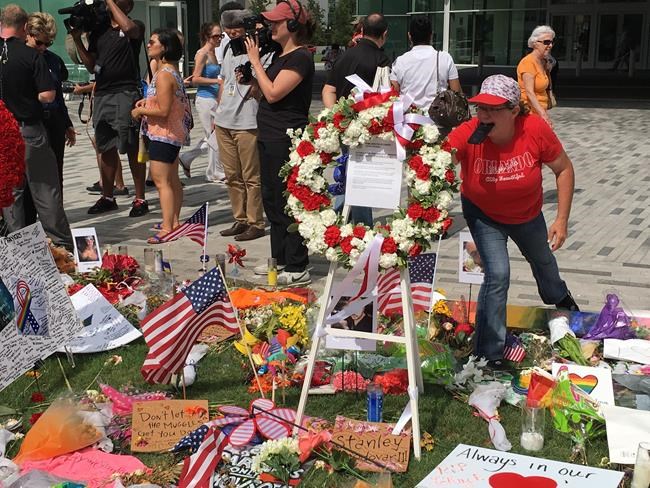
ORLANDO, United States – As families prepare to bury the dead from Orlando’s massacre, Rob Domenico describes an additional layer of grief lingering overhead.
It’s a different type of sorrow — caused by shame, estrangement, and secrets hidden in closets.
The 49 victims of the U.S.’s worst mass shooting were mostly gay, and mostly from a Latino community whose older generation retains a more traditional hostility to homosexuality.
“Friends of mine have told me, ‘I came out. My family’s disowned me. I have nowhere to live,’” said Domenico, who sits on the board of a local LGBT centre.
“Imagine that. Now those families have that extreme guilt. Like, ‘I turned my son away — and now he’s gone.’”
So a tragedy rooted in homophobia is now being compounded by it.
Mourners talk about it as they gather at Domenico’s centre. People describe losing four, five, seven friends in the attack on the Pulse nightclub. But some can’t discuss it with family.
Different versions of that story are shared across the city. At the Orlando airport, an employee prepares to attend the funeral of her close friend. He’d come out before he died. He lost his relationship with his father.
One news report describes a survivor suffering in silence. His boyfriend is dead but he hasn’t told family in Mexico that he’s gay, according to the deceased man’s colleague.
Down in Mexico a state government worker was fired for reacting to the massacre with the cruelest kind of machismo in a social-media post: “Too bad it was only 50 and not 100.”
These attitudes have caused what the deceased man’s colleague calls a double-catastrophe. “You face such horrible loss,” Al Ferguson told The New York Times, “and then can’t share it.”
There’s a huge gap in attitudes toward gay-rights issues between generations of U.S. Latinos. Overall, Latino and non-Latino Americans don’t differ much on issues like same-sex marriage.
But the generational differences are striking. Pew Research found that only 18 per cent of Latino seniors supported same-sex marriage in 2012, compared to 68 per cent of people under 29 — which makes for a 50-per-cent difference in attitudes, compared to a smaller, 30-per-cent generational variance among the overall U.S. population.
The more Latinos became immersed in English, the more supportive of gay-marriage rights they became, the survey suggested.
One young Cuban-American described the consequences when she came out.
Raquel, 19, who asked that her last name not be used, was chatting with her mom on the house porch: “I started explaining to her these feelings I was having. I was only 14 or 15. I was feeling very scared, nervous. I told her, ‘I don’t have a preference… I like boys and girls.’”
Her mom sent her to therapy. She was forbidden from going out after school.
“We went to church and had the big Sunday family dinner and we burned the candles and believed in the saints,” she said.
She’s no longer on speaking terms with her mother. But she says she’s happy now, having just finished high school and finally accepting herself.
Alejandra Delossantos, meanwhile, lost a childhood friend in the shooting.
Her friend Juan Guerrero had come out before he died. They hadn’t spoken for a few years — so she only learned of his sexual orientation in the news.
She fondly recalls how they once hopped on every ride at Universal Studios: “He was a little shy, incredibly sweet and what stood out the most was how much he loved to take care of his niece and nephew.”
He died at age 22.
Delossantos cried the whole way to work the morning she learned the news. She found some solace in knowing that he’d managed to share who he was.
“Thank God he came out before the tragedy. At least he had closure on that.”
Guerrero and his boyfriend Christopher Leinonen were planning to get married.
Now their families are planning a joint funeral. Guerrero’s father, Juan Ramon, told Time magazine through tears: “I think my son wanted to do that (funeral)…
“I don’t care what the people think. I don’t care.”
Raquel expressed hope the tragedy would prompt frank conversations in her community, and change some minds. Delossantos held out less hope of a sudden shift.
The Dominican-born woman said views in her community are a generation or two behind. What will make the difference, she said, is time. Over time the young will replace the old, she said, and attitudes will change.
Note to readers: This is a corrected story. An earlier version incorrectly attributed the comments of Raquel, 19, to Alejandra Delossantos.
News from © The Canadian Press, . All rights reserved.
This material may not be published, broadcast, rewritten or redistributed.

This site is protected by reCAPTCHA and the Google Privacy Policy and Terms of Service apply.
Want to share your thoughts, add context, or connect with others in your community?
You must be logged in to post a comment.