Elevate your local knowledge
Sign up for the iNFOnews newsletter today!
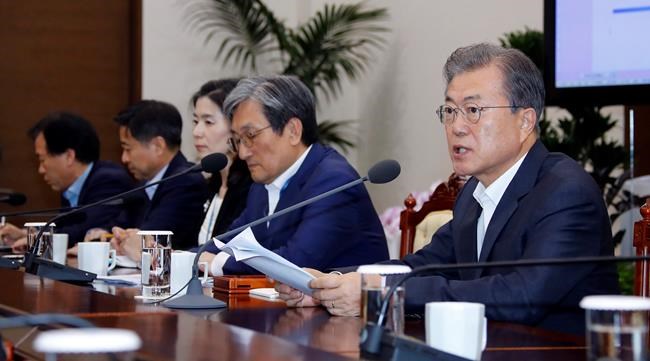
SEOUL, Korea, Republic Of – South Korea’s president said Monday the country is committed to finding a diplomatic solution to a bitter dispute over tightened Japanese control on exports of high-tech materials used by South Korean companies to produce semiconductors and displays.
In a meeting with senior aides, President Moon Jae-in called for Japan to withdraw what he described as a politically motivated measure and “sincere” bilateral discussions for the issue. He said South Korea would be left no choice but to take unspecified countermeasures should the Japanese trade curbs result in actual damages to South Korean firms.
Japan last week removed South Korea from a list of nations with which it minimally restricts trade and ordered a more stringent approval process for shipments of photoresist and other key chemicals to South Korea. The move came amid deteriorating relations between Asian U.S. allies over issues related to forced labour during World War II.
South Korea’s Trade Ministry has said Seoul plans to file a complaint with the World Trade Organization over Japan’s “unjust” action. The Seoul government sees Japan’s move as retaliation against recent South Korean court rulings ordering Japanese firms to compensate South Korean plaintiffs over forced labour during World War II.
“The recent trade curbs imposed by Japan have raised concern over disruption in production for our companies and the threat it poses to global supply chains … there’s global concerns over the move to limit mutually beneficial trade between civilian companies for political purposes,” Moon said.
“A vicious cycle created by measures and countermeasures wouldn’t be ideal for both countries. But if South Korean companies begin experiencing actual damages, our government would have no choice but to a necessary response,” he said before adding he hopes things don’t come to that.
Japan’s export restrictions, which went into effect last Thursday, cover fluorinated polyimides, which are used in organic light-emitting diode (OLED) screens for TVs and smartphones, and photoresist and hydrogen fluoride, which are used for making semiconductors.
Analysts say the measure won’t have a meaningful impact immediately on South Korean companies like Samsung Electronics and SK Hynix, which both have sufficient supplies of the materials for now, given the slowdown in demand for semiconductors.
However, there’s concern is that Japan might expand the restrictions to include other key semiconductor materials, such as wafers, or materials and components used in other products, including rechargeable batteries for electric vehicles.
In January-May, 94% of South Korea’s imports of fluorinated polyimide and 92% of its imports of photoresist were from Japan, according to a report by Moody’s Investors Service, which cited trade data from South Korea.
News from © iNFOnews.ca, . All rights reserved.
This material may not be published, broadcast, rewritten or redistributed.

This site is protected by reCAPTCHA and the Google Privacy Policy and Terms of Service apply.
Want to share your thoughts, add context, or connect with others in your community?
You must be logged in to post a comment.