Elevate your local knowledge
Sign up for the iNFOnews newsletter today!
ANKARA, Turkey – Turkey’s foreign minister has suggested that a landmark deal to stop migrants reaching the European Union can be salvaged despite disagreement on conditions for relaxing visa restrictions for Turkish citizens travelling to the bloc.
Easing concern across Europe, Mevlut Cavusoglu told reporters during a joint news conference with top EU officials Friday that a “common understanding” had emerged and that a consensus could be reached. He said, however, that a “concrete road map” should be worked out to lift travel restrictions.
“I believe that with this understanding we will overcome the problem,” Cavusoglu said after talks with EU’s foreign policy chief, Federica Mogherini, and EU Enlargement Commissioner Johannes Hahn.
Europe’s migration crisis will be a central issue at next week’s EU leaders’ summit in Bratislava, Slovakia, as the member states remain rattled by Britain’s referendum vote to leave the EU and recent gains for the nationalist vote in Germany.
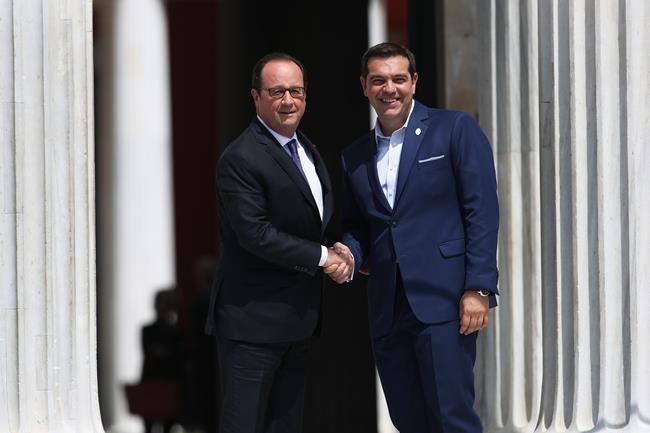
In Athens, the leaders of France, Italy and five other EU Mediterranean countries gathered Friday to discuss immigration and the continent’s debt crisis.
“It’s important to issue a message of co-operation at this important time, following the Brexit vote and with populists and extremists trying to block Europe,” French President Francois Hollande said.
“In the name of Europe, its southern members are facing difficulties on the migration issue … So they must be helped, reinforced, so that we can allow for asylum seekers, but so there can also be an efficient control of immigration.”
More than a million refugees and migrants travelled from Turkey to Greece and on to other EU countries. But numbers have declined dramatically since Balkan nations fenced off their borders and the EU-Turkey deal took effect in March. Border closures have left some 60,000 migrants and refugees stranded in Greece, most in hastily built camps.
Turkey had threatened to scrap the deal — which also promises 3 billion euros ($3.4 billion) to help support refugees in Turkey — if the EU failed to fulfil by October a promise to grant Turkish citizens the right to visa-free travel.
Plans to loosen visa rules came to a standstill after Turkey balked at the EU’s demand that it relax its anti-terrorism laws, over concerns they could be used to target academics and journalists.
With the EU-Turkey deal still largely holding, Athens is pressing EU members to abide by commitments under a relocation program which has covered less that 10 per cent of the 33,000 placements promised to migrants in Greece so far.
Greece was also angered by suggestions it should return to EU immigration rules that existed before last year’s crisis.
A government spokesman on immigration said Athens rejected calls to reactivate the so-called Dublin Regulation, which requires migrants to apply for asylum in the first EU country they reach and would allow other EU members to send asylum-seekers back to Greece.
“A country such as Greece which receives a large number of refugees from Turkey, and also hosts a large number of refugees — practically without any outside help — cannot be asked to receive refugees from other European countries,” Giorgos Kyritsis told The Associated Press. “That would be outrageous.”
Malta’s prime minister, speaking at the end of the Athens conference, also criticized EU migration policy.
“The current system of tackling migration in Europe is simply not working,” Joseph Muscat said. “The Dublin system is out of synch with reality, and here are six countries which are saying ‘we need to fix that for Europe to remain and to be relevant.’”
___
Paphitis reported from Athens. Sylvie Corbet in Paris, Menelaos Hadjicostis in Istanbul, and Derek Gatopoulos in Athens contributed.
___
Online:
Joint Declaration of Athens meeting: http://ow.ly/efl63043X8H
News from © The Associated Press, . All rights reserved.
This material may not be published, broadcast, rewritten or redistributed.

This site is protected by reCAPTCHA and the Google Privacy Policy and Terms of Service apply.
Want to share your thoughts, add context, or connect with others in your community?
You must be logged in to post a comment.