Elevate your local knowledge
Sign up for the iNFOnews newsletter today!
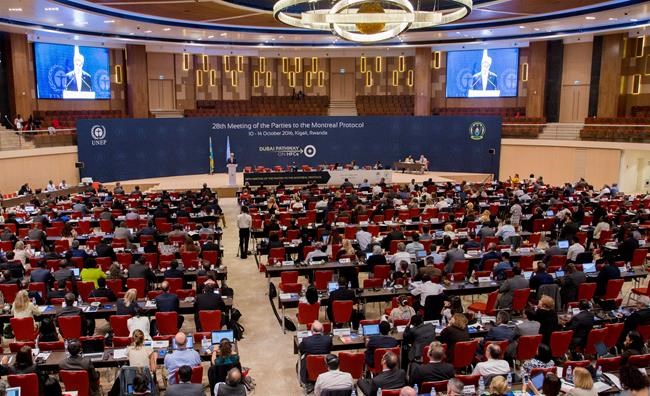
KIGALI, Rwanda – Environmental groups say nations have reached a deal to limit the use of greenhouse gases far more powerful than carbon dioxide as part of efforts to fight climate change.
At issue are hydrofluorocarbons, or HFCs, which are used in air conditioners and refrigerators. Observers say the agreement, set to be announced early Saturday, would cap the use of HFCs beginning in 2019, led by developed countries. Developing countries including China would start taking action in 2024.
Observers say a small group of countries including India and some Middle East states pushed for and secured a later start, arguing that their economies need more time to grow.
Scientists have said an agreement could put a half-degree Celsius dent in global warming by the end of the century.
“Compromises had to be made, but 85 per cent of developing countries have committed to the early schedule starting 2024, which is a very significant achievement,” Clare Perry, UK Climate Campaign Leader with the Environmental Investigation Agency, said in a statement.
HFCs were introduced in the 1980s as a substitute for ozone-depleting gases. But their danger has grown as air conditioner and refrigerator sales have soared in emerging economies like China and India. HFCs are also found in inhalers and insulating foams.
Major economies have debated how fast to phase out HFCs. The United States and Western countries want quick action. Nations such as India want to give their industries more time to adjust.
An ambitious accord would be “the world’s biggest climate protection achievement” since last year’s pact in Paris to cut carbon emissions, the Natural Resources Defence Council said going into the meeting.
U.S. Secretary of State John Kerry led the American delegation to the Rwanda meeting. He had been noncommittal on the chances of an agreement. “We’re making some progress,” he said before meeting Pakistani negotiators.
Although less plentiful than carbon dioxide, HFCs are described as the world’s fastest-growing climate pollutants. Kerry said last month they currently emit as much pollution as 300 coal-fired power plants each year. But that amount will rise significantly over the coming decades as air conditioning units and refrigerators reach hundreds of millions of new people.
HFCs don’t harm the ozone layer like chlorofluorocarbons and similar gases that were eliminated under the 1987 Montreal Protocol. The entire world ratified that agreement, helping to repair holes in the ozone that helps shield the planet from the harmful rays of the sun. The aim of this meeting was to attach an amendment to that treaty dealing specifically with HFCs.
News from © The Associated Press, . All rights reserved.
This material may not be published, broadcast, rewritten or redistributed.

This site is protected by reCAPTCHA and the Google Privacy Policy and Terms of Service apply.
Want to share your thoughts, add context, or connect with others in your community?
You must be logged in to post a comment.