Elevate your local knowledge
Sign up for the iNFOnews newsletter today!
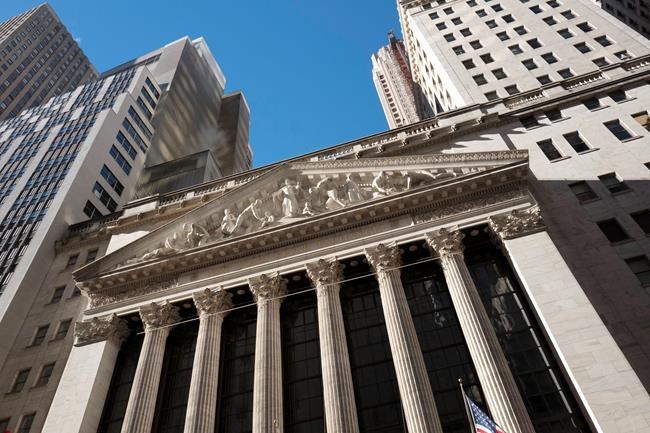
NEW YORK – U.S. stocks plunged Thursday as losses for Cisco Systems hurt technology companies while Wal-Mart declined after its latest quarterly report. Banks also dropped as bond yields and interest rates sank for a second day.
It was the second-worst day for stocks this year, which has seen few large declines. Along with technology companies and retailers, transportation companies skidded and all of the industrial, financial and basic materials companies in the S&P 500 fell. Those sectors tend to struggle when investors are concerned about economic growth, although there weren’t any specific signs of economic trouble Thursday.
The Standard & Poor’s 500 index dropped 38.10 points, or 1.5 per cent, to 2,430.01, its lowest close since July 11. The Dow Jones industrial average tumbled 274.14 points, or 1.2 per cent, to 21,750.73. The Nasdaq composite sank 123.19 points, or 1.9 per cent, to 6,221.91. The Russell 2000 index of smaller-company stocks fell 24.59 points, or 1.8 per cent, to 1,358.94.
High-dividend stocks like utilities and real estate companies fared slightly better than the rest of the market, although they still finished lower. About 95 per cent of the companies in the S&P 500 finished with losses.
Bill Northey, chief investment officer at U.S. Bank Wealth Management, said that minutes released Wednesday from the Federal Reserve’s policy meeting last month marked “a little bit of a change in tone,” and suggested that the central bank is becoming more cautious about raising interest rates.
That helped push long-term interest rates in the bond market lower since then. Lower bond yields tend to hurt banks, because it prevents them from charging higher rates on loans, and benefits high-dividend stocks.
Investors were also assessing the state of President Donald Trump’s business-friendly agenda as he continues to face criticism over his comments after the violence in Charlottesville, Virginia, over the weekend. After he was elected, investors hoped his proposals for tax cuts and infrastructure spending would boost corporate profits.
“Most of the agenda … has been a little bit distracted by non-economic factors,” said Northey.
Investors also looked for safer investments after a deadly van attack in Barcelona that killed at least 12 people and injured 80.
Cisco Systems fell $1.30, or 4 per cent, to $31.04 after it said sales will decline in the current quarter. It’s expecting a decline of 1 to 3 per cent from the $12.4 billion in revenue it reported a year ago.
Data storage company NetApp offered a forecast for the current quarter that disappointed investors. Its stock lost $2.85, or 6.7 per cent, to $39.56. It had a lot of company. Apple retreated $3.08, or 1.9 per cent, to $157.87 while software maker Adobe Systems skidded $3.57, or 2.4 per cent, to $148.23 and chipmaker Texas Instruments fell $2.31, or 2.8 per cent, to $80.15.
Wal-Mart did better than analysts expected in the second quarter as shoppers spent more money on its website and more people came to its stores. But that wasn’t enough to sustain a recent rally in the company’s stock, and its shares lost $1.28, or 1.6 per cent, to $79.70.
L Brands, the parent of Victoria’s Secret, tumbled after it cut its annual profit forecast because of weakening sales. The stock retreated $1.40, or 3.6 per cent, to $37.55, and it’s down 43 per cent this year as retailers slump overall and the company struggles after it decided to stop selling swimwear.
Elsewhere, Amazon fell $17.61, or 1.8 per cent, to $960.57 and Macy’s lost 52 cents, or 2.6 per cent, to $19.62.
Despite some shaky reports Thursday, it’s been another strong quarter of corporate earnings. Per-share profits for S&P 500 companies have grown almost 11 per cent in the second quarter versus the same period a year ago. Profits for energy companies have quadrupled because the price of oil has stabilized, and technology companies have also posted big gains. Consumer-focused companies have made smaller gains.
Analysts, including U.S. Bank’s Northey, mostly expect the stock market to keep rising as long as company profits keep growing.
The only bigger loss for stocks this year came on May 17. At that time, investors were concerned that Trump’s pro-business agenda might be affected by allegations he asked the FBI to drop an investigation into former National Security Adviser Michael Flynn.
Bond prices rose. The yield on the 10-year Treasury note fell to 2.19 per cent from 2.23 per cent. The yield on the 2-year note fell to 1.29 per cent from 1.33 per cent.
Benchmark U.S. crude rose 31 cents to $47.09 a barrel in New York. Brent crude, used to price international oils, added 76 cents, or 1.5 per cent, to $51.03 a barrel in London.
Wholesale gasoline added 2 cents to $1.59 per gallon. Heating oil picked up 1 cent to $1.58 a gallon. Natural gas gained 4 cents to $2.93 per 1,000 cubic feet.
Gold rose $9.50 to $1,292.40 an ounce. Silver added 11 cents to $17.05 an ounce. Copper lost 2 cents to $2.94 a pound.
The dollar dipped to 109.67 yen from 110.16 yen. The euro fell to $1.1742 from $1.1769.
Germany’s DAX fell 0.5 per cent and the CAC 40 of France shed 0.6 per cent. Britain’s FTSE 100 also gave up 0.6 per cent. The Japanese Nikkei 225 index edged 0.1 per cent lower and Hong Kong’s Hang Seng dropped 0.2 per cent. In South Korea, the Kospi gained 0.6 per cent.
___
AP Markets Writer Marley Jay can be reached at http://twitter.com/MarleyJayAP His work can be found at https://apnews.com/search/marley%20jay
News from © iNFOnews.ca, . All rights reserved.
This material may not be published, broadcast, rewritten or redistributed.

This site is protected by reCAPTCHA and the Google Privacy Policy and Terms of Service apply.
Want to share your thoughts, add context, or connect with others in your community?
You must be logged in to post a comment.