Elevate your local knowledge
Sign up for the iNFOnews newsletter today!
KAMLOOPS – Nearly two years after the Supreme Court of Canada issued the first declaration of Aboriginal title in Canadian history in Tsilhqot’in Nation v. British Columbia, there are still many questions left unanswered about how to implement this decision and the impact it will have on resource development in Canada.
Determining Access, Theory and Practice in Implementing Indigenous Governance over Lands and Resources aims to address some of those questions. The two-day conference, Feb. 15-16, 2016, is supported by a $25,000 Social Sciences and Humanities Research Council of Canada (SSHRC) Connection Grant, and builds upon two previous think-tank meetings on developing Indigenous territorial governance with Secwepemc and Tsilhqot’in people.
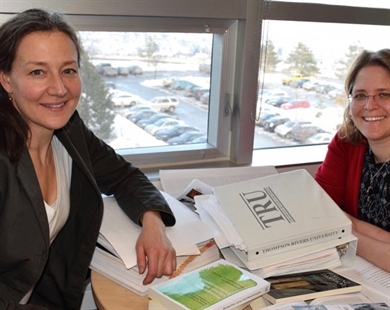
Organized by TRU Faculty of Law Professors Dr. Janna Promislow and Nicole Schabus in partnership with TRU Aboriginal Education and the Interior Alliance nations, Determining Access provides a venue for sharing information and strategies, and answering key questions faced by Indigenous groups navigating this new legal landscape.
Speakers include Chief Russell Myers Ross of the Tsilhqot’in National Government, Guujaaw, a well-known activist and member of the Council of Haida Nation, Arthur Manuel from the Indigenous Network on Economies and Trade and 2014 Trudeau Scholar Aaron Mills.
“The goal is to share information about how people are implementing Indigenous governance in the wake of the Tsilhqot’in Nation ruling,” said Promislow. “There is an expectation that things will evolve towards recognizing Indigenous governance, particularly with regard to lands and resource development.”
There are a number of ways to have Indigenous rights recognized, Promislow explained, but often those channels are inadequate and time consuming. “This research grant allows us to bring in speakers from elsewhere in BC and from other jurisdictions who can speak to experiences in moving beyond traditional legal channels to implement Indigenous governance — those are the types of conversations we want to help create.”
“We will be gathering people who have hard questions about controlling access to lands and resources in Indigenous territories. Our starting point is that implementing Indigenous governance over lands and resources is a necessity and in the interest of all, including government and industry, who need to engage with Indigenous peoples or otherwise will be faced with ongoing legal and economic uncertainty. As academics we are happy to take our guidance from Indigenous peoples and support them by addressing some of the legal and strategic questions they have,” said Schabus.
“This will inform our research, but more importantly it will support Indigenous governance by sharing experiences that come from on-the-ground experiences.”
News from © iNFOnews.ca, . All rights reserved.
This material may not be published, broadcast, rewritten or redistributed.

This site is protected by reCAPTCHA and the Google Privacy Policy and Terms of Service apply.
Want to share your thoughts, add context, or connect with others in your community?
You must be logged in to post a comment.