Elevate your local knowledge
Sign up for the iNFOnews newsletter today!
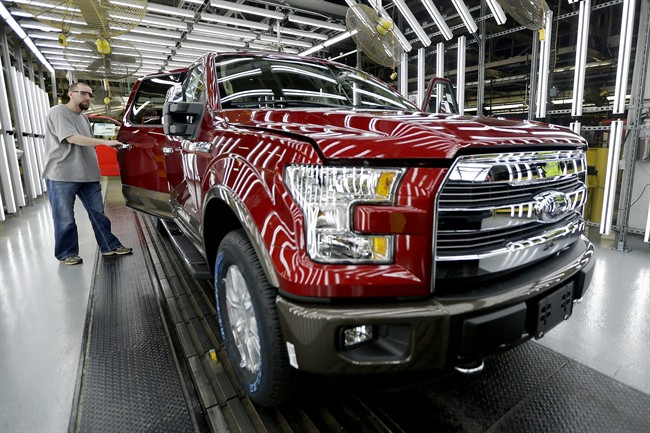
WASHINGTON – Orders for long-lasting U.S. manufactured goods dropped in August with weakness in a key category that tracks business investment plans.
Orders for durable goods fell 2 per cent last month in contrast to July when orders had risen by 1.9 per cent, the Commerce Department reported Thursday. A key category that serves as a proxy for business investment edged down 0.2 per cent last month after gains of 2.1 per cent in July and 1.5 per cent in June.
The underlying demand for manufactured goods has been weaker this year as a strong dollar and China’s economic slowdown have dragged down demand for American exports and big declines in oil prices have resulted in cutbacks in investment by energy companies.
Still, economists said the 2 per cent August decline overstated the weakness in manufacturing because much of the drag last month came from a huge 19.3 per cent fall in orders for defence equipment, an extremely volatile category. Excluding defence, orders would have dropped a smaller 1 per cent in August.
Paul Ashworth, chief U.S. economist for Capital Economics, said the small 0.2 per cent setback in the business investment category had been expected given the strong gains in this area in the previous two months.
“Investment in equipment appears to be recovering in the third quarter,” Ashworth said in a research note.
For August, demand for commercial aircraft fell for a second month, dropping 5.9 per cent after an 8.7 per cent decline in July. In June, this volatile category had shown a 69.9 per cent increase.
Orders for motor vehicles and parts fell 1.6 per cent after gains in the two previous months.
Orders outside of the transportation categories were flat in August after a modest 0.4 per cent rise in July,
Demand for machinery was up 1 per cent but orders for computers fell 5.7 per cent.
The Institute for Supply Management said that its manufacturing index slid to a reading of 51.1 in August, its lowest level since May 2013. It was the second straight drop for the manufacturing index. Anything above 50 signals growth.
The rising dollar makes U.S. goods more expensive in foreign markets while weakness in China, the world’s second biggest economy, also serves as a drag on the global economy.
The overall economy, as measured by the gross domestic product, grew at an annual rate of 3.7 per cent in the April-June quarter, an estimate that will be revised on Friday. Private economists believe the GDP estimate for the second quarter will be unchanged at 3.7 per cent, which represented a sharp increase after an anemic 0.6 per cent increase in the first quarter.
Economists are forecasting that growth in the current July-September quarter will slow slightly to around 2.5 per cent, reflecting in part an effort by businesses to trim their stockpiles after a big rise in inventories in the spring.
News from © The Associated Press, . All rights reserved.
This material may not be published, broadcast, rewritten or redistributed.

This site is protected by reCAPTCHA and the Google Privacy Policy and Terms of Service apply.
Want to share your thoughts, add context, or connect with others in your community?
You must be logged in to post a comment.