Elevate your local knowledge
Sign up for the iNFOnews newsletter today!
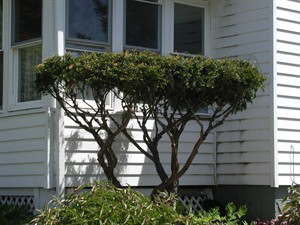
Deer are ready to start pruning our trees and shrubs.
Although unconcerned with promoting plant health or esthetics, in at least one situation deer can actually help us prune well.
Picture an overgrown shrub, especially one planted too close to a home. With age and a little neglect, said shrub begins to swallow up the home, or at least block the view from a window.
There are many approaches to dealing with an overgrown shrub. Briefly, you could, over the course of a few years, renovate the plant by each year cutting some of the oldest stems to the ground to make way for younger, shorter ones. Or you could take the dramatic approach: Lop the whole plant to the ground and start anew with all young shoots, which will enthusiastically sprout forth from the established roots. Also worth considering is just grubbing out the shrub and replacing it with something, or even nothing.
Deer aren’t much help with any of these approaches. But they can help out with another, which capitalizes on the venerability of such a plant: You and your hoofed friends can transform a selected portion of the plant into a picturesque, small tree.
An ideal candidate for this operation is yew, a fast-growing evergreen frequently snuggled against home foundations.
The first step in transforming an old yew — or any other old shrub — is to select two or three of the oldest stems to become the trunks of your tree-to-be. These stems should have pleasant forms and extend from ground level to as high as the future crown of branches.
Once selections are made, cut away all other stems growing from the base of the plant.
The next step — cutting away any branches growing off those new trunks between the ground and a few feet above the ground — is where deer help out. They’ll enjoy munching on all those smaller branches. You and your deer helpers will want to remove branches high enough along the trunk so the plant looks like a tree, or, in the case of the deer, as high as they can reach.
The final step in pruning will be to shorten and remove enough branches in the crown of your new tree to give it good shape. Do this step yourself.
Yew is a particularly good candidate for this treatment because its reddish brown, peeling trunk is well worth exposing and highlighting, and age deepens its beauty. Yew also bounces back enthusiastically from virtually any type of pruning, so you can do the job fearlessly.
In subsequent years, new sprouts will arise from ground level and off the trunks; after all, the plant was once, and really aspires to be, a bush. Deer will be eager to nip off all those young sprouts, but check on their work to cut away any that they miss.
___
Lee Reich is author of “The Pruning Book” (Taunton Press, 2010).
News from © The Associated Press, . All rights reserved.
This material may not be published, broadcast, rewritten or redistributed.

This site is protected by reCAPTCHA and the Google Privacy Policy and Terms of Service apply.
Want to share your thoughts, add context, or connect with others in your community?
You must be logged in to post a comment.