Elevate your local knowledge
Sign up for the iNFOnews newsletter today!
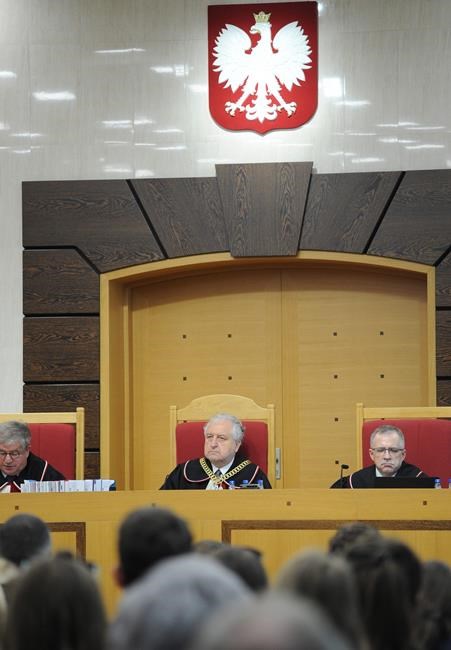
WARSAW, Poland – Poland’s constitutional Tribunal ruled Thursday that parts of a new law governing its own operation are unconstitutional, but the government said it won’t publish the ruling, which effectively kills it.
These latest developments in a nine-month saga centred on Poland’s highest legislative court are seen at home and abroad as a bellwether for the state of the nation’s young democracy.
The legislation, passed in July, is the work of the right-wing Law and Justice party, which took power in November and set out to change both the makeup of the 15-judge court and the rules by which it functions.
Party leaders complain that the opposition is overly represented in the tribunal, and that changes to the court were needed so the party can enact its conservative agenda.
But the European Union and civil rights groups in Poland and abroad accuse the party of eroding the rule of law and human rights. They say the court is unable to act as a check on government power, violating the democratic principle of separation of powers.
The court has been unable to rule on other legislation that critics say harm civil liberties, including laws that have increased government control over state media and police surveillance powers.
As the court deliberated Thursday, government opponents held a protest outside of the building in Warsaw, shouting “democracy!” and “constitution!”
The government of Prime Minister Beata Szydlo will not publish the latest ruling, a step required for it to take legal effect, spokesman Rafal Bochenek said.
There were three dissenting judges to Thursday’s ruling, all appointed by Law and Justice.

Mateusz Kijowski, leader of the Committee for the Defence of Democracy, said the government’s refusal to abide by the ruling indicates that “democracy is in a very bad state.”
Among the provisions that the court struck down would give four judges on the 15-judge court the power to block rulings for up to six months.
It also struck down an amendment which requires the court to examine complaints in the chronological order in which they are brought. With some 400 complaints waiting to be considered by the court, this would mean in practice that any new laws could avoid the tribunal’s scrutiny for years.
Law and Justice said the legislation passed on July 22 was meant to redress international concerns about a law passed in December, which made it much more difficult for the court to strike down legislation. For instance, that legislation abolished an earlier requirement for a simple majority for rulings and required a two-thirds majority.
That law faced strong international criticism, with the Venice Commission, a body of legal experts with the Council of Europe, the continent’s top human rights body, saying it violated democracy, human rights and rule of law.
The constitutional Tribunal struck down many parts of that legislation, but the government also refused to publish that ruling, preventing it from taking effect.
EU Commission First Vice-President Frans Timmermans said in late July that the new legislation leaves fundamental concerns about the rule of law in Poland “unresolved.”
“In Poland the constitutional Tribunal is still prevented from fully ensuring an effective constitutional review,” Timmermans said. “This adversely affects its integrity, stability and proper functioning, which is one of the essential safeguards of the rule of law in Poland.”
U.S. President Barack Obama has also expressed his concerns about the impasse surrounding the court.
News from © The Associated Press, . All rights reserved.
This material may not be published, broadcast, rewritten or redistributed.

This site is protected by reCAPTCHA and the Google Privacy Policy and Terms of Service apply.
Want to share your thoughts, add context, or connect with others in your community?
You must be logged in to post a comment.