Elevate your local knowledge
Sign up for the iNFOnews newsletter today!
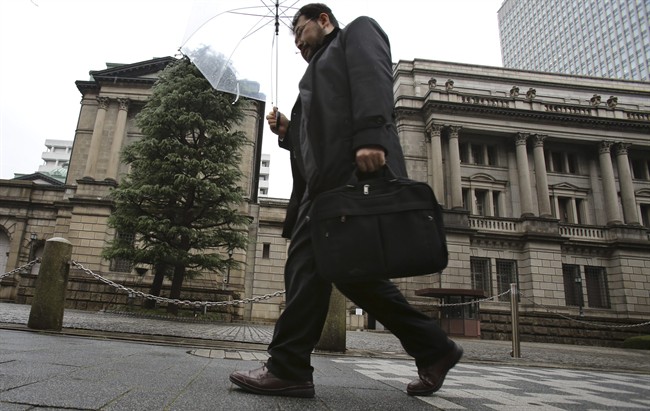
TOKYO – The Bank of Japan on Friday said it will charge lenders that leave too much cash on idle deposit with it, introducing a negative interest rate policy for the first time as it seeks to shore up a stumbling economic recovery.
The surprise move rattled stock market investors, with the Nikkei 225 index swinging between gains and losses after the announcement. It closed 2.8 per cent higher. The Japanese yen slid, with the U.S. dollar rising to about 120.70 yen from about 118.50 earlier in the day.
The central bank said it is imposing a 0.1 per cent fee on some new commercial bank deposits with the BOJ, effectively a negative interest rate. It hopes that will encourage commercial banks to lend more, rather than keeping cash at the BOJ, and stimulate investment and growth in the world’s third-largest economy.
The BOJ said in statement that Japan’s economy is still recovering, but risks from volatile global financial markets could undermine confidence and slow progress toward the central bank’s 2 per cent inflation target.
Bank deposits with the BOJ will be divided into three tiers. Existing current account balances will earn a 0.1 per cent positive interest rate. Required reserves held at the central bank by financial institutions will earn zero interest. Any additional current account deposits would incur the minus 0.1 per cent rate, the BOJ said.
The bank “will cut the interest rate further into negative territory if judged as necessary,” it said.
It said the policy would continue as long as needed to achieve its inflation target. In the meantime, the BOJ pushed back its timeframe for achieving that goal from late 2016 to mid-2017.
“We think there is an increasing risk that an improvement in the business confidence of Japanese firms and the conversion of deflationary mindset may be delayed, and that the underlying trend in prices might be negatively affected,” BOJ Gov. Haruhiko Kuroda said at a news conference.
The European Central Bank has already imposed negative interest rates, after leaving interest rates near zero failed to entice banks into seeking higher returns through lending.
In Japan, keeping interest rates near zero has likewise failed to yield the desired results, raising doubts about the credibility of the quantitative and qualitative monetary easing policies announced by BOJ Gov. Haruhiko Kuroda in April, 2013.
Data on Friday showed Japan’s core inflation rate for 2015, excluding volatile food prices, at 0.5 per cent.
That and other figures show the economy remained anemic last year, as stagnant incomes, the slowdown in China and the mixed blessing of lower oil prices hobbled Prime Minister Shinzo Abe’s recovery strategy.
Consumer spending fell 4.4 per cent in December from a year earlier, as households chose to save rather than splurge on any gains from the low oil prices that are slowing inflation. It was the fourth straight month of year-on-year declines.
Industrial output fell 1.6 per cent in December from a year earlier, partly due to slower demand for machinery and electronics components and devices in China.
“Today’s activity data were disappointing and suggest that Japan’s economy barely grew last quarter,” Marcel Thieliant of Capital Economics said in a commentary.
Abe took office three years ago vowing to get growth back on track through massive injections of cash by the government and central bank, and by sweeping reforms to boost competitiveness.
The central bank said Friday it would also persist with its “quantitative easing” purchases of about 80 trillion yen (about $660 billion) of government bonds a year.
The aim is to end a long spell of deflation, or falling prices, that is thought to be discouraging corporate investment. But while corporate profits have soared as massive stimulus weakened the Japanese currency, making earnings made abroad worth more when converted into yen, investment and wages have lagged.
Average incomes fell 2.9 per cent from a year earlier in December. Even though unemployment was steady at 3.3 per cent and the job market remained tight, companies wary over the economic outlook are opting not to raise pay.
Some economists contend that the “Abenomics” focus on inflation as a spur to growth is misplaced. Pushing the banks to lend will only work if companies borrow and invest.
“Corporate Japan has accumulated substantial cash on balance sheets, while the Japan labour market is getting tighter,” Ajay Kapur of Merrill Lynch said in a recent report.
“The key is to recirculate Japan’s corporate cash to Japan’s household-labour sector via wage increases. Otherwise, ‘Abenomics’ is likely to fail in generating self-sustaining growth,” he said.
___
Associated Press writer Mari Yamaguchi contributed.
___
Follow Elaine Kurtenbach: twitter.com/ekurtenbach and bigstory.ap.org/content/elaine-kurtenbach
News from © The Associated Press, . All rights reserved.
This material may not be published, broadcast, rewritten or redistributed.

This site is protected by reCAPTCHA and the Google Privacy Policy and Terms of Service apply.
Want to share your thoughts, add context, or connect with others in your community?
You must be logged in to post a comment.