Elevate your local knowledge
Sign up for the iNFOnews newsletter today!
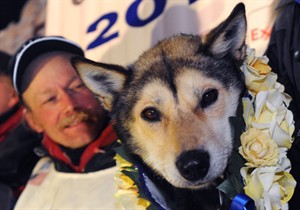
NOME, Alaska – A 53-year-old former champion has won the Iditarod Trail Sled Dog Race to become the oldest winner of Alaska’s gruelling test of endurance.
Mitch Seavey and 10 dogs crossed the Nome finish line to cheering crowds at 10:39 p.m. Alaska time Tuesday night.
“This is for all of the gentlemen of a certain age,” he said after crossing the finish line.
Seavey’s victory in the 1,600-kilometre race came after a duelling sprint against Aliy Zirkle, last year’s runner-up, along the frozen, wind-whipped Bering Sea coast toward Nome. The pair jostled for the lead, with Zirkle never more than a few miles behind. Also trailing by a dozen or so miles was four-time champion Jeff King.
Seavey, who first won the Iditarod in 2004, is the father of last year’s champion, Dallas Seavey, who at age 25 became the youngest Iditarod winner ever, beating Zirkle to the finish line by one hour.
Before Mitch Seavey’s second win, King was the oldest Iditarod champion, winning his fourth race at age 50 in 2006.
The oldies were still stellar performers in a race that ended last year with a top field featuring many finishers in their 20s and 30, noted Iditarod race spokeswoman Erin McLarnon.
“Last year we saw a lot of those youngsters in the top 10,” McLarnon said. “Some of those 45-plussers are taking back the lead this year. They are showing the young ‘uns what they can really do out there on that trail.”
Zirkle, 43, had hoped to be only the third woman to win the race and the first since Susan Butcher won her fourth Iditarod in 1990. Before this year’s race, Zirkle noted the long time that had passed since a woman won.
“This is my 13th year, and I’ve wanted to win every year,” she said before the race, which began March 2 with 66 teams at a ceremonial start in Anchorage.
The competitive part of the race began the following day in Willow about 80 kilometres to the north. Since then, the race changed leaders several times, with front-runners leapfrogging each other. Those at the front of the field included four-time champions Lance Mackey and Martin Buser, who later fell behind.
En route to Nome, the race turned into an aggressively contested run among veterans along an often punishing trail.
Conditions on the Yukon River required dogs to go through deep snow and navigate glare ice. Above-freezing temperatures also led to overflow along the trail, a potentially dangerous situation where water has pushed up through the ice and refrozen, creating a weak top layer of ice that teams and mushers can break through.
For reaching Nome first, Seavey wins $50,400 and a new 2013 Dodge Ram pickup truck. The rest of the $600,000 purse will be split among the next 29 mushers to cross the finish line under the famed burled arch on Front Street, a block from the sea.
___
Online:
News from © The Associated Press, . All rights reserved.
This material may not be published, broadcast, rewritten or redistributed.

This site is protected by reCAPTCHA and the Google Privacy Policy and Terms of Service apply.
Want to share your thoughts, add context, or connect with others in your community?
You must be logged in to post a comment.