Elevate your local knowledge
Sign up for the iNFOnews newsletter today!
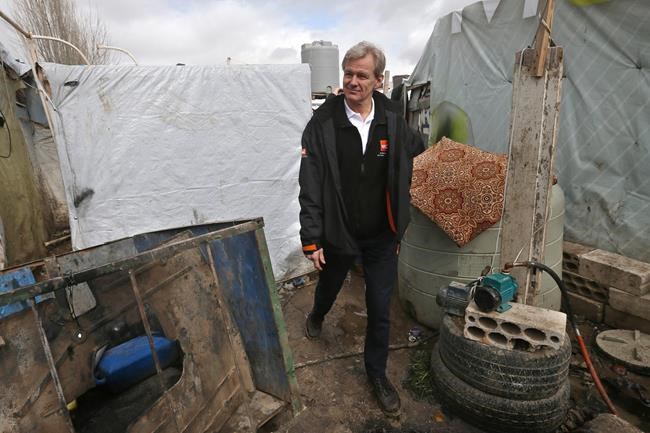
STOCKHOLM – One of the mediators who helped broker the 1993 Oslo Peace Accord remembers Shimon Peres as a charismatic leader who saw peace with the Palestinians as key to Israel’s future.
“He had the kind of visionary leadership that today’s generation of more introverted and narrow-sighted Israeli politicians really lack,” said Jan Egeland, who is now secretary-general of the Norwegian Refugee Council.
Egeland, who was state secretary in Norway’s Foreign Ministry at the time, met Peres on several occasions during the top secret negotiations between Israeli and Palestinian leaders in Oslo in the early 1990s.
“I found him very charismatic, a very strong personality,” Egeland told The Associated Press by phone on Wednesday. “He spoke of peace with the Palestinians throughout the process in very visionary terms.”
Egeland said Peres, who was Israeli foreign minister 1992-1995, “loved the smoke and mirrors” of the covert talks in Oslo.
For example, negotiators used code names for each other, Egeland said. He and Peres’ deputy Yossi Beilin were referred to as the “sons.” Peres and Mahmoud Abbas, who led the Palestinian negotiating team, were known as the “fathers,” while Israeli Prime Minister Yitzhak Rabin and Palestinian leader Yasser Arafat were the “grandfathers.”
“So we would say ‘has the son told the father that we need clearance from the grandfather?’” Egeland said.
Officially, Peres was visiting Norway for other reasons when the Oslo agreement was initialed at a secret ceremony at 2 a.m., Egeland said. The deal was formally signed in September 1993 on the White House lawn with President Bill Clinton.
Peres, Rabin and Arafat shared the 1994 Nobel Peace Prize for the accord, but it fell apart amid renewed Israeli-Palestinian violence.
Egeland said he was impressed by Peres’ sense of humour and his talent as a speaker, both in public and in small group settings.
“But he was also a tough guy,” Egeland said, recalling the furious response he got after condemning the Israeli shelling of a U.N. refugee camp in southern Lebanon in 1996. Israel said the attack was a mistake and that its gunners had been aiming at nearby rocket launchers of Hezbollah guerrillas.
“I called it a massacre, and he got very angry with me,” Egeland said. “But not long after we were friends again.”
He called Peres an “uncompromising defender of Israel in every sense,” but one who found it in Israel’s interest “to not create new generations of hatred” among its Palestinian and Arab neighbours.
“Today’s generation of Israeli leaders is not able to see that,” Egeland said. “And they and their children may live to regret it.”
News from © The Associated Press, . All rights reserved.
This material may not be published, broadcast, rewritten or redistributed.

This site is protected by reCAPTCHA and the Google Privacy Policy and Terms of Service apply.
Want to share your thoughts, add context, or connect with others in your community?
You must be logged in to post a comment.