Elevate your local knowledge
Sign up for the iNFOnews newsletter today!
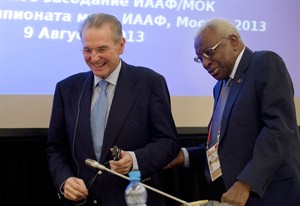
MOSCOW – The International Olympic Committee is waiting for more clarifications from the Russian government on the anti-gay law that is overshadowing preparations for the Winter Games in Sochi, IOC President Jacques Rogge said Friday.
The law, signed by President Vladimir Putin in June, bans “propaganda of nontraditional sexual relations” and imposes fines on those holding gay pride rallies. It has caused a major international outcry and spawned calls for protests ahead of the Feb. 7-23 Olympics in the Black Sea resort.
Rogge said the Russian government provided written re-assurances about the law on Thursday, but that some elements are still too unclear to pass judgment.
“We are waiting for the clarifications before having the final judgment on these reassurances,” Rogge said, a day before the start of the world athletics championships in Moscow.
Russian Sports Minister Vitaly Mutko insisted Thursday that Olympic athletes would have to respect the laws of the country during the Sochi Games. On Friday, he said there was no way Russia would back down under political pressure.
Referring to Western criticism, Mutko was quoted as saying by Interfax: “I wouldn’t call the pressure light. Russia must understand that the stronger we are, the more other people aren’t going to like it. We have a unique country.”
“We don’t have to be afraid of threats to boycott the Olympic Games,” Mutko said. “All sensible people understand that sports demand independence, that it is inadmissible that politics intervene.”
On Thursday, Mutko did make it clear that the private lives and privacy of athletes would be respected as it is guaranteed by the Russian constitution.
Rogge said that was essential.

“The Olympic charter is clear,” Rogge said. “A sport is a human right and it should be available to all, regardless of race, sex or sexual orientation.”
Even if Russia accepts that principle, the law leaves open the issue of athletes speaking freely during the games.
“As far as the freedom of expression is concerned, of course, this is something that is important,” Rogge said. “But we cannot make a comment on the law” until the clarifications have been received.
“I understand your impatience to get the full picture, but we haven’t (received) it today,” Rogge said. “There are still too many uncertainties in the text.”
Rogge said the problems seemed to centre on translations.
“We don’t think it is a fundamental issue,” he said at a news conference following a meeting of the IOC executive board with the International Association of Athletics Federations.
___
Laura Mills contributed from Moscow.
News from © The Associated Press, . All rights reserved.
This material may not be published, broadcast, rewritten or redistributed.

This site is protected by reCAPTCHA and the Google Privacy Policy and Terms of Service apply.
Want to share your thoughts, add context, or connect with others in your community?
You must be logged in to post a comment.