Elevate your local knowledge
Sign up for the iNFOnews newsletter today!
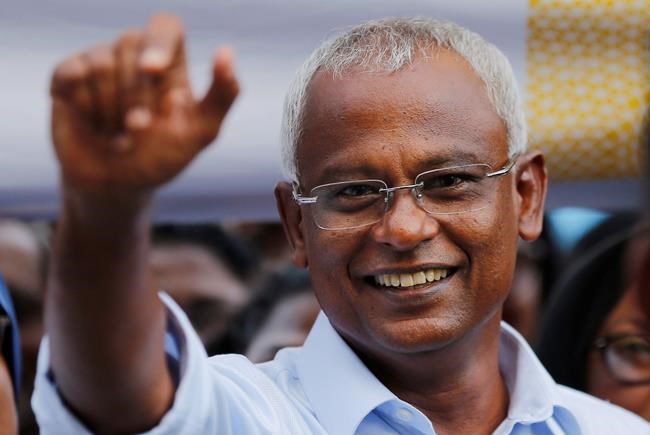
COLOMBO, Sri Lanka – The Maldives’ election commission on Saturday released the final results of this month’s presidential election, confirming the surprising opposition victory by longtime lawmaker Ibrahim Mohamed Solih.
The results showed that Solih received 58.4 per cent of the votes cast in the Sept. 23 election while his opponent and the current president, Yameen Abdul Gayoom, got 41.6 per cent, according to the commission’s spokesman, Ahmed Akram.
The commission had already released provisional results. According to the election law, it must release the official results within seven days of the election.
The election outcome surprised many, given opposition warnings that the voting could be rigged by Yameen.
Since getting elected in 2013, Yameen had cracked down on political dissent, jailing rivals — including his half brother and the Maldives’ first democratically elected president — and Supreme Court justices following allegedly flawed trials, while forcing some into exile. He also consolidated power by exerting control over the courts, bureaucracy, the police and the military.
Solih, 56, was a democracy activist during decades of autocratic rule in the Indian Ocean archipelago nation and a former parliamentary majority leader. He became the Maldivian Democratic Party’s presidential candidate after its other top figures were jailed or exiled by Yameen’s government.
Party leader and former President Mohamed Nasheed, in exile in Sri Lanka, had hoped to run again but was disqualified because of an outstanding prison sentence in the Maldives.
India and China, jostling for greater influence in the Indian Ocean region, had been watching the election closely.
The European Union didn’t send election observers because the Maldives failed to meet conditions for monitoring, and few foreign media were allowed into the country to cover the vote. The U.S., which earlier threatened sanctions if the elections were not free and fair, urged calm while the election results were being finalized.
The Maldives became a multiparty democracy in 2008 after decades of autocratic rule. However, under Yameen’s rule, the country lost many of its democratic gains.
News from © iNFOnews.ca, . All rights reserved.
This material may not be published, broadcast, rewritten or redistributed.

This site is protected by reCAPTCHA and the Google Privacy Policy and Terms of Service apply.
Want to share your thoughts, add context, or connect with others in your community?
You must be logged in to post a comment.