Elevate your local knowledge
Sign up for the iNFOnews newsletter today!
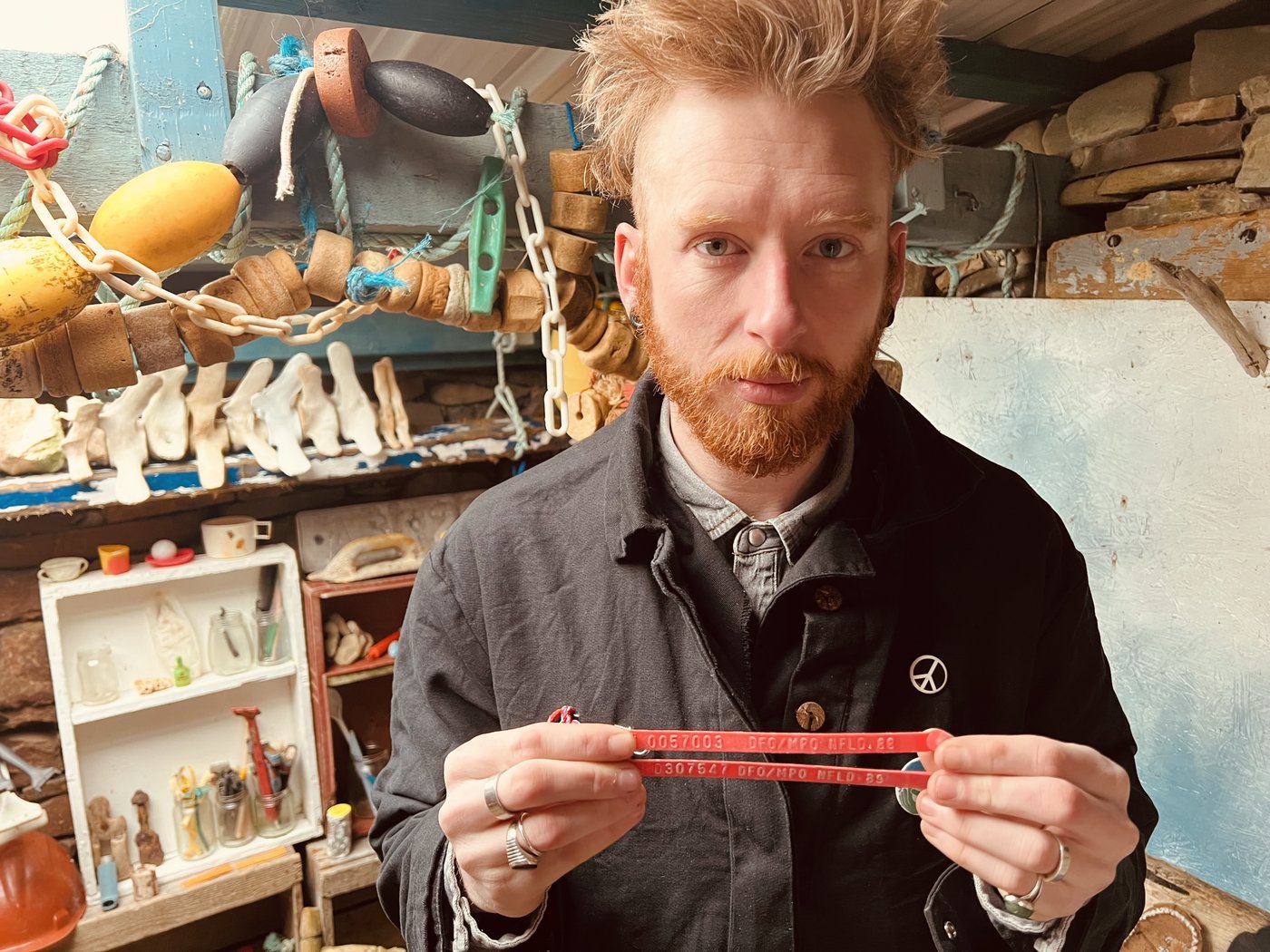
ST. JOHN’S — Lobster tags from Newfoundland dating back to the 1980s are among the piles of plastic trash that has washed up this year on Sanday, an island in the Scottish Orkney archipelago known for its pristine white sandy beaches.
David Warner organizes regular beach cleanups on the island, which is on the northeast side of the remote archipelago. Recent storms and high seas have eroded the dunes on the Howar Sands beach, revealing vast troughs of decades-old plastic bottles and other detritus, he said.
In a video interview, Warner held up a Kirkland-brand bottle of maple syrup with English and French on the label, suggesting it could be from Canada. He also displayed a red plastic lobster tag stamped with “NFLD,” dated 1989.
Other bottles clearly originated in the United Kingdom before Britain stopped using shillings in 1971, he said.
Though decades old, the bottles are in near-perfect condition, the labels still intact. For Warner, it’s a grim reminder that humans have produced years and years of indestructible plastic waste, and there is likely much more to come.
“You’re suddenly faced with the facts that this is out there, and the fact that it’s so old,” Warner said. “Where is the most recent rubbish that still has yet to come in?”
Warner arranges the cleanup events through the Sanday Community Craft Hub, where is the creative sustainability coordinator. Last year, crews found just 42 plastic bottles across eight beach surveys, he said.
This year, they’ve found more than 400 on the Howar Sands beach alone.
There is also an “overwhelming” amount of polystyrene, broken down over time into tiny little bits that are so small, they’re difficult to pick up. Warner said he measured 1,094 polystyrene pieces in a square-metre test patch, on a beach that has been identified as a scientifically significant area because it is home to so many nesting birds.
He said he is not trying to point fingers at Canada or Japan or the United Kingdom, or anywhere else the plastic garbage comes from.
“People say, ‘What’s the solution?’ Short term, it’s beach cleaning, monitoring it, counting it, so people can be aware,” Warner said. “But long term, I think there is no solution which is a solution in itself … we just need to stop using it, if we can.”
This report by The Canadian Press was first published Feb. 21, 2026.


News from © The Canadian Press, . All rights reserved.
This material may not be published, broadcast, rewritten or redistributed.

This site is protected by reCAPTCHA and the Google Privacy Policy and Terms of Service apply.
Want to share your thoughts, add context, or connect with others in your community?
You must be logged in to post a comment.