Elevate your local knowledge
Sign up for the iNFOnews newsletter today!
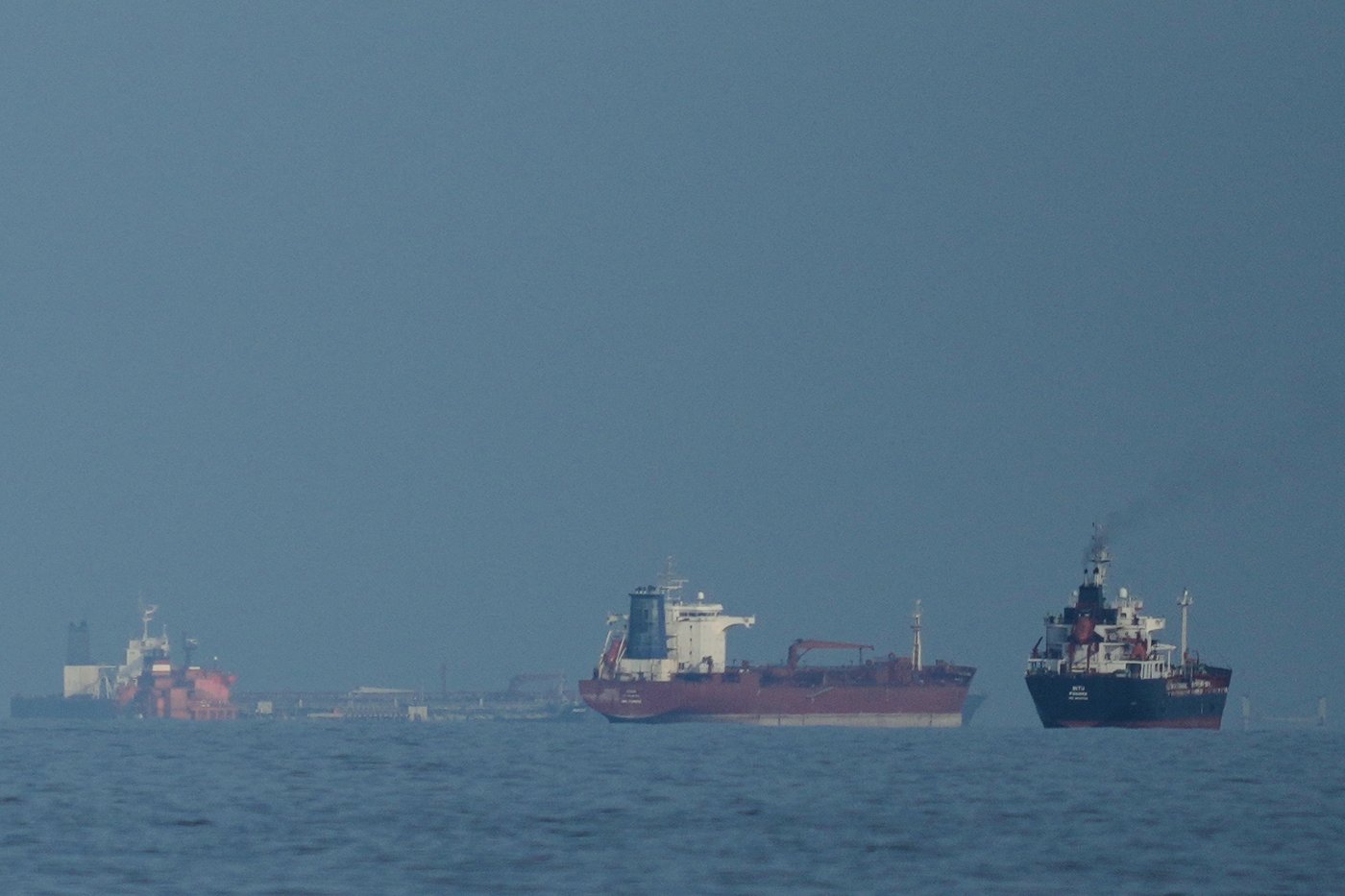
FRANKFURT, Germany (AP) — The U.S. Navy’s sea blockade against Iran appears to be working.
Iran-linked or sanctioned vessels that have left the Persian Gulf through the Strait of Hormuz have stopped or turned around, shipping data firms say. They appear to have jammed or faked their locations in some instances, complicating an uncertain and risky shipping situation.
The blockade that started Monday “has been fully implemented,” said Adm. Brad Cooper, head of U.S. Central Command. “U.S. forces have completely halted economic trade going in and out of Iran by sea.”
The action could put serious pressure on the Iranian economy, while Tehran’s earlier cutoff of the waterway crucial to oil and gas supplies has sent energy prices higher during the war with the U.S. and Israel.
Here are key things to know about the blockade and the situation at the Strait of Hormuz:
How the US Navy is enforcing the blockade
The blockade is being enforced “impartially against all vessels of all nations entering or leaving coastal areas or ports in Iran,” U.S. Central Command said. Vessels avoiding Iranian ports are not affected.
The military set up the blockade in the Gulf of Oman beyond the Strait of Hormuz, a U.S. official said. The official, who spoke on condition of anonymity to discuss sensitive military operations, said the strategy is to observe vessels subject to the blockade leave Iranian facilities and clear the strait before intercepting them and forcing them to turn around.
The official said that the military relies on more than just automated tracking beacons that all merchant ships are required to carry, called AIS, to determine merchant ships were coming from a port in Iran but wouldn’t go into more detail citing the need for operational security.
Ships are turning around as traffic adjusts
U.S. Central Command said Wednesday that no vessels have made it past its forces during the first 48 hours of the blockade.
It noted that 10 vessels have complied with directions to turn around and return toward an Iranian port or Iran’s coastal area. Navy warships are telling merchant ships that they are ready to board them and use force to compel compliance.
On Tuesday, the first full day of the blockade, only eight vessels, most of them linked to Iran or sanctioned, transited the strait, said Ana Subasic, trade risk analyst at data and analytical firm Kpler. The environment is still considered “extremely high risk” despite the ceasefire, she said.
“Most of the vessels have appeared to halt or have reduced movement after clearing the strait,” she said, “which tells us that the effect of the blockade is starting to show up because most of these vessels that have crossed have some kind of history with carrying Iranian-origin sanctioned cargo.”
The Rich Starry, a Chinese-owned tanker previously sanctioned by the U.S. for smuggling Iranian petroleum products, left the strait and then turned back this week, according to publicly available ship tracking data.
Radio transponder data for the vessel, which is sailing under the flag of the landlocked East African nation of Malawi, shows it entered the Persian Gulf on April 4 empty of cargo. It turned off its transponder for more than a week, a tactic smugglers often use called “running dark” to avoid showing its location.
The Rich Starry’s signal popped back up off the United Arab Emirates on Monday laden with oil, though it is possible the ship wasn’t transmitting its accurate location. Smugglers sometimes “spoof” their locations by transmitting inaccurate coordinates.
The ship went through the Strait of Hormuz on Monday night before abruptly reversing course in the Gulf of Oman on Tuesday, heading back through the strait and toward Iran’s coast Wednesday.
Other Iran-linked tankers transited the strait this week only to stop. For example, the oil-products tanker Elpis left Iranian waters Monday, passed through the strait before cutting its engines in the Gulf of Oman, tracking data shows. The ship turned off its radio transponder Tuesday and its current location couldn’t be independently verified.
Maritime intelligence firm Windward said that vessel behavior was “indicating a fragmented and uneven response to the blockade” as sanctioned and false-flagged vessels continued to be active, some transiting the strait, others delaying or reversing course.
Trying to break Iran’s chokehold
Iran has blocked the strait by threatening to attack shipping, cutting off 20% of the world’s typically daily oil consumption, sending oil prices sharply higher and leading to warnings about higher inflation and recessions in leading economies.
Vessels were hit with aerial and undersea drones as well as unknown projectiles, killing 11 crew members. While those attacks have dwindled, the risk of navigating the area means that ship traffic has dropped by more than 90%.
Some of that blocked oil is making it out from Gulf producing nations through pipelines to the Red Sea and the Gulf of Oman. But those pipelines can’t make up for the effective closure of the strait.
Iran has started vetting and collecting money from the few vessels daring to pass. Vessels must submit detailed information on cargo and crew to the paramilitary Revolutionary Guard and pay a $1 fee per barrel of oil or fuel products before being allowed to pass, according to Kpler.
The US blockade has a rule book
The terms of the U.S. blockade have contributed to some uncertainty. According to a notice to mariners, the blockade is being enforced in the Gulf of Oman and the Arabian Sea, not at the Strait of Hormuz. So simply passing the strait doesn’t mean a vessel beat the blockade.
“Humanitarian shipments including food and medical supplies essential for the survival of the civilian populations” can pass with inspections.
That last provision aligns with international law on naval warfare, which bars blockades solely intended to starve civilians, according to a legal guide from the U.S. Naval War College cited by maritime historian Sal Mercogliano, who runs a YouTube channel on shipping.
“Neutral” ships can pass — though they may be inspected — but it’s not clear what “neutral” means. The Lloyd’s List Intelligence maritime data firm said the U.S. action “has plunged shipowners into fresh uncertainty around enforcement.”
So ships from Iranian ports can be detected passing the strait — and still face the risk of being stopped farther out. Container ships heading for Iranian ports could be allowed in or out if they’re carrying food — or not, if they’re carrying other goods.
Iran says it would halt Gulf trade if blockade doesn’t end
Unless Iran can export oil, available storage will fill up and it will have to shut down wells that are difficult to restart. Additionally, Iran imports gasoline since it lacks the refinery capacity to turn its own oil into fuel.
The commander of Iran’s joint military command warned Wednesday that Iran would completely block exports and imports across the Persian Gulf region, the Sea of Oman and the Red Sea if the U.S. does not lift its blockade on Iranian ports.
“Iran will act with strength to defend its national sovereignty and its interests,” Ali Abdollahi said. He added that the U.S. blockade is “a prelude to violating the ceasefire.”
—-
Toropin and Biesecker reported from Washington.
News from © The Associated Press, . All rights reserved.
This material may not be published, broadcast, rewritten or redistributed.

This site is protected by reCAPTCHA and the Google Privacy Policy and Terms of Service apply.
Want to share your thoughts, add context, or connect with others in your community?
You must be logged in to post a comment.