Elevate your local knowledge
Sign up for the iNFOnews newsletter today!
Elevate your local knowledge
Sign up for the iNFOnews newsletter today!
Select Region
Selecting your primary region ensures you get the stories that matter to you first.
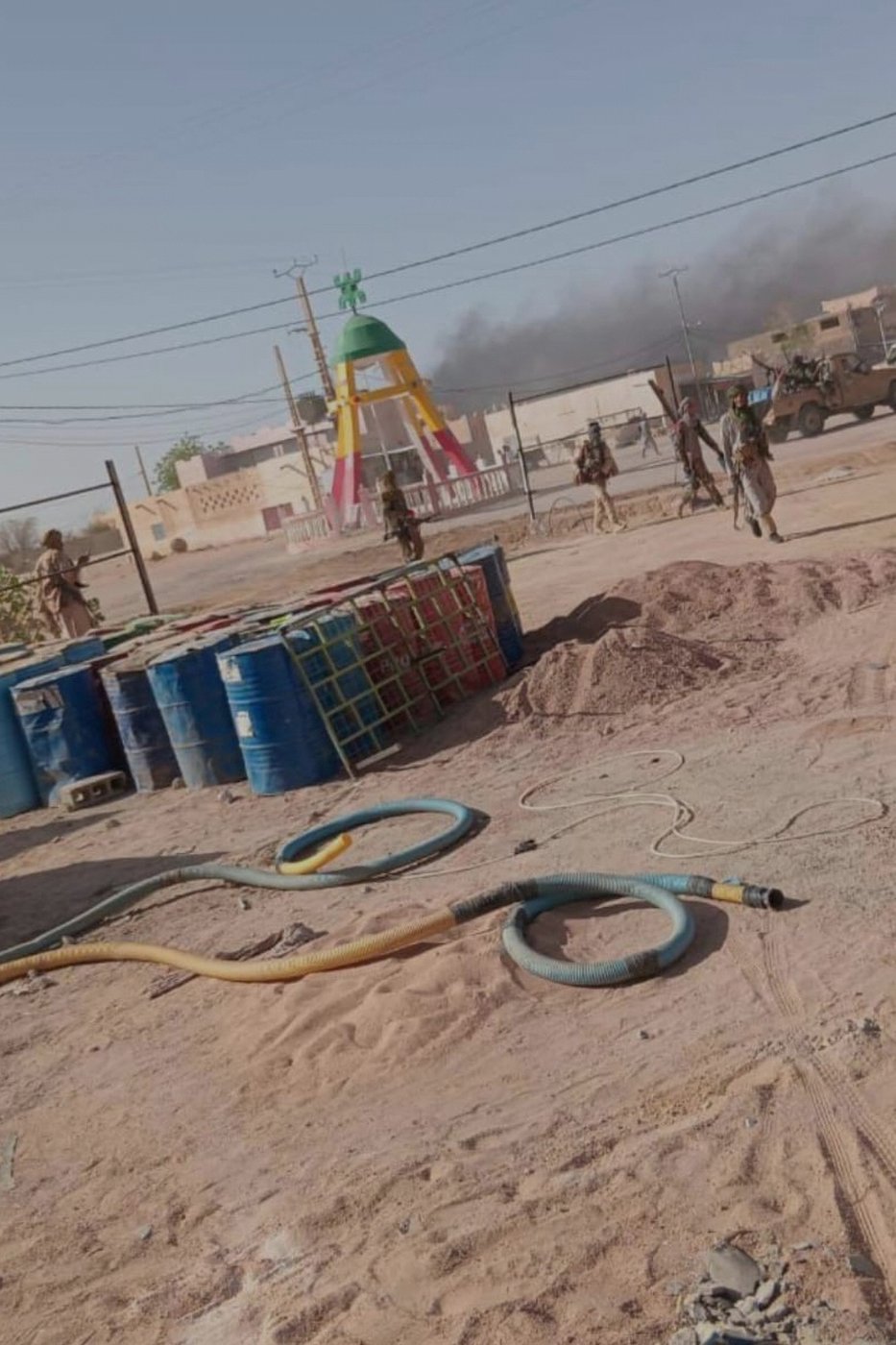
DAKAR, Senegal (AP) — An alliance of al-Qaida-linked fighters and separatists carried out the largest coordinated attack in over a decade in Mali, marking a dangerous escalation in the world’s deadliest region for extremism.
It’s also a challenge for Russia, which Mali’s military-led government has embraced as its security partner after distancing itself from former allies like France.
The scale of the weekend assault was unprecedented for both the number of locations hit and the prominence of the targets, analysts said Monday, although authorities have not yet released an official death toll.
The fighters struck simultaneously across the country — attacking the capital Bamako’s airport, the nearby garrison town of Kati and several northern and central cities such as Kidal and Sevare. Mali’s defense minister was killed when a car bomb targeted his home near Bamako.
The separatist Azawad Liberation Front says the key northern city of Kidal, whose capture in a similar alliance over a decade ago launched the insecurity, is now in fighters’ hands again.
Here’s what to know.
Fighters unite behind shared goals
Landlocked Mali is part of the Sahel, a vast strip of land south of the Sahara desert that has become the epicenter of extremist violence in recent years.
According to last year’s Global Terrorism Index by the Institute for Economics and Peace, the region now accounts for 51% of worldwide violent extremism deaths, up from 1% almost two decades ago. Deaths from extremist attacks have increased nearly tenfold since 2019.
Mali in particular has been plagued by militants affiliated with al-Qaida and the Islamic State group, as well as a separatist rebellion in the north for more than a decade.
Tuareg separatists and jihadist groups worked together before, in 2012, when they seized much of northern Mali, triggering a collapse of state authority that prompted French military intervention.
The al-Qaida linked group JNIM, or Jama’at Nusrat al-Islam wal-Muslimin, has expanded in recent years, seizing vast swaths of territory and recently blockading Mali’s capital from fuel shipments. It is also active in neighboring Burkina Faso and Niger, and its activities have intruded into coastal states like Benin, Ivory Coast and Togo.
JNIM entered the weekend attacks with strong resources. The group taxes local populations, steals cattle and controls natural resources including gold mining, while using sieges, kidnappings and explosives to dominate supply routes.
Ulf Laessing, head of the Sahel program at the Konrad Adenauer Foundation, said the group had a “full war chest” ahead of the attacks after reportedly collecting at least $50 million in ransom for the release of an Emirati member of the Dubai royal family and two of his business associates kidnapped near Bamako last year.
In northern Mali, Tuareg-led separatist groups have been fighting for years to create an independent state named Azawad. In 2024, they merged into the Azawad Liberation Front, or FLA, which fought alongside JNIM in the weekend attack.
Despite ideological differences, JNIM and the FLA have a common interest in chasing the Malian army from territories they control in northern and central Mali, and kicking out Russian fighters allied with Mali’s security forces, said Rida Lyammouri, senior fellow at the Policy Center for the New South, a Moroccan think tank.
Russian mercenaries flee key northern city
Mali, Niger and Burkina Faso are ruled by military leaders who took power by force in recent years with the pledge of providing more security to citizens. They accused the former democratically elected governments of being corrupt and propped up by France.
Despite years of French military presence and U.N. peacekeeping, attacks had multiplied since 2014, territory had steadily slipped from government control and civilians had continued to bear the brunt of the violence, fueling the popular discontent the juntas rode to power.
The countries have turned to Russia as their security partner and forced traditional allies like U.S. forces and a U.N. peacekeeping mission to leave, while creating their own security partnership, the Alliance of Sahel States.
Now Mali’s top security partner is the recently created Africa Corps, a Russian military unit that reports to Russia’s defense ministry. Analysts estimate the unit has around 2,000 troops in the country.
But the security situation in Sahel has worsened since the military governments took power starting with Mali in 2020, analysts say, with a record number of attacks and a record number of civilians killed by both Islamic fighters and government forces.
Laessing said French forces and the U.N. peacekeeping mission had effectively filled the vacuum left by a largely absent state, particularly in central and northern Mali. Their withdrawal left people with fewer employment options, making them targets for jihadist recruitment, he said.
Russian support has not filled the gap, and its forces are on the run. On Monday, Africa Corps said on Telegram its fighters had withdrawn from Kidal, two days after an FLA spokesperson said its forces had taken control.
Kidal has been at the heart of Mali’s security crisis. In 2012, Tuareg separatists and jihadist groups seized the city along with much of northern Mali. The city’s recapture by Malian government forces and Russian mercenaries with the Wagner group in 2023 had marked a significant victory.
The FLA claimed in a statement Saturday it had negotiated a deal allowing Africa Corps forces and the Malian army to withdraw from Kidal, with a convoy departing under rebel escort from the former U.N. peacekeeping base.
Mali’s capital was already weakened by a blockade
In recent months, JNIM relentlessly attacked fuel tankers coming from neighboring Senegal and Ivory Coast, plunging Bamako into crisis well before the Iran war tightened global fuel supplies.
Fuel shortages followed, with long lines snaking around gas stations, while the Malian army escorted some fuel convoys into the capital for partial relief.
A fragile truce was reached in late March but has since collapsed. Attacks on supply routes resumed ahead of the weekend attacks.
Analysts say JNIM’s goal is to use the blockade to pressure businesses and residents to distance themselves from Mali’s military authorities, undermining the government’s legitimacy and authority. But they say the militants don’t appear to seek power themselves.
___
Follow AP’s Africa coverage at: https://apnews.com/hub/africa
News from © The Associated Press, . All rights reserved.
This material may not be published, broadcast, rewritten or redistributed.

This site is protected by reCAPTCHA and the Google Privacy Policy and Terms of Service apply.
Want to share your thoughts, add context, or connect with others in your community?
You must be logged in to post a comment.