Elevate your local knowledge
Sign up for the iNFOnews newsletter today!
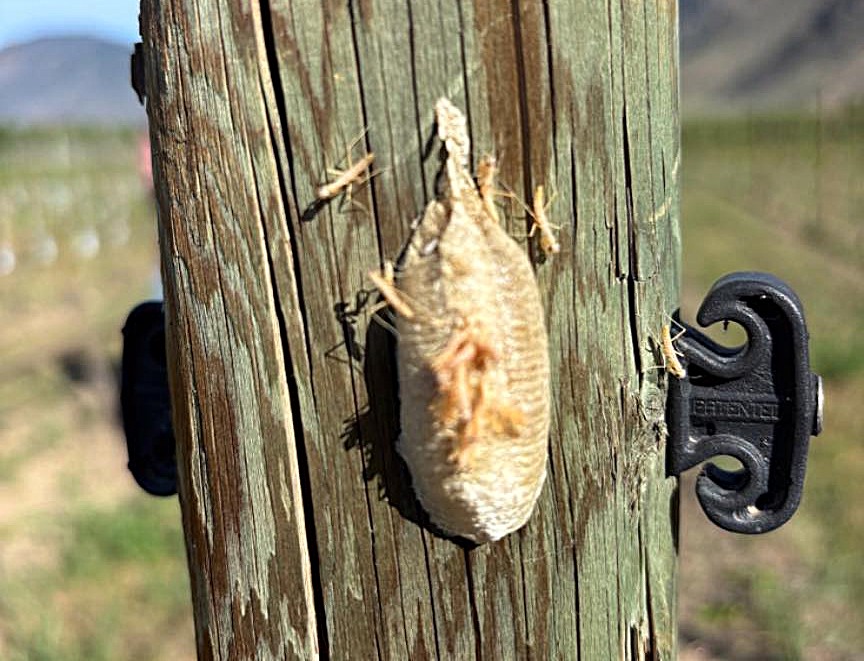
Keremeos farmer Cheryl Hendsbee was tending her grapes this week on her property when she saw something she’d never seen before.
Praying mantis nymphs were spilling out of a nest – called an ootheca – that was attached to a wooden post.
“I’ve been farming on this property for a long time and have seen praying mantises around but I’ve never seen them hatch, it was quite an experience,” she said. “I was calling out to my husband to come see it.”
While Hendsbee had done some research on the ootheca and knew it was a praying mantis nest, she said she was shocked at how many nymphs came out of it.
“When I walked by the post the nest had started to crack, they’d started to hatch and there were maybe four or five out of the nest and I thought, ‘oh wow’,” she said. “They were very small and quick.”
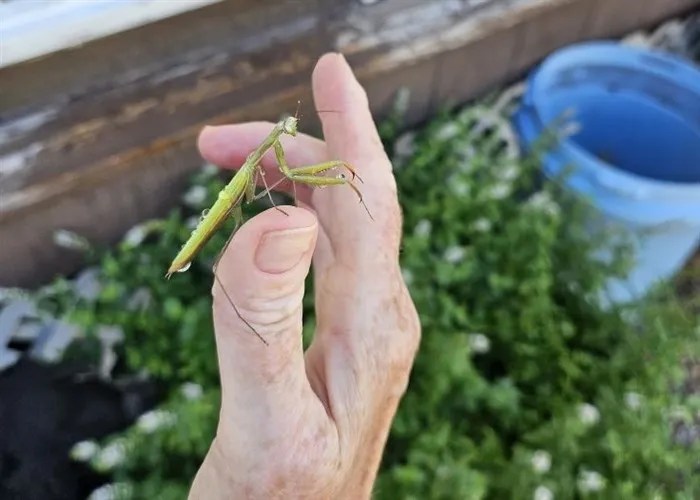
By the time she had pulled out her phone to snap photos of the phenomena, there numerous nymphs coming out.
“There were like 30 of them and I thought how on earth can that many fit into a nest that size, I was only expecting one to come out,” she said.
Hendsbee sent the photos to her kids to share with her grandkids who often look for mantises when they visit her property. She posted the photographs in a community Facebook group.
“I thought I’d share in case other people haven’t seen praying mantises hatch and was surprised at the large response,” she said. “People are sharing comments and photographs, it turned out to be quite educational.”
Praying mantis nymphs hatch in late spring and early summer in the Thompson-Okanagan region and never fail to fascinate onlookers with their alien-like appearance.
The insects are carnivorous, preying on other insects, spiders and centipedes, using their camouflage to ambush prey which they seize with their giant forelegs and eat alive, according to the Canadian Encyclopedia.
There are two species of mantid found in the province.
The European mantis was introduced to New York State from Europe in 1899 and spread into parts of Canada. It was later introduced in the Okanagan in an effort to control grasshoppers.
The ground mantid is the only native species in the country and can only be found in the dry grasslands of the South Okanagan.
“The experience cheered me up a little bit, it’s just not something you ever see,” Hendsbee said.
“Now I’m keeping an eye on the other oothecas on the property in case I get to watch this again.”
News from © iNFOnews.ca, . All rights reserved.
This material may not be published, broadcast, rewritten or redistributed.

This site is protected by reCAPTCHA and the Google Privacy Policy and Terms of Service apply.
Want to share your thoughts, add context, or connect with others in your community?
You must be logged in to post a comment.