Elevate your local knowledge
Sign up for the iNFOnews newsletter today!

The upcoming Kamloops election will likely see voters audit council for the last four years of interpersonal turmoil, but it may also be a gauge on the public’s reaction to the millions of dollars it’s taking on in debt.
Candidates are already throwing their hats in the ring, months ahead of the October election, and some are expected to come out strong against the city’s fast-growing debt load.
City staff have assured the public that spending remains well below limits set by the province, but critics like Kamloops Citizens United have been raising alarms.
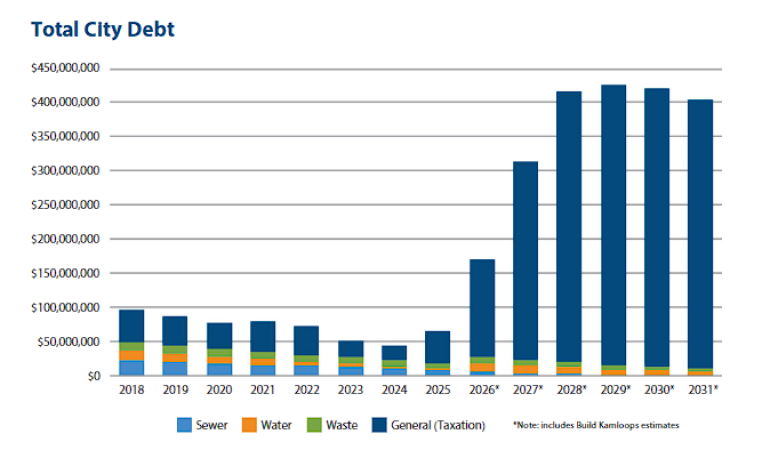
The city’s overall borrowing was last projected to peak in 2029 at around $416 million, which will see more than $35 million in spending per year going toward servicing the debt. For context, the city will take in $173 million in taxes this year. The bulk of that debt is from three major projects: the performing arts centre, the multiplex arena and a new police station.
While the construction costs for those projects have changed since, the city says taxpayers won’t bear more of a burden than already projected.
“We cannot arbitrarily go beyond that amount, so our top end numbers for debt on these is a certainty,” the city’s corporate services director David Hallinan said. “If we have changes, we will find other sources or reallocate something from another project.”
But one of those projects still hasn’t been approved and it likely won’t cost what city staff expected it would last year.
The performing arts centre accounts for $140 million of borrowed funds, but its overall cost is now poised to be $211 million. That includes around $150 million in construction, $38 million for “soft costs” and contingencies and another $23 million for a parkade.
The multiplex arena is a $154 million project, planned to include up to $125 million in debt. Its final design hasn’t been finalized yet, but staff have already considered paring down the project, including a reduction from four sheets of ice to three.
Those loans aren’t entirely active yet. The city is paying off $98 million in previous debts. The two projects make up most of the approved $275 million in approved borrowing in 2024, but that leaves four other big ticket projects that haven’t been yet publicly accounted for.
Another $10 million in already-approved debt is set aside to plan for a new racquet sports facility and curling rink, poised to replace the downtown Memorial Arena.
Hallinan said the debate between saving for major projects in advance or taking on debt at a municipal government rate is hampered by both inflation and four-year election cycles. Borrowing the money now means the city is locked in on the projects.
“One of the biggest risks around municipal government is, as different councils come in, they have different priorities,” he said.
Frustrations over previous councils’ failure to commit to major projects was shared in this term, like when Coun. Kelly Hall called the lack of preparation for a new police station “short-sighted” and said previous councils “lacked vision.”
The full cost of the curling rink and racquet facility project isn’t clear, nor is it clear whether the city is planning to take on more debt to build it.
Construction is expected to start in 2030 after both the arts centre and arena are done, followed by an indoor sports field facility in 2032 and a pool in 2034. The costs of those two projects also aren’t known, but the city plans to seek public approval for more loans in 2028.
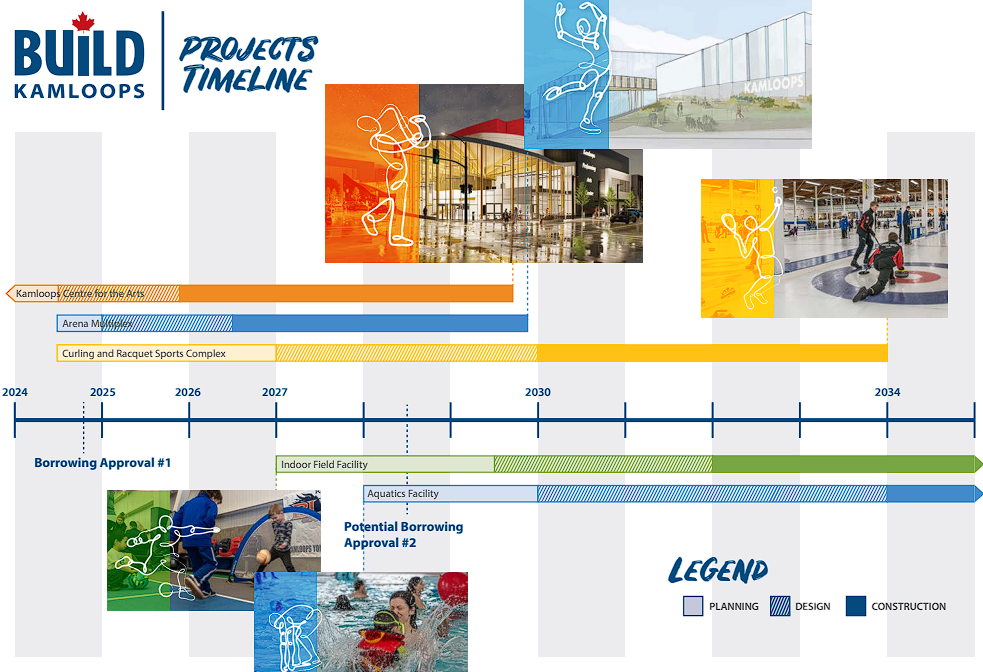
Hallinan said there’s a possibility they won’t be funded through debt at all, and instead through grants or through public-private partnerships.
“I don’t think any of that has been determined or decided at this point, so right now what we’re looking at is we’re in very early preliminary phases of developing concepts,” Hallinan said. “That doesn’t automatically equate to the city borrowing money to build these things.”
Another unknown cost is the upcoming police station, which was last expected to need $150 million in debt. Hallinan said it’s a “wildcard” in projecting the city’s upcoming debt.
It was supposed to be included in the latest, ongoing alternative approval process, but it was struck from the list so staff could re-evaluate the project, and it’s expected the cost will rise after the loan request was delayed several months. Instead the counter-petitions account for $26.75 million in combined debt for an infrastructure project and a civic operations yard expansion.
“We’ve been asked to put that on hold at this point, pending a review of how the next council wishes to engage with the public,” Hallinan said.
The police station is also the only project the city has no choice in building. Kamloops RCMP have said the station was outgrown years ago and they now double its capacity. If left too long, the federal government could impose its construction and send city hall the bill once its done.
“Obviously with what we’ve seen with inflation and our lovely friend to the South who seems hell-bent on taking us up to five-dollars-a-litre of fuel, we’re seeing a lot of cost increases,” Hallinan said. “We’re going to have to re-look at the potential borrow and, if it has changed, what the change is.”
A pair of other projects still not decided on include a $27 million firehall in Dallas, which is expected to be funded through debt, and a new city hall. The latter hasn’t been discussed much on council, but it was briefly considered as part of planning for the new police station last year.
By the end of 2025, the city had around $98 million in debt.
City financial projections only extend to 2031. The extent of city hall debt for all Build Kamloops projects and the police station aren’t yet known, but staff predict debt payments will remain well below the province’s set limit.
BDO auditor Mario Piroddi told council last month that they should expect “a lot of volatility” in the next few years as Build Kamloops projects progress, but he didn’t raise any red flags or suggest city hall was going down a financially dangerous path.
“You have to show you have enough revenue to cover off the debt service, otherwise it won’t be approved,” BDO auditor Mario Piroddi told council last month. “There’s a lot of rigour that happens behind the scenes in reporting to the province, who is monitoring this, and this is why the Municipal Finance Authority is yet to see a default.”
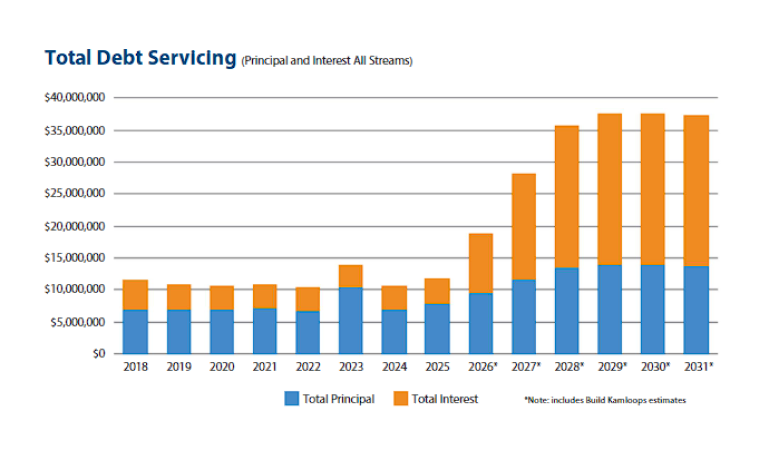
The province sets the limit based at 25 per cent of city hall’s annual revenue. As of 2024, the province’s formula gave Kamloops room to pay up to roughly $62 million toward debt that year, for which city hall spent less than $10 million.
“Based upon where we project to be at 2028 or 2029, we’re going to be at 10 per cent. That’s the highest we’ve probably ever been. Most triple-A credit rating bureaus look to see things at around eight per cent,” Hallinan said. “We know we’re taking a bit of a spike up to accommodate these buildings, but we also know that immediately afterwards, we start to fall back down.”
By 2029, annual debt payments might still be less than $40 million if the $150 million loan for the police station doesn’t change.
News from © iNFOnews.ca, . All rights reserved.
This material may not be published, broadcast, rewritten or redistributed.

This site is protected by reCAPTCHA and the Google Privacy Policy and Terms of Service apply.
Want to share your thoughts, add context, or connect with others in your community?
You must be logged in to post a comment.