Elevate your local knowledge
Sign up for the iNFOnews newsletter today!
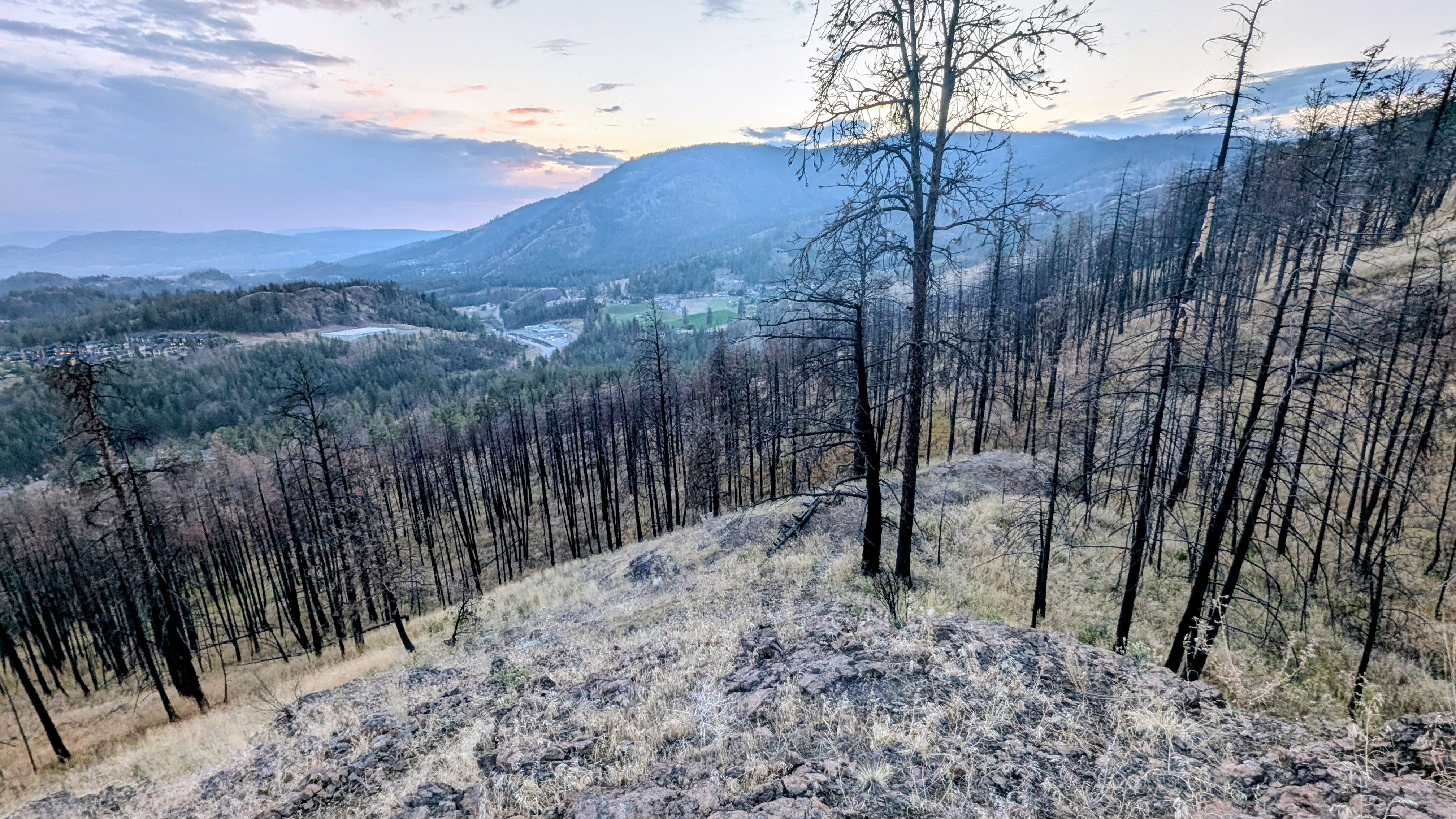
Okanagan residents aren’t strangers to wildfires, some monumental and others small.
With the memory of the 2023 McDougall Creek wildfire still fresh, and the scars still visible in areas like Rose Valley, the area might be safer, but that’s no guarantee it’s safe from fires.
“It’s never that linear to say we had a fire in our community, so we’re not going to have another one,” West Kelowna fire chief Jason Brolund said.
Just outside West Kelowna, a recent wildfire sparked in the grass along Bear Lake Main Forest Road just last week. It was stopped quickly, burning a hectare at the perimeter of the McDougall Creek wildfire.
According to BC Wildfire Service, these areas are less prone to new wildfires. If there are fires, they’re less likely to burn at high-intensity or spread quickly because needles, leaf litter and ladder fuels have been cleared already.
“At a landscape level, large previously burnt areas can help create fuel discontinuity, making it more difficult for large wildfires to spread and grow,” BC Wildfire Service information officer Sarah Budd said.
It’s generally true that these areas are safer from high-intensity blazes like the one that burned dozens of homes three years ago, but Brolund said it’ll never be fire-proof.
“I live right on the interface, I love it because I can be on the trail within ten seconds, but it also means me and my neighbourhood need to learn to live with wildfire,” the fire chief said. “Whether that means being evacuated or needing to do some of the FireSmart things, so it’s a trade-off.”
Brolund emphasized that property owners should adhere to FireSmart principles to reduce the risk on their own homes when wildfires approach, adding that Okanagan residents are highly aware of wildfire risks and evacuation orders and he hopes many have go-bags and plans.
He also advocates for more prevention tactics in the province’s forests.
“We still have some work to do around trying to make that controlled burning process as simple and easy as possible. There’s lots of factors there, including air quality,” Brolund said. “But also, we have a lot to learn still. Right now when they’re done, we have such a narrow window to do them… but we need to get better at them so we can open that window wider.”
Since the McDougall Creek wildfire, Brolund has spoken widely on forest management and climate change, drawing attention to a need to not only adapt to life with wildfires but burn off areas at-risk.
“The only way we’re going to make a meaningful impact in the forest surrounding our community is by using controlled burns. We can clean up forests a hectare at a time, but there are like tens of thousands of hectares that need work done,” he said.
“It really is one of the leading solutions we have right now.”
Surrounding West Kelowna, much of the forests have burned at various times over the last century, and there’s been intentional forest management in areas that haven’t, like Glenrosa and Smith Creek. Those are areas where there could still be a major threat if the right conditions strike.
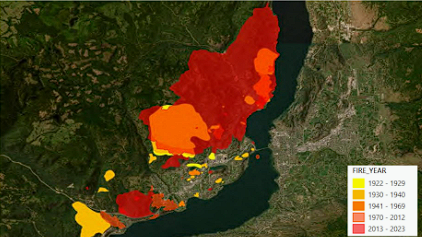
Since 1922, there have been 58 wildfires in the area surrounding West Kelowna, with an average size of 431 hectares and totalling 25,000 hectares. The largest was McDougall Creek, which covered nearly 14,000 hectares. Of those 58 fires, 50 were human-caused.
According to the BC Wildfire Service, even a forest that’s been burnt can still be susceptible.
As years pass, dead wood falls, new growth becomes less fire resistant and previously burnt areas can see wildfires sooner than expected when droughts set in.
“On the flip side, there have also been examples in recent years of lightning strikes in previously burnt areas either not igniting, or briefly igniting, but quickly self-extinguishing due to a lack of available fuel,” the wildfire service’s Budd said.
News from © iNFOnews.ca, . All rights reserved.
This material may not be published, broadcast, rewritten or redistributed.

This site is protected by reCAPTCHA and the Google Privacy Policy and Terms of Service apply.
Want to share your thoughts, add context, or connect with others in your community?
You must be logged in to post a comment.










One response
There are many good points in the article. Thanks for that.
I want to add a few points.
We have seen massive wildfires in the southern interior started by human-caused grass fires intentionally or in error. One of the biggest ones that comes to mind is the Barrier Wildfire, which was caused by a cigarette dropped in dry grass. Another is the Elephant Hill wildfire from Cache Creek north, which was started in the grass in someone’s backyard. Fire smarting would have prevented these fires, perhaps. At least, it would have delayed these types of wildfires.
We know that nature needs the removal of older forests to provide space for their seeds to germinate and create new forests that grow and provide habitats for many species as part of conservation and biodiversity. Nature’s process of ecosystem refreshment usually starts with old trees emitting pheromones to attract the beetles, which kill the trees. The trees dry out, get struck by lightning, and are consumed by the flames fanned by the wind. Nature is chaotic and traumatic in this process.
Forest management offers to do the same service for conservation without the trauma by harvesting older or damaged trees and replanting the areas. The wildfire fuel is removed. Young green trees are generally more fire-resistant. We see that work in many places. Most obvious for those who travel the Coquihalla, where you see the older pine trees attacked by the mountain pine beetle. The trees turned red, and then gray. Many areas were harvested to provide employment and produce forest products. These areas were planted to become a lovely forest habitat.
Strategic forest management with input from First Nations, the Ministry of Forests, and the forest industry reduces wildfire and flooding risk.
People need to support active forest management.