Elevate your local knowledge
Sign up for the iNFOnews newsletter today!
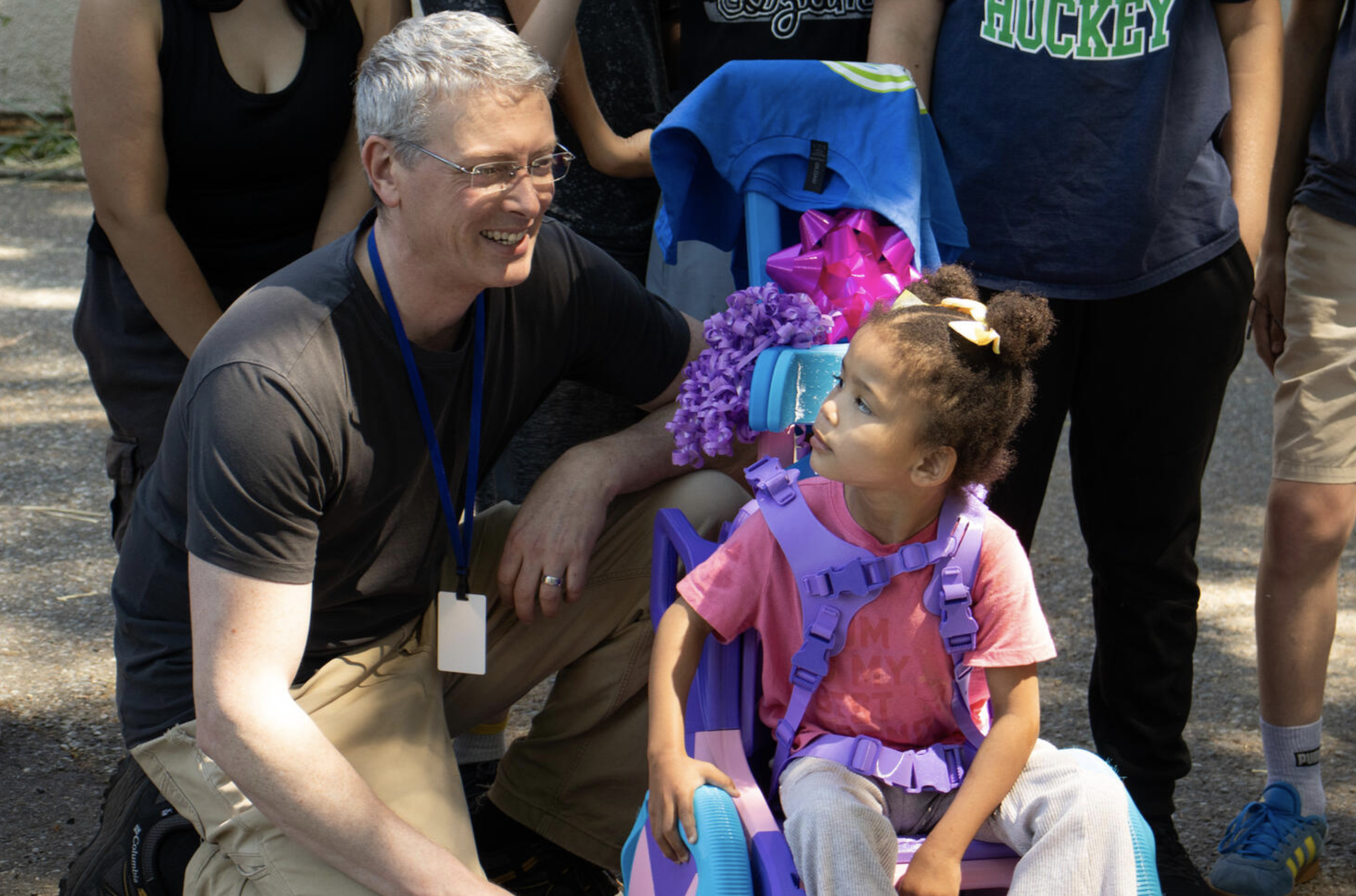
A five-year-old girl in Kelowna with cerebral palsy and epilepsy got a wheelchair mobility device thanks to students in Abbotsford and a new program to connect people with disabilities with people who have 3D printers.
The story begins with kindergartener Prescott who needed a mobility trainer to help her get around. Craig Amendt is a teacher at Abbotsford Virtual School who got student volunteers between grade six and eight to build her that mobility aid.
“I’ve always been interested in 3D printing, that’s why I signed up,” one of the student volunteers Ayvin H. said in a press release. “And I’m inspired to continue to learn.”
The students raised $600 and 3D printed a brightly coloured mobility aid that has a seatbelt, push handle and adjustable footrest.
“Usually there are donors who contribute to the projects,” Amendt said in a press release. “But when there was a gap, it was a great opportunity for students to step up and take initiative.”
Abbotsford Virtual School said Prescott and her family were thrilled with the mobility trainer when the students gave it to her.
This project was part of a larger program growing across B.C. and the world.
It was facilitated by a non-profit based in the U.S. called MakeGood. It designs various 3D printable mobility aids, like grabbers and chairs, and helps connect people who need them with locals who can print them.
The program has 800 makers around the world, 500 chairs delivered and another 400 in progress.
MakeGood’s founder and president Noam Platt said there are already a lot more people in B.C. ready to print more devices like the one given to Prescott.
“We released the design in December, and then we launched this online portal in February. And what the online portal is, it matches volunteer makers with families who need the device,” he told iNFOnews.ca.
There are 42 requests for mobility devices in Canada and 43 makers so Platt said they’re all likely to be fulfilled.
The designs are meant to be easy to print in small, typical household 3D printers and easy to assemble. They can also be printed for around $200 when regular wheelchairs for little kids can go for more than $1,000.
“The design was intentionally made to be very easy, and that allows it to be democratized widely,” he said.
Platt said this is sometimes the only option for families who can’t afford to buy a regular wheelchair or mobility device, especially since kids grow out of them quickly.
“That’s not going to work. They kind of wait until they stop growing,” he said.
The chair is called a mobility trainer because it’s meant to teach kids how to use a wheelchair.
“It’s to start to build muscles and start to build their independence before graduating to a larger wheelchair,” he said.
He said it’s not only satisfying to see someone get something life-changing, it’s also satisfying to solve problems in an affordable and easy way.
“Seeing the kids in the chairs and people using the devices is obviously satisfying,” he said. “I’ve worked on projects for 20 minutes that have changed people’s lives… I don’t think there’s any other field in the world where you can create new inventions in a day, that are kind of cutting edge.”
News from © iNFOnews.ca, . All rights reserved.
This material may not be published, broadcast, rewritten or redistributed.

This site is protected by reCAPTCHA and the Google Privacy Policy and Terms of Service apply.
Want to share your thoughts, add context, or connect with others in your community?
You must be logged in to post a comment.