Elevate your local knowledge
Sign up for the iNFOnews newsletter today!

The criticism of the Kamloops Indian Residential School search for children’s graves has been building for years since Tk’emlups announced their findings, and national publications are now questioning when shovels will hit the dirt, or whether the graves are there at all.
While the First Nation has been quiet about the investigation over the past five years, their work has continued behind the scenes.
At the time of the 2021 announcement that shook the nation, there was no timeline in place. What the band did say, however, was that the suspected graves may never be exhumed at all.
Since the initial flood of news coverage that summer, updates on the investigation have been sparse.
Filling the void of information have been critics and skeptics with fringe blogs claiming Tk’emlups te Secwepemc merely found septic lines. Critical, right-wing publications have called the findings a “hoax” to get federal funding, a message echoed by populist politicians like MLA Dallas Brodie, or have given air to the septic lines theory.
Last week, the Globe and Mail‘s editorial board called coverage of the suspected graves a “failure of journalism,” pointing to the fallout of the announcement and a lack of archaeological verification at the Indian residential school, sparking renewed coverage of the findings five years on.
Kukpi7 (Chief) Rosanne Casimir has shied away from news media since the announcement, outright denying any interviews after the First Nation’s update in February, work appears to be ongoing in the investigation into Le Estcwicwey (the missing).
There’s a chance suspected graves of the students could be exhumed next year.
Jeanette Jules, a former band councillor and Le Estcwicwey manager, has detailed how the First Nation is preparing to collect DNA samples from potential family members and exhume the graves, so long as there is consent from the dozens of First Nations it will consult.
“I knew the testing part was going to take a while. People think it’s like CSI or FBI, but it is not that,” she told a National Centre for Truth and Reconciliation panel last year.
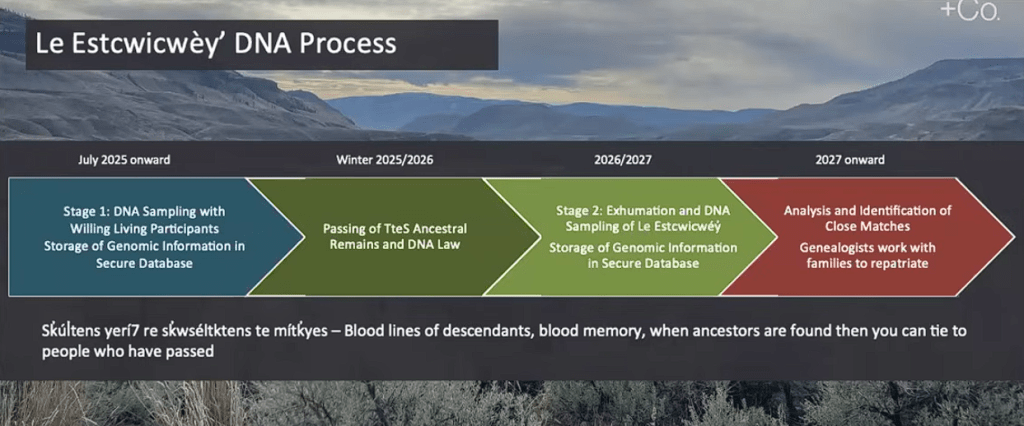
A video of the seminar was posted to its YouTube page, in which Jules detailed the legal and technical hurdles behind DNA collection and analysis. She said there were people lining up from the beginning to provide their DNA to help the search, but the First Nation needed time to prepare, which involved lengthy consultation with lawyers.
According to the Globe and Mail, Jules didn’t know the video was going to be made public.
iNFOnews.ca reached out to Casimir for an update on the investigation, but her office did not respond.
When Tk’emlups announced findings in May 2021, they were simultaneously deemed “preliminary” results of ground-penetrating radar work and a confirmation of what the community had known.
The Band was careful about its messaging at the time. Casimir was largely focused on the impacts of the discovery on the Tk’emlups community and survivors from elsewhere, while reporters tread carefully when questioning her during early news conferences.
It was also in those early days that Casimir pointed out that despite the phrasing in a New York Times headline, the findings were not a “mass grave”. They were individual graves and there were believed to be 215 of them.
The news set off a wave of national and international coverage, revisiting the sordid history of Canada’s Indian residential school system, where thousands were forced to attend and more than 3,000 children are known to have died, most of the time due to disease in the unsanitary buildings.
Later than summer, the archaeologist who led the investigation spoke at a hotel conference room in Kamloops. Sarah Beaulieu told the crowd the “anomalies” were suspected graves, but the ground-penetrating radar process was commonly used for similar searches across the world.
Since then, it was always known the science behind the graves hasn’t been conclusive and it would require exhumation to confirm precisely what’s there. Beaulieu’s comments had also reduced the count to 200 suspected graves.
In the years that followed, the First Nation has received millions in government funding, some used to build a “healing house” to support elders, survivors and their families. Other funding has likely been used for the extensive legal and archival research done in the background, along with the additional radar work at the site.
There has also been increasing pressure on the First Nation to dig the site from populists and, in 2023, from people who showed up at the site with shovels to do it themselves. Fringe and critical publications have increasingly called the findings a “hoax” as the years pass without a conclusion to the investigation.
A wave of so-called denialism as been decried by First Nations and from officials in Ottawa. Until last week, Parliament considered making the denial or downplaying of the Indian residential school system as a criminal offence.
Meanwhile, it appears Canadians do want conclusive answers on what was discovered beneath the soil at the Kamloops Indian Residential School. A poll last year suggests majority of Canadians want the graves to be exhumed. There was also agreement among two-thirds of Canadians that the Indian residential school system was a form of cultural genocide.
News from © iNFOnews.ca, . All rights reserved.
This material may not be published, broadcast, rewritten or redistributed.

This site is protected by reCAPTCHA and the Google Privacy Policy and Terms of Service apply.
Want to share your thoughts, add context, or connect with others in your community?
You must be logged in to post a comment.