Elevate your local knowledge
Sign up for the iNFOnews newsletter today!
Elevate your local knowledge
Sign up for the iNFOnews newsletter today!
Select Region
Selecting your primary region ensures you get the stories that matter to you first.
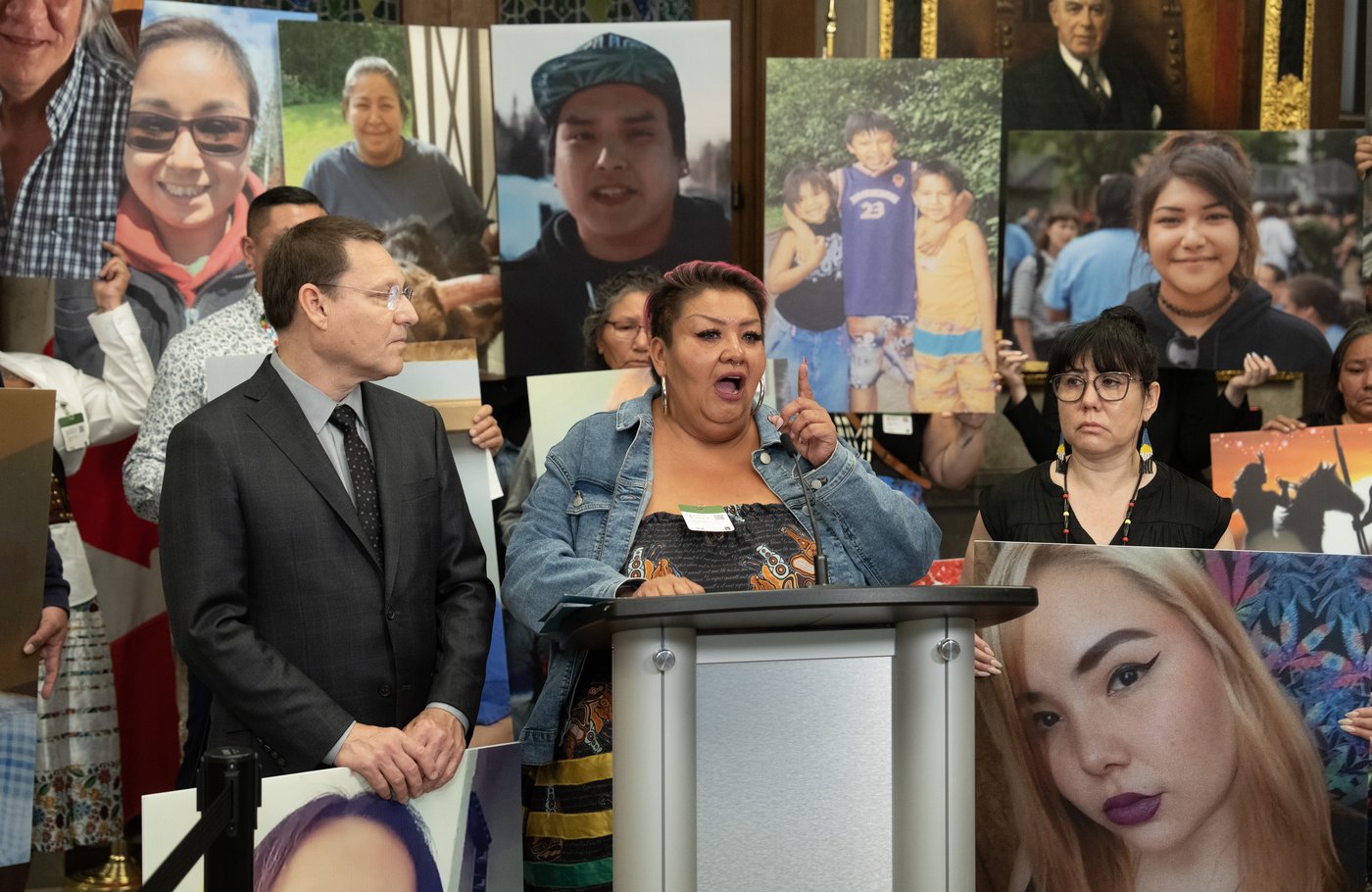
OTTAWA — A Grassy Narrows First Nation woman who suffers from mercury poisoning is insisting that Prime Minister Mark Carney apologize for saying he could “outlast” her during a March protest.
At a press conference on Parliament Hill on Thursday, Chrissy Isaacs stood with Grassy Narrows Chief Sherry Ackabee, NDP Leader Avi Lewis and a large delegation of community members carrying photos of their deceased loved ones to demand both an apology and the termination of the paper mill Isaacs said is still poisoning her people.
The Dryden Paper Mill released thousands of kilograms of mercury into the community’s river system in northwestern Ontario from the 1960s to 1970s. Community members are still dealing with the fallout today.
“When Mark Carney said that he can outlast me, well, I’m here,” Isaacs said.
“You need to apologize to my people. And you need to clean the river, shut down that mill and compensate our people because our lives matter. We were robbed of a good life.”
Isaacs and a group of community members attended a news conference Carney held in Toronto in late March with Ontario Premier Doug Ford to announce new funding for housing. She and the other protesters could be heard chanting and shouting in the background about the mercury contamination.
“I can outlast her,” Carney told the news conference, laughing briefly along with Ford and Toronto Mayor Olivia Chow.
The Prime Minister’s Office said in a media statement at the time that the prime minister could not hear what the demonstrators were saying and that members of his staff spoke to them afterward to hear their concerns.
It’s not clear if Carney knew why the protesters were there when he made the remark.
Isaacs said she still doesn’t buy the explanation offered by the Prime Minister’s Office.
Indigenous Services Minister Mandy Gull-Masty stopped to talk to the Grassy Narrows delegation on her way into the House of Commons after their press conference wrapped.
She pulled Chief Ackabee aside for a conversation in the House of Commons lobby. Isaacs later said the minister asked for a meeting with her, but she declined the invitation.
“She doesn’t have any power to shut down the mill, she doesn’t have any power to clean the river, she doesn’t have any power to compensate our people,” Isaacs told The Canadian Press.
“My whole purpose of this trip was to come here and invite Mark Carney to come and talk to me. That’s who I came here for.”
Carney was in Vancouver Thursday, where he was set to attend the FIFA World Cup game between Canada and Qatar.
In an April letter to Carney, Moderator of the United Church of Canada Kimberly Heath said the prime minister’s words were “hurtful.”
“An apology from you, delivered in person in Grassy Narrows, would be an important step toward accountability and respect — a step toward right relations,” Heath wrote.
“Regardless of the intention, your ‘joke,’ and the laughter it elicited from other political leaders were hurtful to a community that has been ignored by prime ministers for decades.”
In response, the Prime Minister’s Office said again that Carney was not aware of the nature of the demonstration.
“That said, I want to emphasize the prime minister’s deep respect for the fundamental right to peaceful protest,” wrote PMO spokesperson Jean-Luc Marion.
“In response to the situation, we engaged immediately with Grassy Narrows representatives who spoke outside the event.”
Grassy Narrows is located 150 kilometres from Dryden, Ont., close to the Ontario-Manitoba border. Wabaseemoong Independent Nation is also nearby.
The mill is upstream from the Grassy Narrows First Nation, a community of fewer than 1,000 people.
The community’s water was contaminated when the mill dumped 9,000 kilograms of mercury into the English-Wabigoon River system in the 1960s. The mill stopped using mercury in its industrial process in the 1970s, but mercury levels downstream from the plant haven’t decreased significantly since the 1980s.
One study estimated that 90 per cent of the Grassy Narrows population suffers from some degree of mercury poisoning. The heavy metal can be passed from mothers to babies they carry, making it a problem that spans generations.
A 2024 study from Western University found emissions from the mill, including sulphate, continue to wreak havoc on the community by generating methylmercury.
The report found levels of methylmercury — the most toxic form of mercury — in the Wabigoon River’s fish may be twice as high as they would have been without the mill discharge.
Mercury poisoning can cause neurotoxicity and damage human nervous systems, causing premature deaths. Children and babies are most at risk.
“We’ve tried to ask Carney to come to Grassy. He hasn’t even come. So we come here and we bring our people,” Ackabee said.
“Our people need to be respected and listened to and not pushed around person to person. The government should shut down the mill because it’s taking our children.”
This report by The Canadian Press was first published June 18, 2026.
News from © The Canadian Press, . All rights reserved.
This material may not be published, broadcast, rewritten or redistributed.

This site is protected by reCAPTCHA and the Google Privacy Policy and Terms of Service apply.
Want to share your thoughts, add context, or connect with others in your community?
You must be logged in to post a comment.