

Not the daily grind: Okanagan seeing new wave of craft coffee roasters

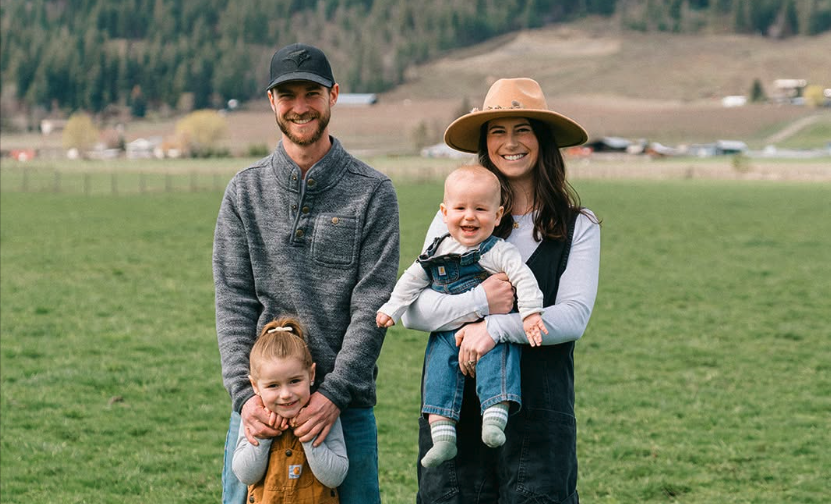
When Jenna Martin tasted the coffee her father brought back from his regular trips to Colombia, she always wished she could get such a tasty cup here.
Having lost their jobs during the pandemic and moved from Vancouver to her parents’ farm in Armstrong, her husband, Tyson, bought a small coffee roaster and started experimenting.
It could only roast half a pound of beans at a time, but their barn-roasted coffee tasted good, and got good feedback from family and friends. There was a logical next step.
“We just decided, well, I’m supposed to go back to work after having our second baby, why not just create a business?” Jenna told iNFOnews.ca.
In May 2025, they launched the Barn to Bean Coffee Co.
They’re one of a wealth of small-scale roasters in the Okanagan and across the Southern Interior, and part of a budding new industry which has seen a lot of independent coffee roasters spring up in recent years.
Jenna says there was lots of trial and error to get them where they are, and they spent months experimenting. They drank “a lot of coffee,” tweaking their different roasts, until they decided on the final product.
The company now has 10 different roasts of beans and sells at the Enderby and Armstrong farmers’ markets, through its online store, at several local grocery stores and at a few cafes.
The small-scale business is one of several in the North Okanagan. Down the road from Barn to Bean, and also run from the family farm, is Purple Springs Coffee Company, which opened in 2021. Roaster Las Margaritas Coffee is also in Armstrong, and further south in Vernon Khaos Coffee and Multiply Coffee, are two roasters that opened up in the last five or so years.
Kelowna is also home to a bunch of small new independent roasters. Anarchy Coffee, Bright Jenny, Torréfacteur Neon and Craft 42 Roasters, to name a few.
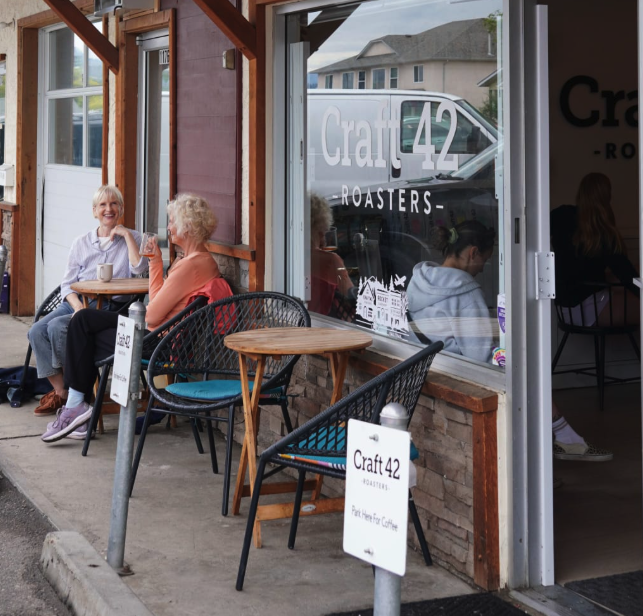
Taylor MacInnis and her partner, Aaron Moore, started Craft 42 Roasters at the beginning of 2023 and have quickly grown out of their 480 square feet space and are opening a new place on Leckie Road. The new tasting room is about five times the size of the current place on High Road, next to the rail trail, and there’s a patio for 30.
“Business is going very, very well,” Moore said. “We could not have expected the growth that we’ve had.”
While the number of small independent craft coffee roasters has skyrocketed in recent years, Moore says there’s plenty of room for more.
“I don’t think it’s even remotely close to saturated, just because there are way too many Starbucks, Tim Hortons around, and that they’re still the lion’s share of the coffee market,” Moore said.
The Craft 42 owner said roasters are supportive of each other, and he’s even sold other roasters’ coffee at his business.
“What you’re actually trying to do is educate people and pull market share from commodity coffee,” he said.
While there’s an array of newcomers, not all small independent coffee roasters are new start-ups.
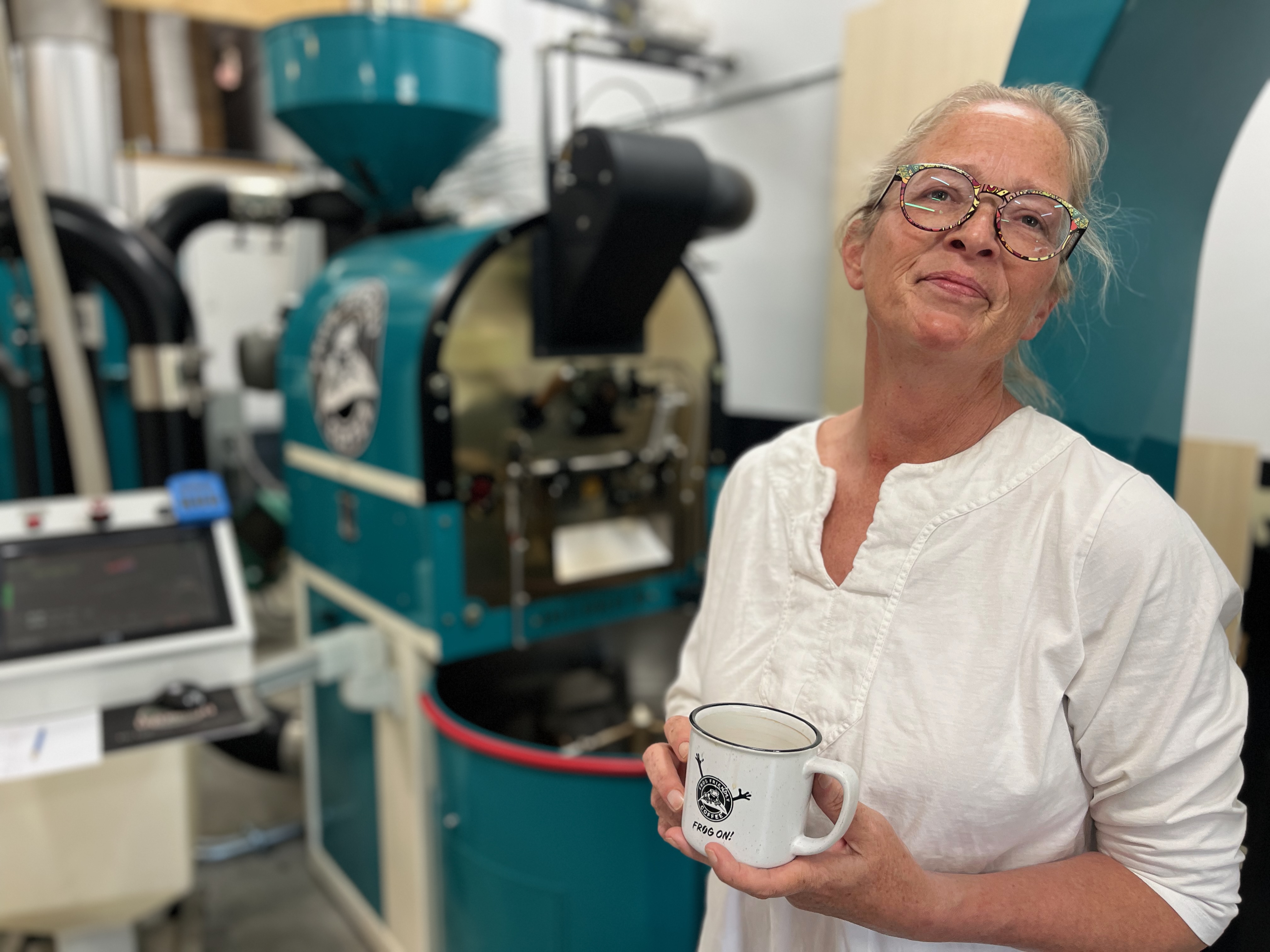
Enderby-based roaster, Karla Ferster, launched Frog Friendly Coffee 20 years ago.
Having spent a large amount of time in Mexico throughout her life, she teamed up with a local and began harvesting beans from Oaxaca and importing them into Canada.
In the early days, she would pay other roasters to roast the beans for them, before packaging the beans themselves and selling them.
At the time, craft coffee was becoming more popular and other craft companies like Salt Spring and Kicking Horse had been leading the way and becoming well established.
Her company partnered with Vernon firm, Canterbury Coffee, which roasted their beans before the product was packed in Frog Friendly Coffee packaging.
Crucial to the arrangement was that it meant Frog Friendly Coffee had access to the wealth of Canterbury coffee’s customers.
Learning how to roast good coffee is just one aspect, getting it to market is another. Having your foot in the door with a big distributor is a way to get your product into lots of different places.
“But you’re playing in a corporate world where you really have to fight for your margin… and I’m not corporate. And that’s where we started to shift away from (big distributors) into specialty groceries,” Ferster said. “We’re not just a box. We’re not just a nondescript product. We’re a values-driven coffee. I really believe that coffee has substance. And it’s an entire supply chain that we have a responsibility to.”
Her supply chain is small, with all the company’s coffee being harvested from wild coffee trees from the same area of Mexico. The term coffee companies use is “single source.”
Large coffee companies get their beans from multiple sources around the world, often from large sun-exposed plantations. To create the same consistent taste, they have to over-roast, she said.
“When you taste that sort of caramel chocolate in coffee, that’s not coffee. That’s carbon… it’s like brewing the shavings off your barbecue,” she jokes.
“Roasting is an absolute craft, you can’t just buy a coffee roaster and be a good roaster,” she said. “It is a true skill that not everybody has.”
Luckily, she said, her husband, Frank, has it.
For almost a decade, they ran their roaster from Canoe, before moving the roasting business to Enderby and in 2024, opening Enderbeans cafe next door.
She says you’ll now find Frog Friendly Coffee in about 90% of independent supermarkets in BC, and only in independent supermarkets.
Karla estimates they roast about 100,000 lb. of coffee beans a year.
“We’re very comfortable with our size now,” she said. “We’re just getting bolder and bolder and doing it our way and enjoying what we do.”
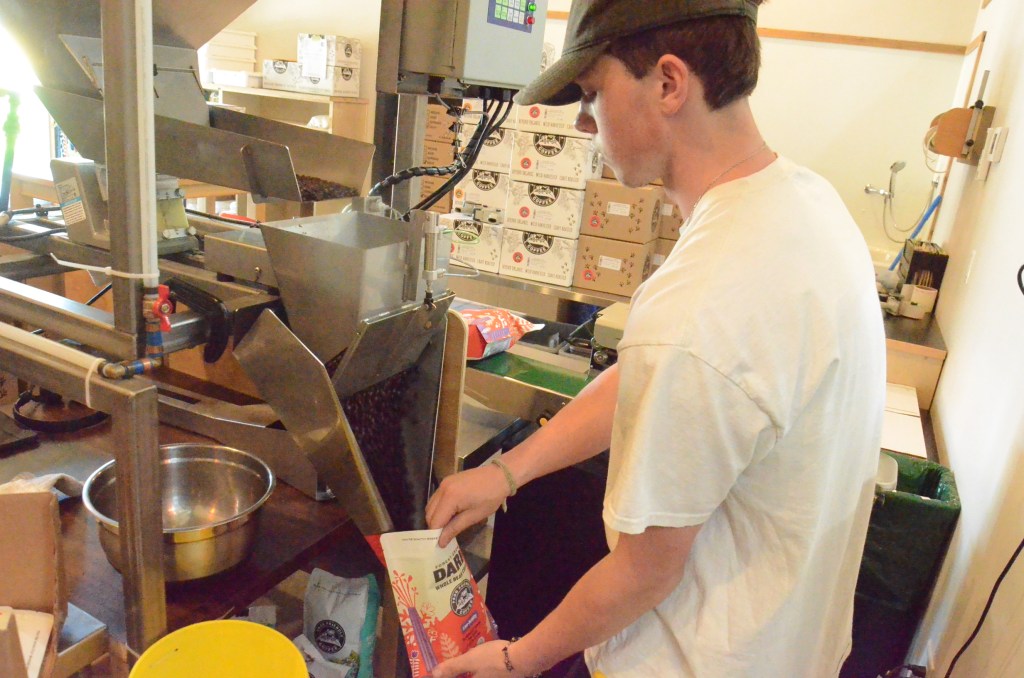
Her husband Frank roasts the beans, and their teenage son, Cohen, packs the final product into bags.
The Roast
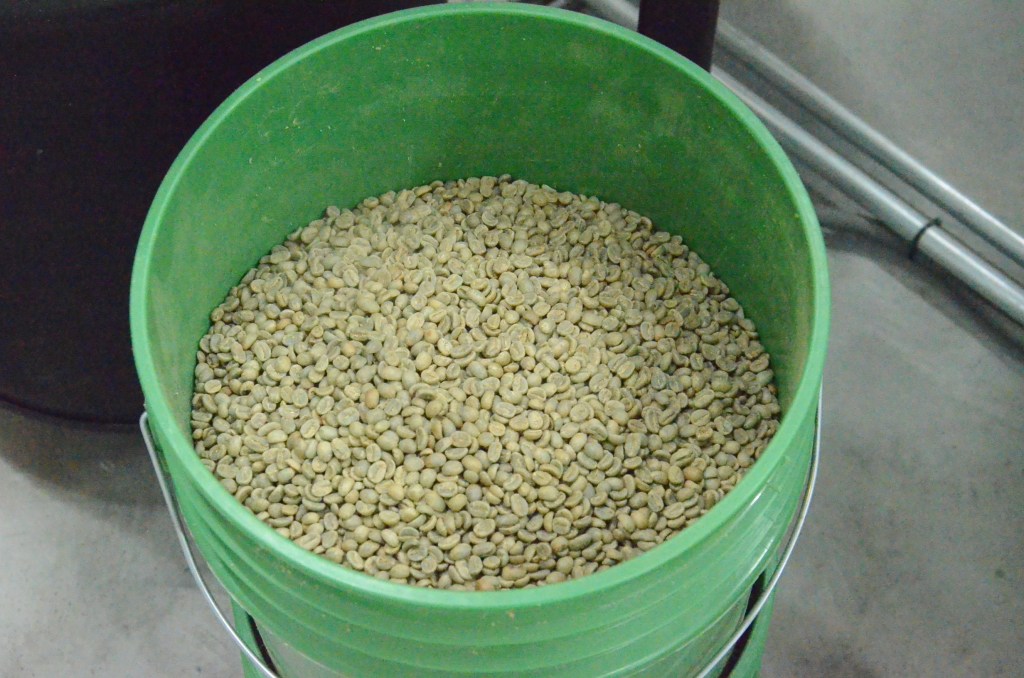
A coffee bean is the stone of a cherry, and once it’s been through several processes to extract the bean, it’s shipped raw to roasters.
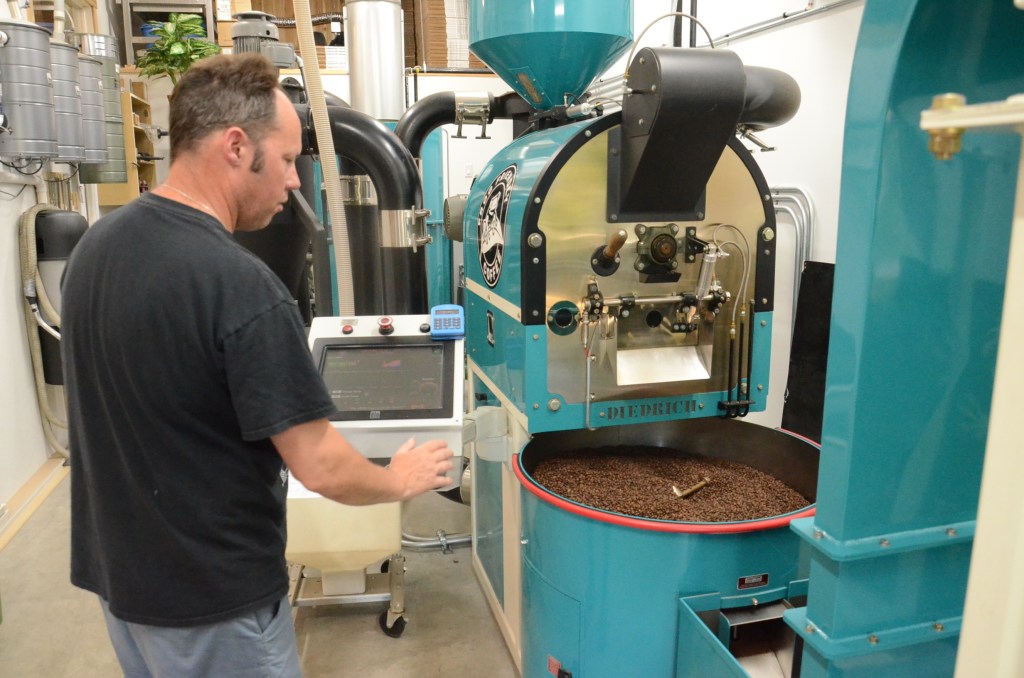
The green beans are poured into a roaster, which has paddles, much like a cement mixer.
Frank says you actually have very little control.
“You have air, and you have time,” Frank said.
Different temperatures and different lengths of time control what type of roast a bean has.
“You could do different combinations of each. You could do a short, fast roast that gets to the same spot… Or you could do a long, slow one to get to that same spot,” Frank said. “It depends on how you want to get there.”
Frank said with each new shipment of beans, there’s a trial-and-error process, because even with beans from the same trees, there are differences.
“Depends on how much rainfall they had, depends on the fermenting process, there’s a lot of variables,” he said.
There’s also a lot of fine-tuning, and getting it right comes with years of experience.
Frank will taste the coffee when it’s hot and as it cools. Then play around with the roaster until it’s right. It’s not like wine, and he doesn’t spit it out, instead he gets jittery.
“On those days you just expect you’re going to stay up late, it’s going to be a rough week,” he said. “But you’ve got to do it, you’ve got to nail the profiles.”
It’s clear, Frank, and the other roasters are passionate about the product they create.
How much coffee do Canadians drink?
According to the Coffee Association of Canada in 2024, 74% of Canadian drank coffee every day making it the most popular drink in Canada. Second place goes to tap water at 71%.
Statistics Canada showed that in June 2024 alone, the country imported 20.5-million kilograms of coffee. Canadians come about 10th in the world in coffee consumption, depending on whose stats you look at. Northern European countries top the list.
Another longstanding coffee roaster is Colin Burton, who bought the Kelowna-based company Pioneer Gourmet Coffee from a fourth-generation coffee roaster, Luigi Cicchelli, 20 years ago.
Burton applauds the new wave of roasters, but says it’s a tough business.
After buying the company, they spent thousands of hours in grocery stores giving samples away to get people to know their brand.
“That’s every Saturday and Sunday for years and years,” Burton said. “To break in something new is really hard because, like most people, we’re creatures of habit, and we’re used to buying the same brand.”
He said breaking into the grocery store market is extremely difficult, and even once in, if your brand doesn’t sell, it’s taken off the shelf and won’t come back.
After years of hard work, Pioneer Gourmet Coffee is in about 150 grocery stores across the province.
“The stores tell us we’re the number one selling local coffee in the Okanagan,” Burton said.
Even after being established for two decades, the business still has its challenges.
“I’ve just spent a year just changing my packaging… because our packaging became outdated,” Burton said. It cost the company $25,000.
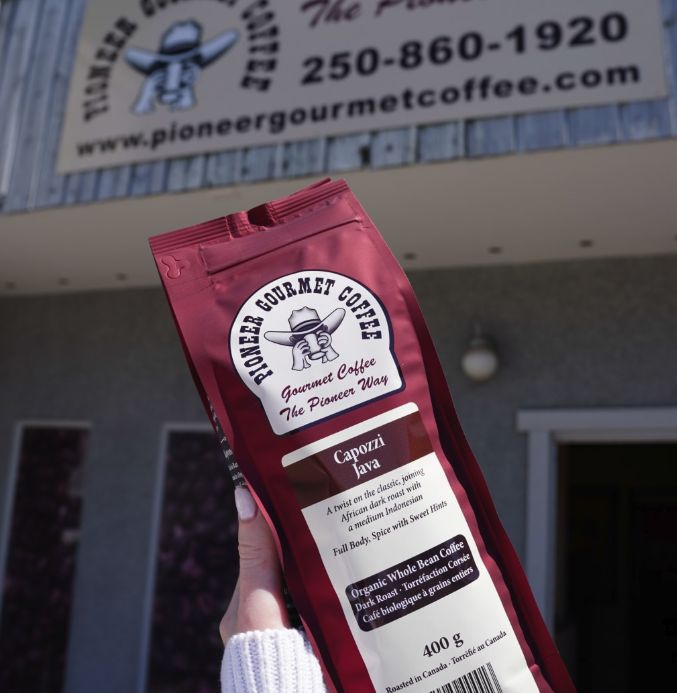
INSTAGRAM/Pioneer Gourmet Coffee
And then there’s the soaring price of coffee.
“It’s gone up 350% in the last 10 years,” Burton said.
In 2010, a pound of green beans cost $2.40. Roasting beans loses 20% of their volume as water evaporates, so a pound of roasted beans works out to be $3.
He’d then sell it to the supermarket for $8.50 who at a 50% mark-up would sell a pound for $12.99.
Nowadays a pound of green beans costs $8. After roasting, it’s $9.60, and by the time it gets to a grocery store shelf, it’s $22 a pound.
“People want to support local, they want to support fresh. But… do you really want to spend $25 on a bag of coffee?” he said.
The coffee industry reacted with shrinkflation. Burton’s bags are now 400 grams, an 11.5% reduction.
Barn to Bean sells half-pound bags, and Anarchy coffee and Craft 42 have, like many others, gone to 12-ounce (340 gram) bags.
Most craft roasters begin life selling at farmers’ markets, and some, like Bright Jenny, move on to open cafes. Burton said it’s a good way to get your brand known, but he doesn’t envy the overheads that go with it.
“Most of these roasters… do a pretty good job with the coffee,” he said. “(But) can they market it properly?”
For Karla in Enderby, she wishes the new wave of roasters the best of luck.
“I always see small roasters celebrating getting on the grocery shelf. But it’s not getting on the grocery shelf. It’s customers buying your bag over and over again,” she said. “They have to connect with it… and that’s a challenge.
“It has to be a hug in a cup.”
News from © iNFOnews.ca, . All rights reserved.
This material may not be published, broadcast, rewritten or redistributed.

Join the Conversation!
Want to share your thoughts, add context, or connect with others in your community?
You must be logged in to post a comment.