
Wildfire destruction mounts in B.C. Interior, structures lost on 120 more properties

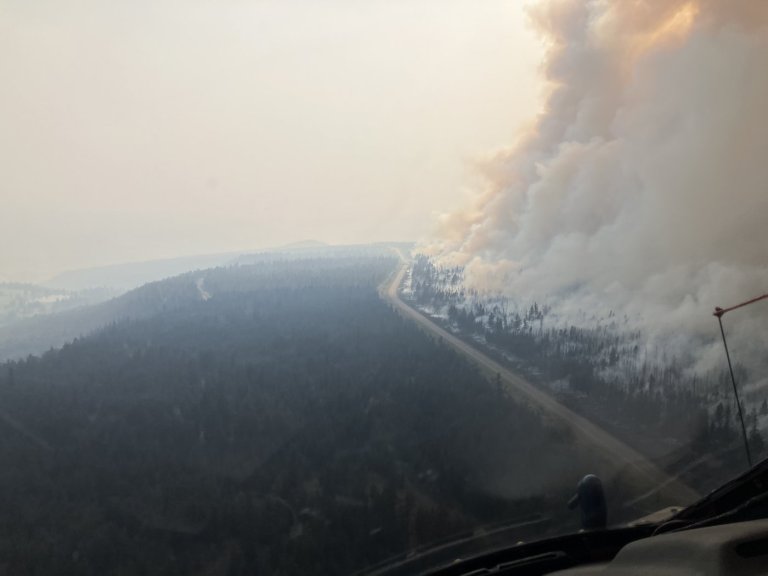
VERNON — Wildfire destruction in British Columbia’s Interior continued to mount on Wednesday, with authorities outside Clinton confirming structures had been lost on about 120 properties, while more tales of devastation emerged from near Okanagan Lake, where 230 homes were razed over the weekend.
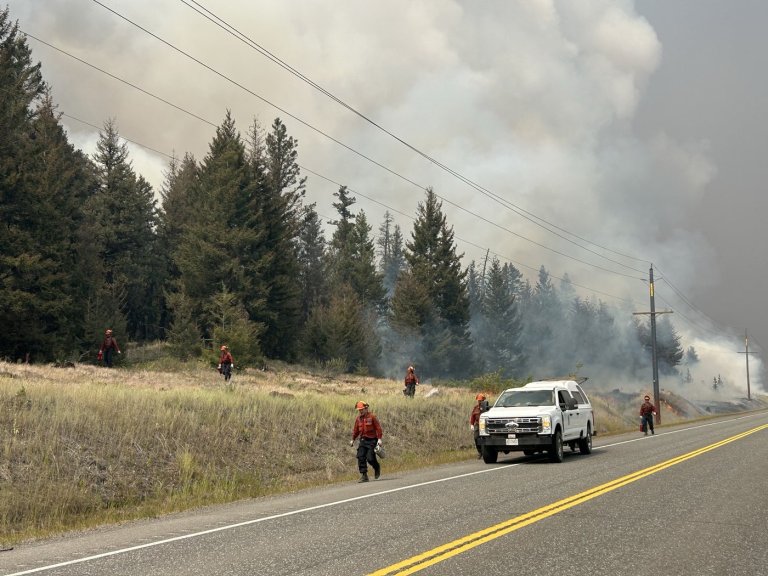
Colton Davies, an information officer with the Thompson-Nicola Regional District, said some properties have lost multiple structures due to the massive Pear Lake fire that forced the evacuation of Clinton and surrounding areas on July 24.
Davies said about 1,500 properties in the district remained under evacuation order due to the fire.
“The impact has been very significant from this fire in the rural TNRD areas and tragic, certainly, for a lot of people who have suffered losses,” he said.
He said the district was still working to determine the exact number of buildings destroyed, while the village’s Mayor Roland Stanke said last week that damage in his municipality was still being tallied.
Other developments in B.C.’s wildfire battle included a firefighting helicopter crashing into a lake near Clinton on Tuesday — with the BC Wildfire Service saying the pilot suffered minor injuries — while weeks-long evacuation orders came down in and around Boston Bar in the Fraser Canyon on Wednesday.
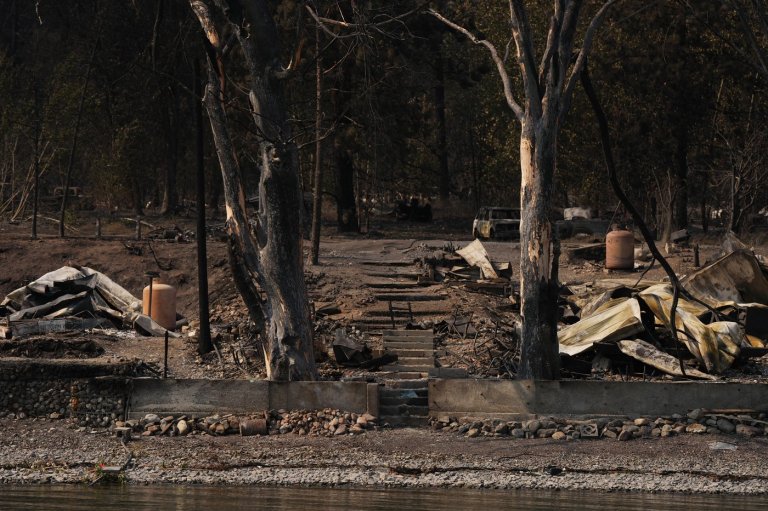
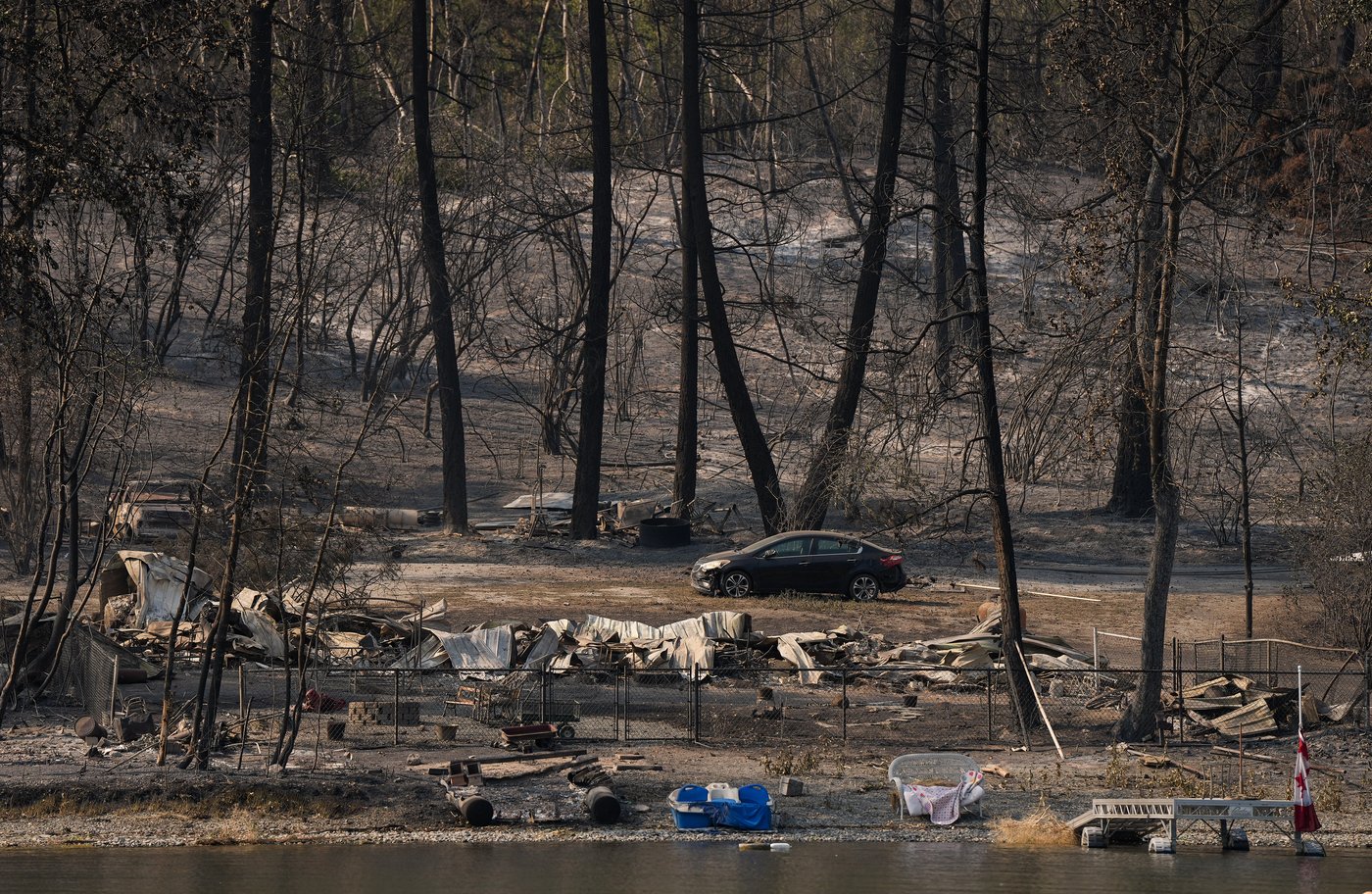
The province’s other major losses are about 300 kilometres southeast of Clinton, where the chief of the Okanagan Indian Band said about 30 homes of band members and 200 non-band homes on its reserve were destroyed by the Bradley Creek blaze that roared through the area near Vernon on Saturday.
Among the losses were rows of trailer homes on reserve land off Westside Road, on the shore of Okanagan Lake.
Gord Bowers likened the area to a war zone when he and neighbours fled on the weekend.
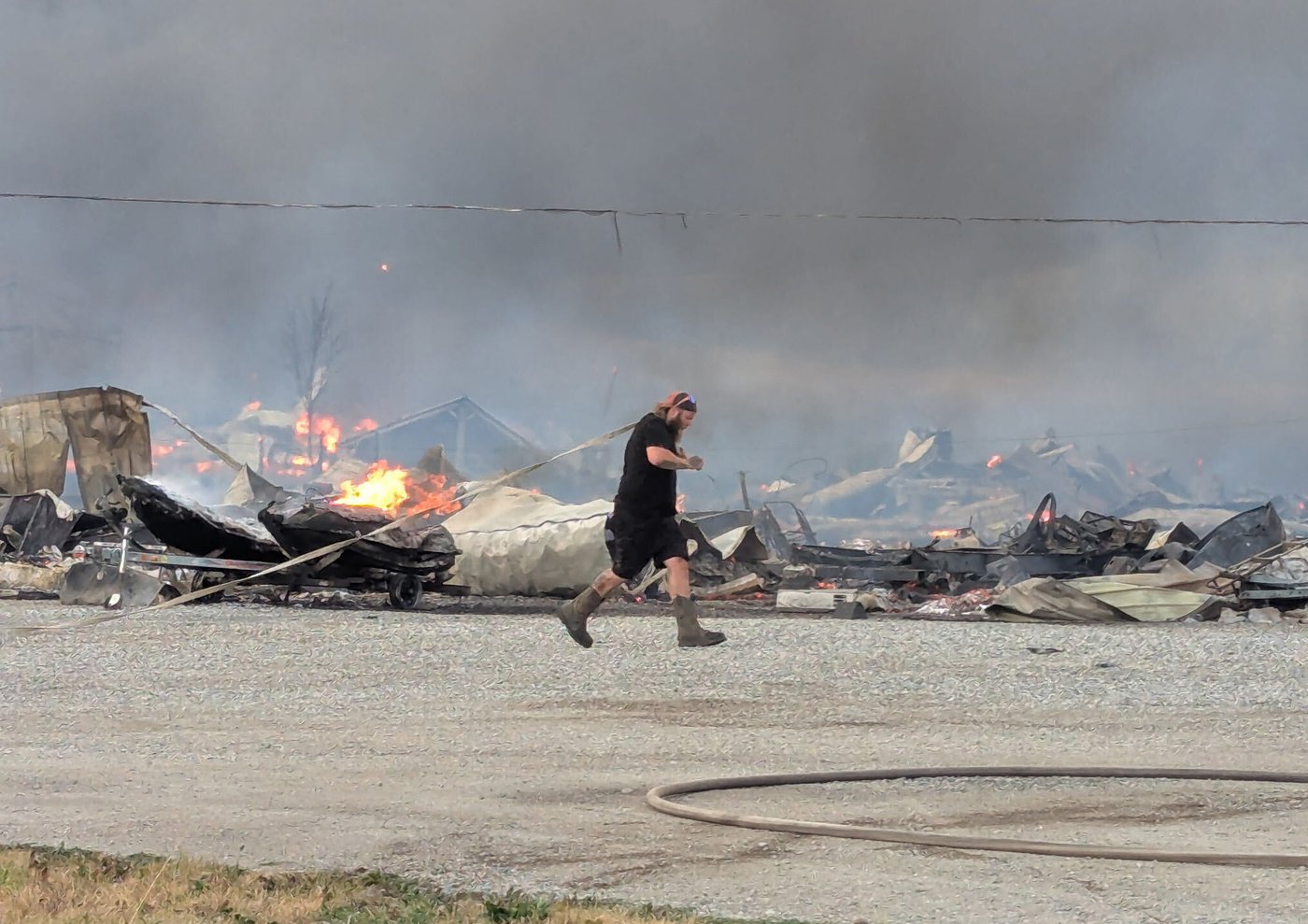
He said his home survived the fire, but the nearby trailer park with 20 seasonally-occupied trailers was completely lost. He shared a photo showing one of his neighbours trying to fight the flames as the trailers burned behind him
“There were 20 trailers along that row there … They all went up, they’re all burnt right to the ground,” he said.
Bowers, whose home north of Komasket Park was previously evacuated due to wildfire in 2021, is staying in a Vernon hotel with his wife and dog as they wait on word when they may be able to return.
He said it would be “hopeful” to think of going back in the next two weeks or so but they were out for a month last time.
“But I’m not optimistic on it because of the amount of damage that there is out there. I can only describe it as a war zone, to be honest with you,” he said.
The fire that razed Okanagan Lake-front properties to their foundations was still burning out of control on Wednesday, although the wildfire service said there was no significant growth on the blaze overnight.
The residents who escaped from that blaze are among about 8,000 people who Emergency Management Minister Kelly Greene said Tuesday had been forced from their homes across B.C. due to wildfires.
Much of Metro Vancouver is meanwhile shrouded in “high-risk” wildfire smoke from the fires that span much of the province’s south.
The smoke that is rated nine on the 10-level air-quality health index used by Environment Canada has enveloped areas north of the Fraser River, including Vancouver, Burnaby, the North Shore, Coquitlam and Maple Ridge, as well as the eastern Fraser Valley.
That rating means everyone should consider reducing or rescheduling strenuous outdoor activities, while people at risk should do so immediately.
Officials are also warning of the potential for more fires from dry lightning storms.
Cliff Chapman with the BC Wildfire Service said temperatures were expected to increase to the mid-30s with dry lightning forecast for Thursday, which could lead to fire starts across the southern Interior where most of B.C.’s estimated 115 wildfires are burning.
Chapman said the service had helicopters and fixed-wing planes ready to tackle new starts in what looked to be another challenging week for B.C. fire crews.
Davies, with the Thompson-Nicola Regional District, said there was “obviously concern” about the province entering another stretch of warm and dry weather that would potentially feed the flames.
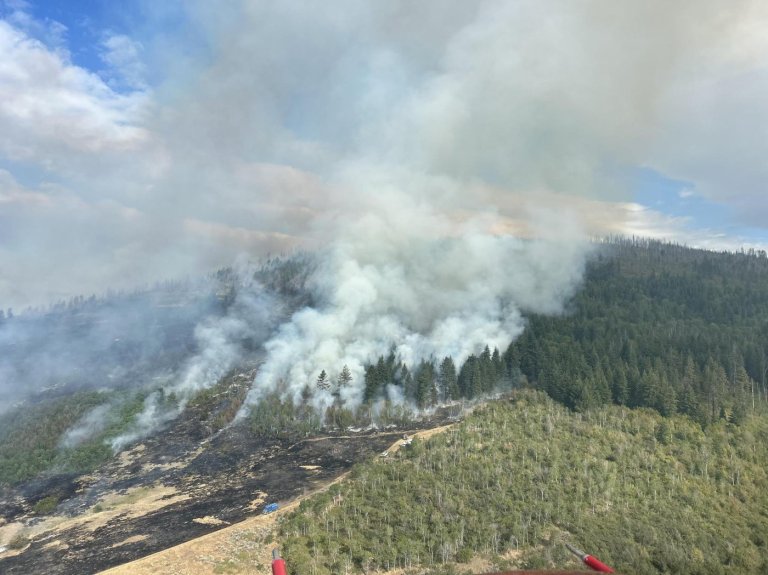
The Pear Lake fire was measured at about 1,250 square kilometres, and the BC Wildfire Service said it showed “extreme fire behaviour and significant growth” on Tuesday as it moved south and west.
“We’re kind of in a holding pattern … with this immediate weather forecast and hoping for the best,” Davies said. “(We) want people to be able to go home as soon as it’s safe, too.
“It’s obviously an extremely challenging time for everyone who’s directly impacted. And we’re doing our best to support people as well as we can and meet them where they are.”
There are currently six wildfires of note in the province, all burning near communities in the southern Interior.
While some are still counting the cost of wildfires, residents in and around Boston Bar in the Fraser Canyon were told Wednesday they can go home, more than a month after being chased out by separates blazes.
The Fraser Valley Regional District said in a statement that residents of North Bend, Canyon Alpine, Fishblue Lake, Nahatlatch, North Boothroyd, Boston Bar and Scuzzy Creek still needed to be ready to leave if the fires flare again.
The first evacuation order was issued July 4 and at the peak, about 460 people were evacuated.
This report by The Canadian Press was first published Aug. 5, 2026.
— With files by Chuck Chiang and Nono Shen in Vancouver
News from © The Canadian Press, . All rights reserved.
This material may not be published, broadcast, rewritten or redistributed.

Join the Conversation!
Want to share your thoughts, add context, or connect with others in your community?
You must be logged in to post a comment.