Elevate your local knowledge
Sign up for the iNFOnews newsletter today!
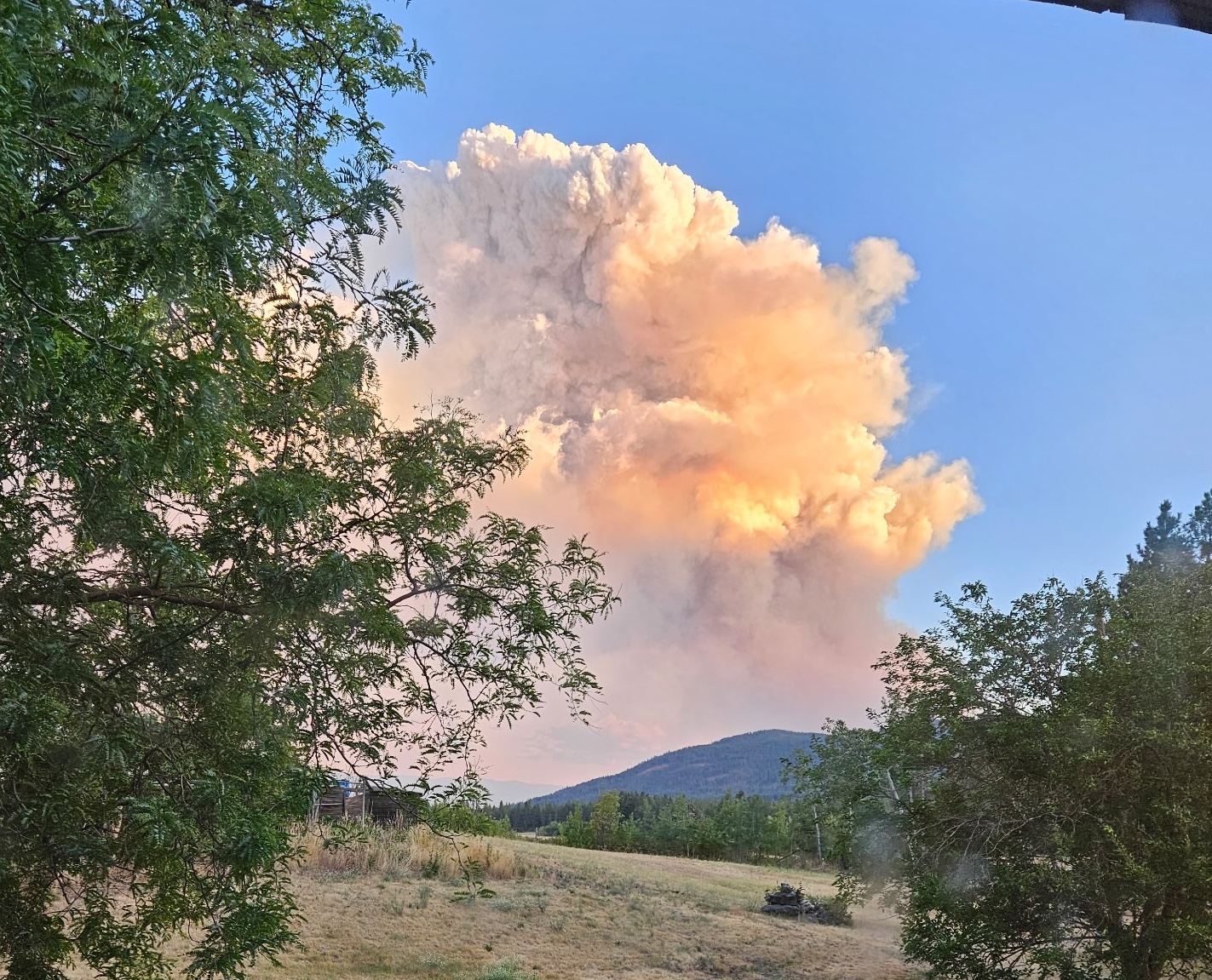
At the peak of wildfire season this year social media was awash with conspiracy theories about arsonists, which while seeming ridiculous have been touted by people who should know better.
Last week, while posting about a meeting with European diplomats in Ottawa, Vernon-Lake Country-Monashee Conservative MP Scott Anderson mused about who was behind the rash of arsons that caused wildfire in Canada.
“I’ve often wondered who is behind the rash of arsons launching wildfires right here in Canada,” Anderson said in a social media post.
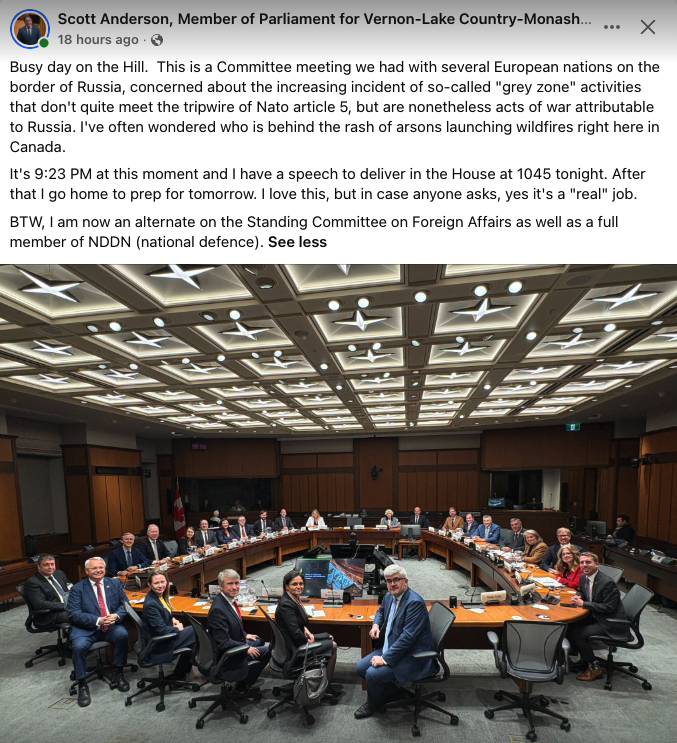
Anderson later told iNFOnews.ca he had “no explicit evidence” of a scheme to light wildfires in Canada.
While a cabal of foreigners paying Canadian criminals to start fires is an eye-catching narrative, the reality of those charged and convicted of arson in recent years is far different.
Substance use, mental illness and homelessness are generally strong factors.
Kelowna arsonist Robert Teal was seriously mentally ill when he set fires on Knox Mountain last fall. He struggled with homelessness and drug addiction and had little grasp of reality at the time he set the fires.
Currently still in custody, Andrew Dent was arrested in August and charged with arson in relation to a fire on Knox Mountain this summer. The court is currently waiting for a psychological evaluation.
In Vernon, 35-year-old Jaylyn Raie Smith was arrested and charged with arson for setting fire to a newspaper box. She has bipolar disorder and a history of substance abuse and has done jail time before for setting a hedge on fire.
Also in Vernon, 33-year-old Mariah Faye Banning Baer made headlines for starting grass fires at the beginning of August. Banning Baer has previous arson charge dating back to early 2025, and received probation for the rarely seen charge of falsely reporting a fire.
In Penticton, 54-year-old Christopher Wirick is facing arson charges for setting a garage bin on fire and possessing a lighter, which was contrary to his probation.
Further south, a Spokane man charged with a fire than destroyed hundreds of properties and forced 60,000 people to evacuate this summer has a history of mental health problems, and was previously convicted for killing his step-father.

It’s far cry from targeted arson attacks orchestrated by Russian intelligence on companies supplying weapons to Ukraine.
According to the Ontario-based Forensic Psychiatry Institute many people charged with arson have a history of mental health issues and are more likely to have schizophrenia than the general public.
“Studies also show that people with mental disorders who set fires often lack dependable relationships, have a history of brain injury or abnormal results of tests for brain electrical activity, or have substance use disorder or antisocial personality disorder,” the institute said.
They also have higher rates of suicide.
In the weeks before Teal set a fire at Knox Mountain he was found hanging off the Bennett Bridge, in an apparent suicide attempt.
The institute said arsonists tend to be single, lack education and stable employment, have lower self-esteem, behavioural problems as children, and be more hostile, passive aggressive and irritable.
Reasons for setting fires include revenge, attention-getting, covering up other crimes and suicide. In the U.S., people charged with arson are more likely to be found not competent to stand trial than people who commit other crimes.
Researchers have recently developed guidelines to help psychiatrists assess individuals who set fires.
Understanding the psychological reasons for why people start fires is immensely complicated, whereas blaming fires on foreign actors isn’t.
While easy to dismiss the wild speculation that wildfires are started by the government to clear the way for lithium mines, or to frighten people into accepting climate policies, the Canadian Association of Physicians for the Environment say that wildfire conspiracy theories endanger public health and obstruct emergency response.
“Wildfire disinformation is not innocuous. It can obstruct emergency response, undermine confidence in public health warnings, and weaken support for the measures needed to prevent even greater suffering in the future,” Canadian Association of Physicians for the Environment president Dr. Samantha Green and professor Ricardo Grinspun recently wrote in the Hills Times.
“During wildfire season, accurate information is a public health intervention… but critical emergency and public health information is increasingly undermined by online disinformation,” the article reads.
“The growing disinformation crisis is the predictable outcome of a largely deregulated information system. Social media companies control the algorithms that decide what billions of people see, but conceal how they work, what they amplify and who profits from the spread… Governments can no longer treat disinformation as an unavoidable feature of the internet.”
The authors write that while government can’t stop every false claim it could require transparency from platforms and stop them from profiting from disinformation.
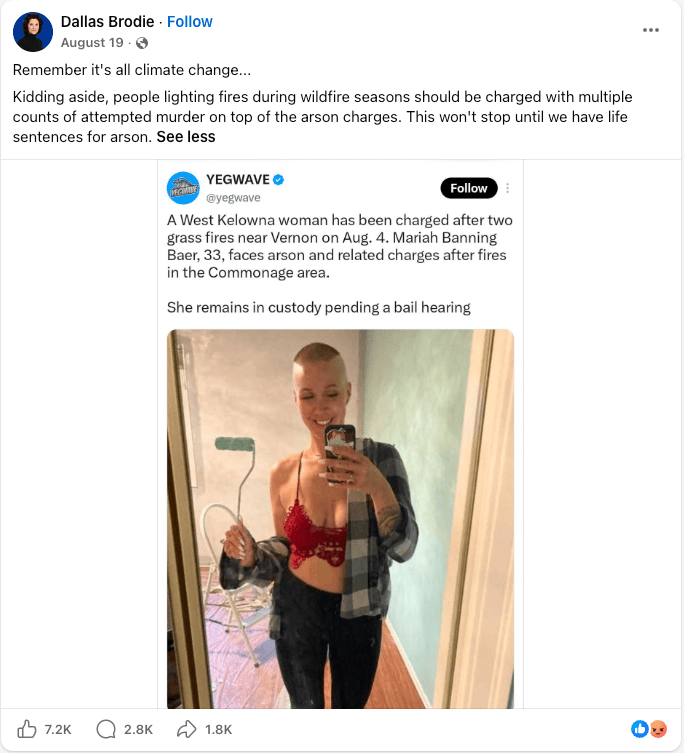
According to the Centre for Media, Technology, and Democracy, the rightwing/anti-establishment community amplified the narrative that fires were being used to justify climate policy more then any other group.
Climate Action Against Disinformation found this information was then spread by right-wing media outlets.
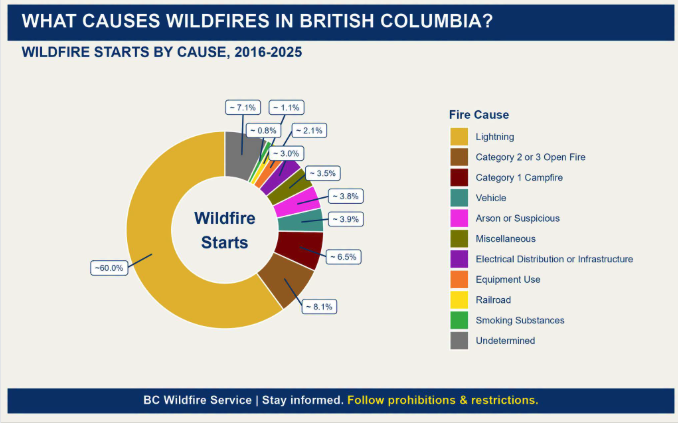
The disinformation is completely contradicted by the reality of what causes wildfires.
According to the BC Wildfire Service lighting causes 60% of all wildfires in the province, with arson accounting for 3.8%, slightly lower than vehicles at 3.9%. Cigarettes come in at less than 1%.
News from © iNFOnews.ca, . All rights reserved.
This material may not be published, broadcast, rewritten or redistributed.

This site is protected by reCAPTCHA and the Google Privacy Policy and Terms of Service apply.
Want to share your thoughts, add context, or connect with others in your community?
You must be logged in to post a comment.










One response
Scott Anderson might find his time better spent encouraging his party to put forward a platform to fund help for the homeless and people with mental health issues than ginning up conspiracy theories. Of course that wouldn’t put him in the spotlight