Elevate your local knowledge
Sign up for the iNFOnews newsletter today!
More than 100,000 Hawaiʻi residents who qualify for Medicaid may soon find their doctors prescribing them fresh food as medicine.
The script could be for fresh fruit and vegetables, even ahi, beef, chicken and eggs. The federally funded initiative will start as soon as January as part of a special state Medicaid program aimed at addressing chronic diet-related health issues in low-income communities.
The Food Is Medicine program could help many in Hawaiʻi, where one in three households have limited access to safe, affordable and nutritious food. It could also boost the local agricultural sector, as state advocacy and health groups have tailored the program to promote the use of local produce, which could inject millions of dollars into the economy and create almost 1,000 new jobs.
“It’s really a no-brainer,” said Alicia Higa, chief health equity officer at Waiʻanae Coast Comprehensive Health Center. “If there’s an opportunity to give food as medicine to our people, we should absolutely be using that money to support the local farmers. We’ll have an increased food supply and we’ll be much better off… Not to mention it’s the pono thing to do.”
Conventional medicine has long turned a blind eye to the importance of nutrition, but its influence on health has been gaining greater attention with the uptick in obesity and diet-related illness globally. In Hawai‘i, where food insecurity and diet-related diseases are rife, advocates hope the move will help ensure lower income communities have sufficient food and that the food is nutritious and patients are well-versed in healthy eating.
Hawaiʻi has long held goals to address its lack of a local food supply and winnowing population of farmers, but few programs have been able to meaningfully increase the islands’ food security as it continues to be plagued by natural disasters.
Now Hawai‘i will join at least a dozen states in implementing the nutrition scheme, enabled by the Social Security Act’s 11-15 waiver program, which allows for experimental and innovative health programs under Medicaid. The state’s program will be rolled out in three phases, starting in January with nutritional education programs and prescription food boxes for eligible patients.
The program has been years in the making.
Healthcare providers and advocates recommend at least 15% of all produce and protein comes from local sources, setting it apart from other states. It’s not binding, but it’s an aspiration, said Jordan Smith of Hawaiʻi Good Food Alliance, which is one of the program’s lead agencies in the initiative. And it’s still a work in progress.
“It’s a lot of work to bring together a broken healthcare system and a broken food system, and asking them to work together,” said Smith, the alliance’s Food Is Medicine program manager.
Sourcing food from the continent is certainly an easier option, but healthcare providers are resolved to stay as local as possible. Otherwise, the food is mostly “coming across the ocean on a boat, it’s not fresh, it’s not necessarily culturally relevant,” Smith said. “That’s why we’re exceptionally excited about the 11-15 waiver.”
Better Diets, Better Health
Big Island residents Moses and Suzette Paio have struggled with health issues associated with diet for years, making little progress in the past. What they could afford to eat plays a major role in their diet.
They’re not alone, living on an island where 43% of residents report food insecurity. One-third of the state’s households report insufficient access to adequate, nutritious, affordable food, according to Hawaiʻi Food Bank’s 2025 State of Food Security Report. And about half of Native Hawaiians and Pacific Islanders are food insecure, suffering the diet-related health ramifications.
Puna, where the Paios live, is classified as a food desert: a location with limited or no access to affordable, fresh, healthy and nutritious food.
“It’s not that I don’t want to buy it,” Suzette Paio said, “it’s just that I can’t.”
The Paios took part in a pilot program that rolled out under the Medicaid waiver this year. It included access to five months of weekly produce and protein boxes, delivered by the The Food Basket, Hawai’i island’s food bank. The boxes included locally caught and harvested proteins, greens and fruits.
Suzette Paio’s average blood sugar has halved, something she has struggled to get under control for more than a decade. Moses Paio lost over 70 pounds.
Local bananas and papayas, “they’re my candy,” said Suzette Paio, having replaced cheaper sugary treats she used to enjoy.
The Paios have also started gardening, preserving food, and getting more active, taking lessons from other education programs.
“We just thank God for the opportunity that we had,” Suzette Paio said, “because you know our health issues have been going on for a while.”
Advocates are encouraged by the data they have been collecting during pilot studies, which have run for at least the past year, though there is much more research to do.
The University of Hawaiʻi, for one, is conducting a five-year study on the program’s influence on hypertension at various healthcare centers in the islands. UH assistant professor of nutrition Monica Esquivel, who is leading the study, says much more data will come as the program develops, but its premise is proof of a growing recognition of diet’s influence on health.

In West Oʻahu, also considered a food desert, nutritionally focused healthcare programs have been operating since 2017, separate from the Medicaid initiative. The positive results kept them going, said Higa, who is also ʻElepaio Social Service’s CEO.
“We built it because we didn’t have it,” she said. “I think that’s traditionally what Waiʻanae does because we’re so far from everything.”
During the Covid-19 pandemic, Waiʻanae Comprehensive Health Center tracked almost 500 Medicaid patients over 18 months, Higa said, when they received a $60 monthly produce prescription.
Higa’s team tracked how much of the money was used, how the recipients’ health changed and how much it cost insurance. It resulted in about $118 in healthcare savings per patient, per month, she said.
Now, with the Med-QUEST program, the initiative has far greater security, Higa said.
Thousands Could Benefit
Advocates believe the produce prescription will function like Hawai‘i’s Da Bux program, which doubles the spending power of beneficiaries of the Supplemental Nutrition Assistance Program – formerly known as food stamps – when purchasing locally produced food.
There were almost 250,000 Da Bux transactions last year, accounting for more than $5.5 million in local produce, making it a triple win by benefiting the economy, the hungry and local farmers.
Food Is Medicine could do the same, advocates say, given approximately 121,000 residents could be eligible for the program.
The initiatives could unlock $12.3 million in additional annual revenue for Hawai‘i farmers, according to a national Rockefeller Foundation analysis, the lion’s share benefiting small and mid-sized farms. It could also boost the state’s GDP by $125.5 million.
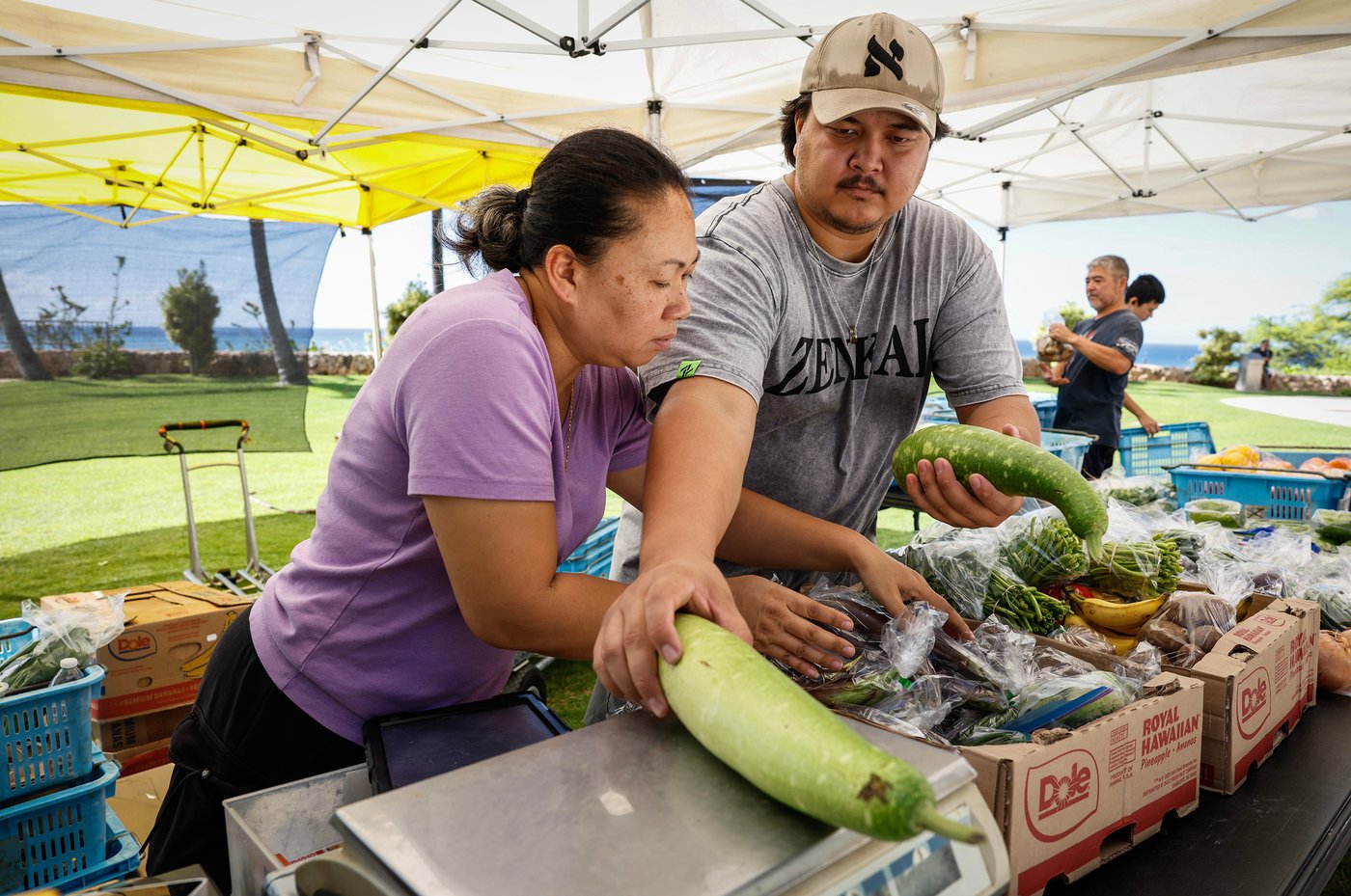
The results for farmers have already been seen on Oʻahu, with Waiʻanae Farmers Market vendors scaling up production in response to demand driven by food-based health programs run by Waiʻanae Comprehensive. The same has happened on the Big Island, with egg producers scaling up to meet demand, according to Food Basket CEO Kristen Frost Albrecht.
Micah Richards of Mauka Meats, a local meat provider, says his business and the ranchers he works with have benefited immensely. And he believes the program holds great promise for the entire agriculture sector.
Some hurdles exist, Richards said, including helping farmers and ranchers get food safety certifications so they can take part.
The greatest payoff from the program, he said, has been “having auntie come up to you at the market, tell you they feel better, they’re making progress with their doctor, but all they feel they changed was going to the farmers market and having access to the funds for local meat and produce.”
Produce Prescriptions
The Medicaid program’s official rollout in January will start with prescriptions and nutritional education, but will mostly rely on organizations being able to deliver the service to eligible residents.
The second phase will include helping eligible Medicaid users stock their pantries and acquire cooking supplies, as well as phasing in medically tailored meals. The meals, on a national level, could help reduce the need for 2.6 million hospitalizations annually, a net cost savings of $23.7 billion, according to Tufts University.
The program is being coordinated by Med-QUEST, part of the state Department of Human Services, and the Hawaiʻi Good Food Alliance. But the programs’ full rollout will depend on individual health centers and food distributors, Med-QUEST Administrator Meredith Nichols said in an email, adding that the state is providing grants to help increase organizations’ ability to deliver the programs statewide.
The prescriptions will give eligible recipients $50 per week to buy fresh protein and produce on Oʻahu, while other islands’ residents will receive $55 weekly. The food could come in the form of food boxes, like the Paios get, or in vouchers to be used at farmers markets, like Waiʻanae Coast Comprehensive Health Center’s patients do.
Advocates anticipate the program will be popular. On the Big Island, Moses Paio expounds the program’s virtues openly, giving tips to friends, family and members of his church. It’s changed his life, he said, now that he’s lost weight and can be more active.
“My yard pushes me. I see the grass growing,” Moses Paio said. “There are times out there, I’m cutting grass, and I’m just crying. You know, I’m just thanking God that I can even just stand there.”
___
This story was originally published by Honolulu Civil Beat and distributed through a partnership with The Associated Press.
News from © The Associated Press, . All rights reserved.
This material may not be published, broadcast, rewritten or redistributed.

This site is protected by reCAPTCHA and the Google Privacy Policy and Terms of Service apply.
Want to share your thoughts, add context, or connect with others in your community?
You must be logged in to post a comment.