Elevate your local knowledge
Sign up for the iNFOnews newsletter today!
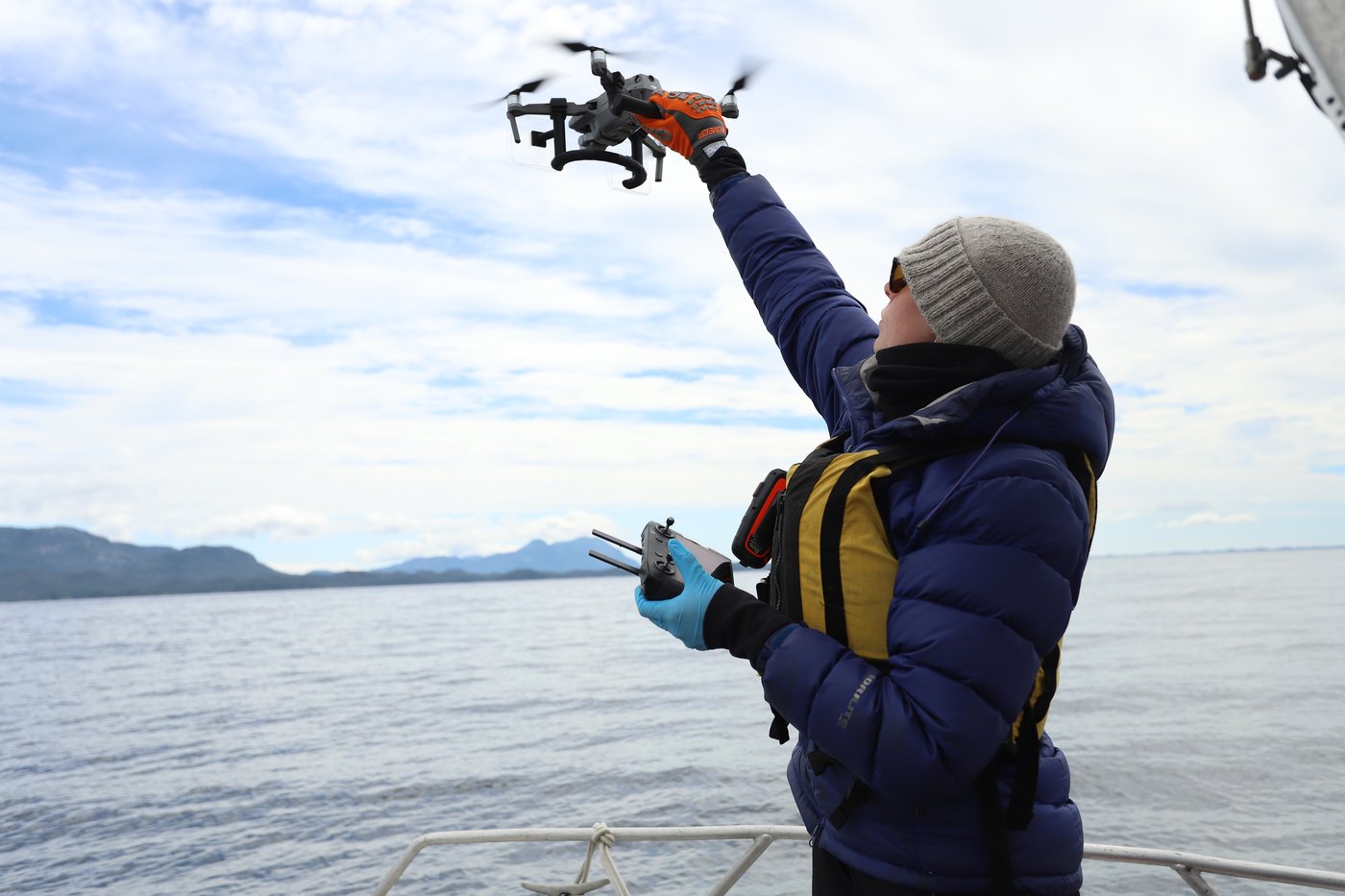
Researchers studying humpback whales off the coast of British Columbia used drones to collect “whale snot,” allowing scientists to conduct a complete genome sequencing without darts, biopsies or approaching closely with a boat.
Eadin O’Mahony, lead researcher in the study published in the scientific journal Molecular Ecology Resources this week, said her team spent 2022 and 2023 collecting the samples.
“It was (about) getting the whole genome, but it was getting a whole genome in a non-invasive way,” she said of the project.
Genomic data is an important tool for conservation, she said, letting researchers measure population health, including genetic diversity and inbreeding, and helping them identify individuals and estimate population size.
“To have an understanding of the genetic resilience of a population of animals is really important for their long-term protection, their conservation,” O’Mahony said in an interview from Cork, Ireland.
To collect the DNA, she would pilot a drone from a small vessel or from land at the Fin Island Research Station in a remote location on B.C.’s northern coast.
Humpback whales forage in the region in the summer before migrating to Hawaii to breed in the winter, she said.
The drone flights were conducted under a Fisheries and Oceans Canada research permit.
O’Mahony said she would be watching through the video feed to ensure the animal was not visually showing any signs of distress as she approached. If any were detected, they would terminate the flight, she said, adding this happened “very rarely.”
The drone carried a sterile petri dish and would hover over the whale, waiting for it to take the typical five to six breaths per surfacing.
“I’m trying to pre-empt the whale’s behaviour somewhat positioning the drone just behind the blowhole so that when she comes up to take that exhale, I’m ready to just fly through the breath covering the petri dishes in these little ‘mucusy’ droplets that’s what is effectively snot,” O’Mahony said.
The drone would then capture a photo of the animal’s tail fluke as it dove below the water’s surface.
She said the tail fluke is similar to a “human fingerprint,” allowing scientists to easily identify each animal.
A second photographer would use a zoom camera to help ensure a “fluke ID photograph” is captured during each collection.
“The actual sampling event is very quick,” she said, noting each flight only takes a couple of minutes.
“The scientific study, on the other hand — science is a slow game,” she said.
They collected 58 blow samples from a total of 26 humpbacks. The study said about 84 per cent of the DNA in the blow came from the whale itself.

Repeat samples from the same whales, collected in different encounters and across the two years, gave matching genomes. Blow genomes also matched previously collected biopsy genomes from the same animals, the study said.
Researchers, alongside collaborators from the Globe Institute at the University of Copenhagen, the North Coast Cetacean Society and Fisheries and Oceans Canada, also discovered genetic diversity estimated from blow samples was very similar to those of traditional biopsies.
The customary way of obtaining a genetic sample is from a biopsy, which requires getting a boat very close to the animal to dart it to obtain pieces of the whale’s blubber and skin.
The research also determined the population studied shows little evidence of recent inbreeding.
O’Mahony said the humpback whale population declined about 20 per cent between 2012 and 2021, which she called “quite significant and quite worrying.”
“Genetic understanding helps us make management plans for our conservation agencies, to make management plans that are sustainable and protect these animals going forward,” she said.
O’Mahony noted humpbacks were long subjects of commercial hunts, which “brought their numbers to the brink of extinction.”
She said there has been local recovery along B.C.’s coast, but there are conservation concerns over more expanded vessel traffic from tankers in the region, which increases the chances of fatal ship strikes.
“Getting that baseline information on what their genetic health looks like is really important in that context,” O’Mahony said.
She said there are scenarios where biopsy sampling is not possible, so this provides a non-invasive alternative.
“It’s not so much that the blow sampling will once and for all replace biopsy sampling, but there are a number of places where the blow sampling has its place,” she said.
“It just opens the door to more scenarios in which we might need to get the genetic material, but we haven’t been able to get it to such quality up until this point.”
She said she thinks blow sampling data is “only going to get better from here.”
“This is not the end of the road,” she said.
“It’s just going to open the door to increasingly non-invasive methods of research for conservation genomics.”
This report by The Canadian Press was first published Nov. 18, 2026.
News from © The Canadian Press, . All rights reserved.
This material may not be published, broadcast, rewritten or redistributed.

This site is protected by reCAPTCHA and the Google Privacy Policy and Terms of Service apply.
Want to share your thoughts, add context, or connect with others in your community?
You must be logged in to post a comment.