Elevate your local knowledge
Sign up for the iNFOnews newsletter today!
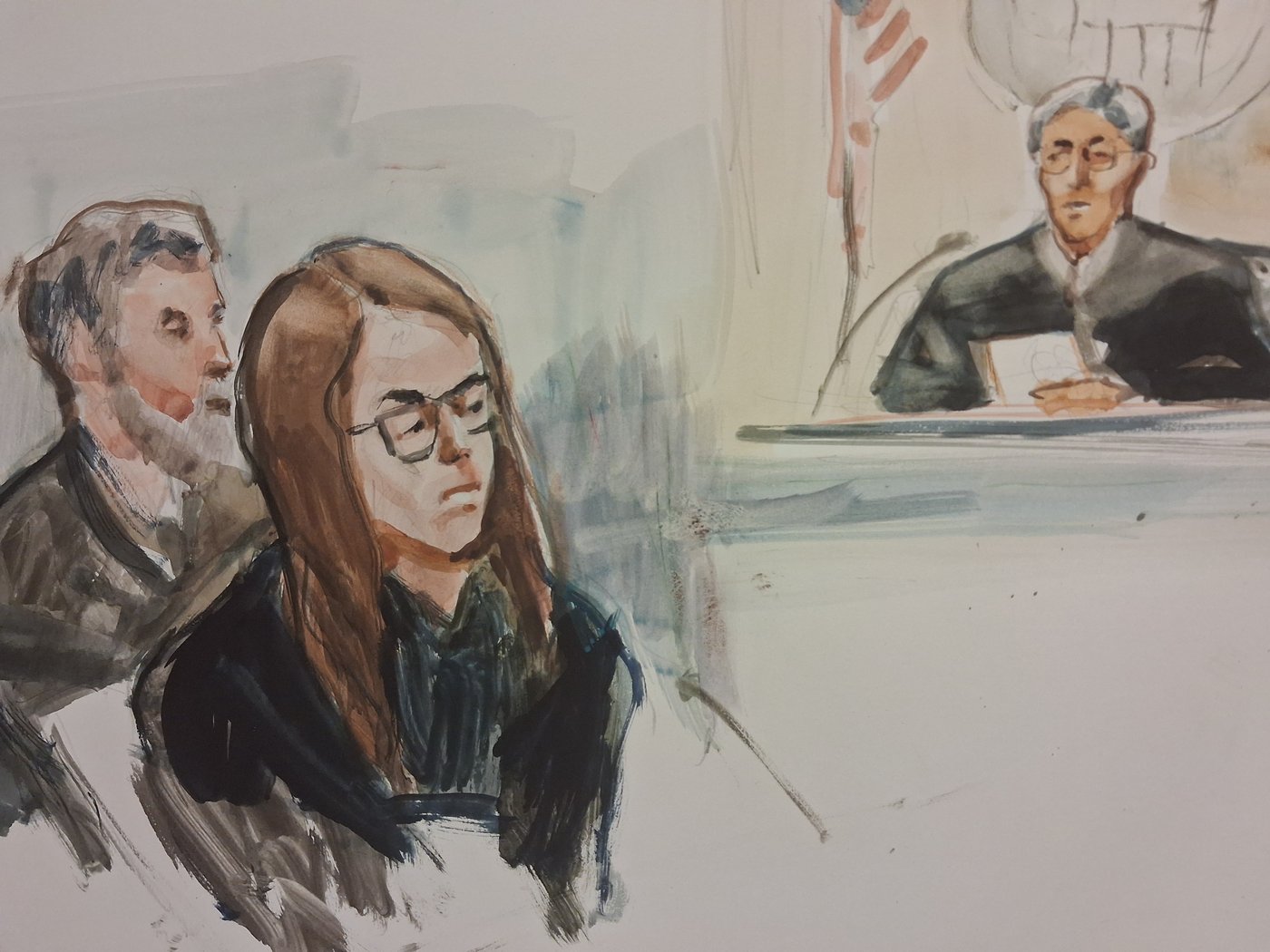
SEATTLE — The alleged co-conspirator in the Tumbler Ridge, B.C., mass shooting exchanged almost 74,000 texts with the killer but her lawyers argue that on at least three occasions she tried to talk Jesse Van Rootselaar out of killing people, U.S. court documents say.
James Bryant filed an application for release from jail last week claiming her messages with the shooter are protected under the U.S. First Amendment on the right to free speech, and she poses no risk to the community if released.
The criminal complaint against Bryant, 30, alleges she colluded online with shooter Jesse Van Rootselaar, 18, and attempted to set up a livestream of the murders.
Bryant’s lawyers say in the 33-page filing in U.S. district court in Seattle that the 73,858 individual texts between Bryant and the shooter were misconstrued by the government as it argued for her detention.
“The chats make clear that Ms. Bryant believes, at least for the bulk of their communications, that Van Rootselaar is basically a decent person who is troubled by violent thoughts she wouldn’t act on,” the document says.
Bryant pleaded not guilty to conspiracy to murder persons in a foreign country in a Seattle court in October and remains in custody. The magistrate found Bryant, who uses female pronouns and goes by the name Melody, would pose a danger if allowed internet access.
Van Rootselaar killed eight people last February, including five students and an educational assistant at the local secondary school, before fatally shooting herself as police closed in.
U.S. prosecutors allege Bryant also advised Van Rootselaar on where to carry out the attack and sent the shooter money to buy a lighter for an explosive device.
But Bryant’s court filing says that six months before the attack, the plan the two discussed over the Discord platform was fantasy because Van Rootselaar did not have access to guns.
“Ms. Bryant was not alone in initially failing to understand that Van Rootselaar was genuinely dangerous,” the document says.
It says RCMP had seized then returned one of the guns Van Rootselaar would use in the attack, which had been “altered to enable rapid firing.”
“Family members and friends bought Van Rootselaar ammunition, even after her release from psychiatric hospitalization,” the document says.
Van Rootselaar also spoke about her plans to kill “widely” with other people and with ChatGPT.
“Because neither Ms. Bryant, OpenAI … the many people Van Rootselaar communicated with online, Van Rootselaar’s family, nor the RCMP wanted Van Rootselaar to use her firearms to kill anyone, none are responsible as co-conspirators for her actions, even if each of these provided services that helped Van Rootselaar commit her crime,” the document says.
About two-thirds of the texts were from Van Rootselaar to Bryant, and that the American often discouraged the teenager’s violent and suicidal urges, the court motion says.
Van Rootselaar sent messages about her desire for notoriety and what it would take to surpass the deaths in the La Loche school shooting in Saskatchewan in 2016 and the École Polytechnique massacre in Quebec in 1989.
Bryant’s lawyers say that while Bryant sometimes joined in Van Rootselaar’s fantasies, “the chats also contain an extended discussion of how Van Rootselaar would commit mass murder if she grew to the size of a giant.”
The lawyers say Bryant’s jokes “may be tasteless and, in retrospect, were ill considered,” but they are protected by the U.S. First Amendment because Van Rootselaar had made it clear she had no immediate intention to commit an act of violence.
“For better or worse, the First Amendment also protects their debate about whether a school shooting or attack on a crowd would be more likely to make someone infamous, even if the government tries to recast that conversation as ‘tactical advice,'” Bryant’s application says.
The lawyers say that Bryant also worried that reporting Van Rootselaar “might trigger a massacre” and cautiously urged the shooter to get medical help rather than hurting herself or others.
Messages included in the application show Bryant trying to dissuade Van Rootselaar from hurting others by getting her to empathize with the potential victims, saying they “could be incredibly important to someone.”
The application noted that “because Van Rootselaar had been talking about killing people nearly every day for at least six months, Ms. Bryant did not understand when violence was imminent.”
“On at least three occasions, Van Rootselaar announces that she is going to proceed with her plan imminently, only to be talked out of killing people,” the application says.
On Feb. 10, the day of the shooting, she made a final attempt to dissuade Van Rootselaar, the motion says.

“Today doesn’t have to be the day,” she wrote.
The document argues that though it is “horrifying in retrospect” to imagine that Bryant could have prevented the killings if she had contacted police, “it is undisputed that the law provided no affirmative duty to do so.”
“In the past, Ms. Bryant had repeatedly been able talk Van Rootselaar out of committing a crime,” it says.
It also notes that though Bryant agreed to watch and screen capture the “gore scenes” during the shooting, she had stated she did not want to and “made it clear that her agreement to livestream her friend’s final moments did not indicate agreement with Van Rootselaar’s actions.”
In that exchange, Van Rootselaar also said she would commit her crimes even if Bryant was not watching or recording.
Bryant’s lawyers argue she would not pose a threat to society if she is released ahead of trial.
The evidence “of an agreement to murder people in Canada is extremely weak,” it says.
“In fact, the chats make overwhelmingly clear that Ms. Bryant did not share — and in fact opposed — Van Rootselaar’s plans to murder others,” the motion says.
“From the first chats in August 2025 until the day Van Rootselaar killed her family and attacked a school, Ms. Bryant attempted to distract and dissuade her friend from her murderous purpose.”
The application argues that Byrant co-operated with police and was arrested without incident last month.
It says the judge granted her detainment on an order that “makes several factual mistakes,” including that she suffers from a “deeply rooted” mental illness or substance abuse history that they say does not exist.
It alleges that the 41-page complaint filed by the government was “replete with distortions,” including that some texts were rearranged to make it appear that Bryant was helping Van Rootselaar build a bomb or sent her money to buy a lighter for a bomb.
“In fact, nowhere in the complete chats does Van Rootselaar say that she needs a lighter for the bomb. Nowhere does Bryant offer to provide Van Rootselaar a lighter for that purpose,” it says.
The document says that though the alleged crime is “extremely serious,” Van Rootselaar’s homicidal fantasies predate their relationship.
“The government has never contended (and there is no evidence) that Ms. Bryant recruited Van Rootselaar to commit violence or groomed her to do so,” it says.
It notes there is also no evidence that Bryant visits any chat communities that glorify violence.
“Absent any evidence of any similar relationships, there is simply no basis for concluding that Ms. Bryant poses an unmanageable risk of future danger,” it says.
It also notes the government’s willingness to leave Bryant in the community for seven months after initially reviewing the Discord chats, which it says “proves that she did not, and does not, pose any danger.”
The application asks the court to order release of Bryant with conditions, “which may include home confinement, mental health treatment if an assessment determines it is appropriate, and restrictions on her use of digital devices.”
Emily Langlie, a spokeswoman for the U.S. Attorney’s Office, said in an emailed statement that the prosecution’s response to the motion is due on Wednesday, after which the judge will rule on the filings or schedule an oral argument, “probably in early December.”
She said the trial on the charges against Bryant is expected in December next year.
This report by The Canadian Press was first published Nov. 24, 2026.
— By Brieanna Charlebois in Vancouver and Kelly Geraldine Malone in Washington, D.C.
News from © The Canadian Press, . All rights reserved.
This material may not be published, broadcast, rewritten or redistributed.

This site is protected by reCAPTCHA and the Google Privacy Policy and Terms of Service apply.
Want to share your thoughts, add context, or connect with others in your community?
You must be logged in to post a comment.