Elevate your local knowledge
Sign up for the iNFOnews newsletter today!
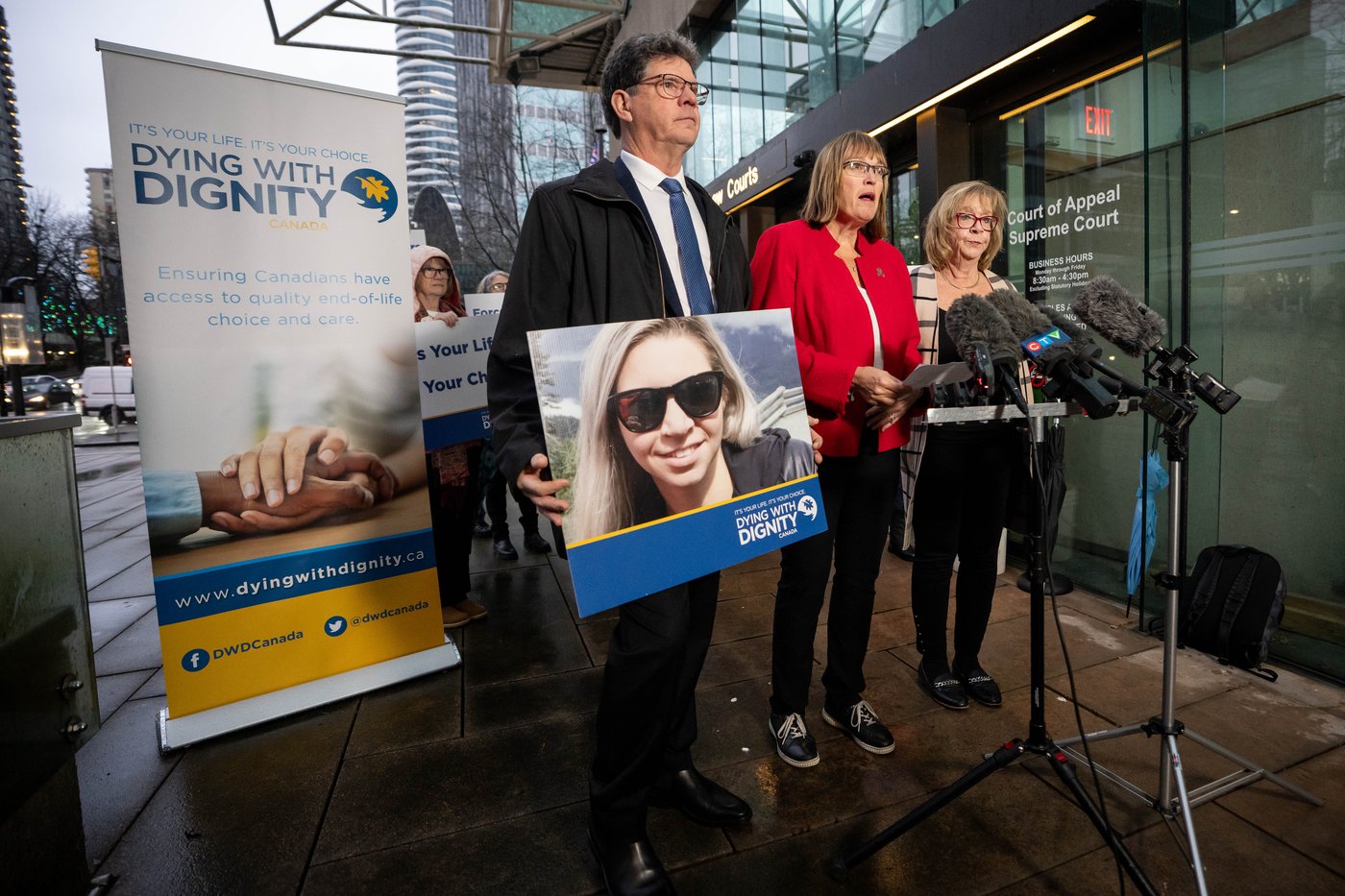
VANCOUVER — The parents of a woman whose care leading up to her death set off a legal challenge over how medically assisted dying is provided in British Columbia say they struggle to understand how her pain was not enough to qualify as a Charter violation.
A B.C. Supreme Court judge said in a ruling released on Friday that policies of a publicly funded Catholic-run hospital requiring patients to be transferred to another facility to be given MAID do not violate the Charter rights of doctors or their patients.
The decision by Justice Ronald Skolrood said the hospital’s policies don’t stop a patient from accessing MAID and that doctors who practice medicine at faith-based organizations do so voluntarily, with full knowledge of the facility’s position.
“A particular physician’s belief in the importance and value of MAID does not give rise to a right to provide MAID services wherever the physician wishes to do so, nor does it permit a physician to compel a facility to make MAID available,” he said.
The legal challenge was filed by the family of 34-year-old Samantha O’Neill, who was denied a medically assisted death at St. Paul’s Hospital in Vancouver in 2023.
She was sedated and transferred to another facility, but never regained consciousness, something that her family said was “traumatic and unbearably cruel.”
The family, advocacy group Dying with Dignity Canada and a MAID provider, argued at the trial earlier this year that requiring a transfer puts patients at increased risk of pain and psychological stress, but the judge ruled that transfers are a routine aspect of health care and the risks are managed.
Skolrood ruled that to suggest MAID transfers are fundamentally different from other transfers “essentially amounts to a claim to the right to demand access to MAID at the time and in the location of the patient’s choice,” which “goes well beyond the established bounds of the Charter.”
O’Neill’s father Jim O’Neill said it appears his evidence of what his daughter experienced during the transfer was dismissed as anecdotal, rather than evidence of harm.
“I was in the vehicle with Sam and witnessed her writhing and moaning in pain and the additional drugs being administered,” he said at a news conference hours after the decision was released.
He said he doesn’t know how what his daughter experienced doesn’t meet “the definition of pain.”
“It’s not a bump in a hallway when you have to be sedated for the rest of your life. And somehow that’s not harm,” he said.
Skolrood said the Charter “is intended to protect individuals from state coercion on matters of conscience.”
“It is not intended to empower individuals to compel the state or other institutional actors to act in a particular manner that accords with that individual’s conscientious beliefs.”
Lawyers for St. Paul’s said the hospital is prohibited by Providence Health Care from offering assisted dying because of a decision by the Archbishop of Vancouver that it is morally wrong under Catholic beliefs.

Lawyers for the plaintiffs said the policy effectively imposes Catholic doctrine on patients, but the judge ruled that allowing faith-based organizations to operate in a manner consistent with their beliefs does not amount to state sponsorship of those beliefs.
“This allegation is similarly not made out on the evidence. Specifically, there is no evidence that any patients, including the patients whose circumstances were in evidence, were compelled to accept or observe Catholic beliefs either generally or as a condition of receiving MAID,” the ruling said.
The patient’s mother Gaye O’Neill told reporters that she was struggling to understand the decision.
“The Catholic administration would like you to turn a blind eye to the fact that forced transfers are not Christian and certainly not humane,” she said, calling them “knowingly harmful.”
“Dying is not the worst thing that happens to people, suffering is.”
A statement from Providence Health Care on Friday said it is thankful for “the thoughtful consideration given to this important and complex issue.”
“We are committed to continuing to build on our 130-plus-year history of providing compassionate, exceptional and innovative health care to British Columbians,” the statement said.
Dr. Jyothi Jayaraman, who is a MAID provider and was also a plaintiff in the case, said the court’s ruling that doctors choose to work at Providence Health Care ignores that some of them need to be there when patients who are qualified for assisted dying are admitted.
“Only the MAID provider who has completed a waiver of final consent with the patient can provide MAID to the patient who has lost capacity,” she said.
“A previously assessed and eligible-for-MAID patient could be admitted to a (Providence Health Care) facility because that is where their care could be optimally provided. And I would not be able to assist them when they needed me the most if I did not have privileges.”
Daphne Gilbert, the board chair for Dying with Dignity Canada, told the news conference that it stands by the arguments that were made in court and it is reviewing the decision before deciding what the next steps might be.
She has previously said the case is likely to end up before the Supreme Court of Canada.
“Forced transfers for MAID are an ongoing issue, not just in British Columbia, but across the country. Of Canada’s 1,087 hospitals, 129 of them are Catholic. Most of those refuse to allow MAID provisions on their premises,” she said on Friday.
“As a country, Canada embraces religious freedom, which means the government doesn’t prefer any one religion over another. And yet religiously affiliated health-care institutions continue to deny access to health-care services because of their religious beliefs.”
This report by The Canadian Press was first published Nov. 27, 2026.
News from © The Canadian Press, . All rights reserved.
This material may not be published, broadcast, rewritten or redistributed.

This site is protected by reCAPTCHA and the Google Privacy Policy and Terms of Service apply.
Want to share your thoughts, add context, or connect with others in your community?
You must be logged in to post a comment.