Elevate your local knowledge
Sign up for the iNFOnews newsletter today!
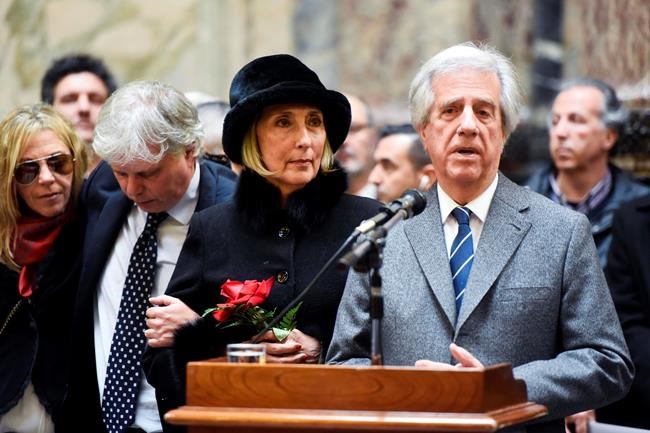
MONTEVIDEO, Uruguay – Former President Jorge Batlle, who has died at age 88, was remembered Tuesday as a force in Uruguayan politics for half a century.
Current President Tabare Vazquez was on hand at the morning wake for Batlle, who had undergone surgery to stop a cerebral hemorrhage after he fainted and struck his head earlier this month during an event for his Colorado Party. Batlle never fully recovered and the Sanatorio Americano hospital where he was interned announced his death late Monday.
Batlle, who was known as outgoing, even politically incorrect at times, remained active in politics until the end, needling his successors through newspaper columns and social media after leaving office.
He practiced law, worked as journalist and was a senator and a member of the lower house of Congress before serving as president from 2000-2005.
He had promised that his presidency would be “fun,” but it was overshadowed by an economic depression that brought Uruguay, long one of Latin America’s most stable economies, close to bankruptcy.
The slump left one of every three Uruguayans below the poverty line — a blow to a country where generous social benefits had for years assured one of the region’s highest living standards.
As president, Batlle also pursued closer ties with the United States at a time when leftists were taking power in Argentina, Brazil, and Venezuela and distancing themselves from Washington.
Born on Oct. 25, 1927, Batlle came from a political family. His father, Luis Batlle Berres, was president of Uruguay between 1947-1951 and 1954-1958. He was related to 19th century Presidents Jose Batlle y Ordonez and Lorenzo Batlle.
But his road to the presidency was challenging. After an unsuccessful first run in 1966, his image was dented by a financial scandal in 1968, when he was accused of using privileged information on an imminent devaluation. The claim was never proven.
In 1971, he lost another presidential election. During the 1973-1985 military dictatorship, he was detained on several occasions, as were dozens of other political leaders. After the return of democracy, he was elected senator for the Colorado Party.
After another unsuccessful run in 1994, Batlle finally won election in 1999 and took office in 2000.
In 2001, Uruguay was hit by an outbreak of foot-and-mouth disease that forced the country to suspend all exports of meat, a backbone of the economy. Shortly after that, Uruguay was dragged down by an economic crisis in its neighbour and major trading partner, Argentina.
By 2002, Uruguay’s foreign reserves had plunged and unemployment reached 20 per cent.
Batlle was succeeded by Vazquez, Uruguay’s first leftist president.
Although Batlle promised to steer clear of politics after leaving office, he often criticized Vazquez and his successor, Jose Mujica, and their Broad Front coalition of socialists, communists and former Tupamaro guerrillas.
News from © The Associated Press, . All rights reserved.
This material may not be published, broadcast, rewritten or redistributed.

This site is protected by reCAPTCHA and the Google Privacy Policy and Terms of Service apply.
Want to share your thoughts, add context, or connect with others in your community?
You must be logged in to post a comment.