Elevate your local knowledge
Sign up for the iNFOnews newsletter today!
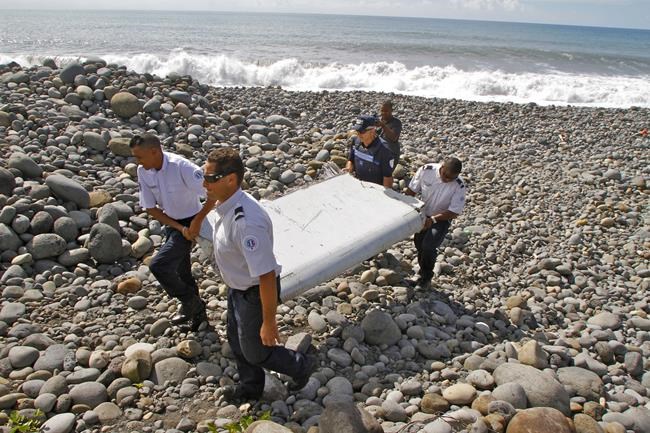
SYDNEY, Australia – Malaysia’s confirmation on Thursday that debris found in South Africa and an island off Mauritius came from missing Malaysia Airlines Flight 370 brings to five the number of parts that have been recovered from the aircraft that vanished two years ago. Here’s a look at each of the pieces found so far:
THE FLAPERON
Johnny Begue, who lives on the French island of Reunion in the western Indian Ocean, was collecting stones on one of the island’s beaches last July when he saw a two-meter (6-foot) long piece of an airplane wing lying on the sand. The barnacle-encrusted part turned out to be the first trace of Flight 370 that was discovered since the plane disappeared. Authorities in France later confirmed that the part, known as a flaperon, came from the trailing edge of one of Flight 370’s wings. The discovery provided the first physical proof that the plane had indeed crashed somewhere in the Indian Ocean.
___
NO STEP
Blaine Gibson, an American adventurer who has been hunting for Flight 370 over the past year, discovered the debris that came to be known as “No Step” off the coast of Mozambique in February. After consulting experts on ocean currents and travelling throughout the region looking for any trace of the plane, Gibson asked a boat operator to take him to a sandbar in Mozambique named Paluma. The boat operator called him over after spotting a piece of debris with the words “NO STEP” written on it. Though Gibson initially thought the piece came from a small plane, officials later said it was a part known as a horizontal stabilizer from the missing Boeing 777.
___
‘RUBBISH’
Liam Lotter, a South African teenager vacationing in Mozambique in December, was strolling on a beach near the resort town of Xai Xai when he spotted a grey piece of debris washed up on the sand. The piece had rivet holes along the edge and the number 676EB stamped on it, convincing him he had found a piece of an aircraft. But after he dragged it back to his family’s vacation home, they dismissed it as “rubbish” that had likely come from a boat. Still, Lotter insisted on bringing it home to South Africa to research it further. The piece was stored with the family’s fishing gear and almost forgotten; his mother even tried to throw it out. In March, Lotter heard the news about Gibson’s “No Step” discovery and began to wonder if the piece he’d found might also be from the missing plane. Officials later confirmed it was indeed a part of the vanished aircraft’s right wing, known as flap track fairing.
___
ROLLS ROYCE
Neels Kruger, a South African archaeologist, was walking along a lagoon on the southern coast of South Africa near the town of Mossel Bay in March when he spotted something unusual. The piece lying in the sand had a brown honeycomb structure Kruger recognized from other photos of debris believed to be from Flight 370. On one side of the debris, Kruger noticed the remains of a Rolls Royce logo, the manufacturer of aircraft engines. Officials determined it was a segment from an engine cowling that almost certainly came from Flight 370.
___
FIRST CABIN DEBRIS
The piece of debris that tourists discovered in March on Rodrigues Island in Mauritius was different than the other four: This one had a pattern that appeared to come from a wall inside the plane. Until that point, all the debris that had washed ashore had come from the plane’s exterior. Officials have since determined it was a panel from the main cabin, likely part of a door closet, that almost certainly came from Flight 370.
___
PARTS LEFT TO BE FOUND
Though the floating bits of debris that have washed up on coastlines bolster authorities’ assertion that the plane crashed somewhere in the Indian Ocean, they offer no clues about why and where it crashed. What officials really hope to find is the underwater wreckage. This is where the coveted flight data recorders, or “black boxes,” are most likely to be. But hopes are dwindling that the wreckage will be found; search crews have already scoured 105,000 square kilometres (40,000 square miles) of the 120,000 square kilometre (46,000-square-mile) search zone to no avail, and there are no plans to expand the search area further.
News from © The Associated Press, . All rights reserved.
This material may not be published, broadcast, rewritten or redistributed.

This site is protected by reCAPTCHA and the Google Privacy Policy and Terms of Service apply.
Want to share your thoughts, add context, or connect with others in your community?
You must be logged in to post a comment.