



Okanagan winery forging ahead with new agri-tech to combat climate change

There’s an innovative winery owner in the South Okanagan who is forging ahead to bring solar technology to the region in the wake of consecutive years of crop losses due to climate change.
Abbotsford resident Jesse Gill owns three wineries in the Okanagan Valley. His winery in Oliver, Double Barrel Vineyards, will soon become the site of a multi-million-dollar agrivoltaics project, and he said it’s the first of its kind in North America.
If successful, the technology could play a crucial role in food production for growers in the province battered by consecutive years of damaging climate events including drought, heat domes and deep freezes.
“After talking with multiple other growers in the region, this third year of climate-related damages have left many of them feeling discouraged,” Gill said.
Also known as farm-first solar and dual-use solar, agrivoltaics is still in its infancy in Canada, and allows land to be used both for agricultural protection and solar energy production.
The system is composed of solar panels that track the sun. If there is a cold event, such as the one in January, 2024 that wiped out many of the Okanagan’s grapevines, the panels fold into table top mode over the crops and thermal shade curtains automatically deploy, coming down around the perimeter of the vineyard creating an enclosed structure with temperature control.
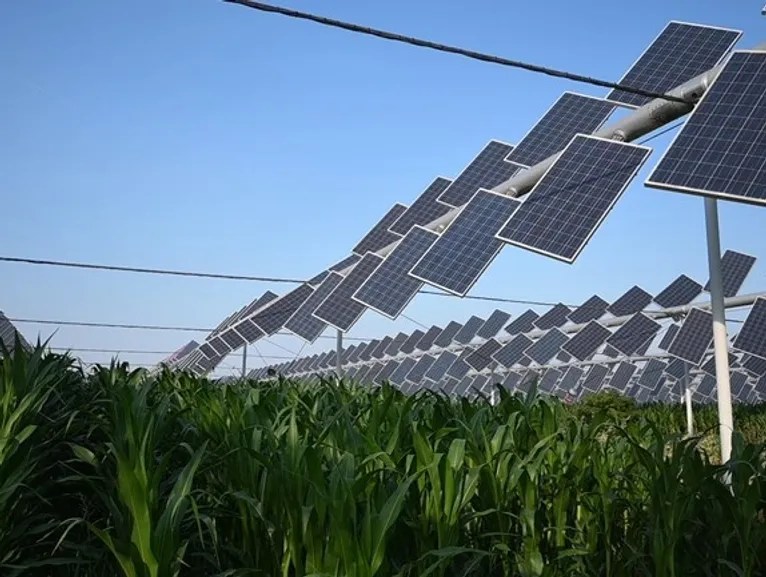
In summer months, shading from the panels protects the crops from high temperatures, reducing heat stress and water requirements.
“We are not simply putting solar panels over a vineyard,” Gill said. “We’re trying to build an agricultural climate-adaptation system around the crop, reducing frost exposure, heat stress, water demand and production volatility while generating energy from the same land.”
Solar energy collected from the panels can be stored for use during emergency events.
“If the power is shut off in an emergency event, what happens to the growers, packers and winery owners that are sitting with fruit in cold storage, full winery tanks and fields to irrigate all of which run on power?” Gill said.
“When I have discussions with the Ministry of Agriculture, the focus is on protecting crops, but also emergency preparedness.”
Gill has a team working on the project including professors from UBC, Western University and Simon Fraser, and members of the Ministry of Agriculture. They want to make a blueprint other growers can follow, and set up similar sites throughout the valley in the future.
“They all want to see what the production numbers are before and after installation, and how this technology is going to evolve,” Gill said. “During the process, we’ll learn so much it will probably spawn other innovative ideas from all the academia involved in the project.”
It’s the third year in a row Gill and fellow grape growers in the Similkameen and Okanagan have experienced lost crops due to extreme weather events. This season there was drought and wildfires to contend with.
“Drought conditions really impacted growers in the North Okanagan, and we were all issued letters from various districts to keep an eye on irrigation,” Gill said.
“The biggest issue was smoke taint from fires.”
Gill lost a large portion of grapes to smoke taint when the Bald Range fire came a few hundred metres away from his Summerland winery, Back Door Winery. He said he wouldn’t be surprised if the losses across the valley from smoke taint will be 50%.
“Vineyards throughout the valley are more or less affected, and it was based on the decisions of each wine maker whether to harvest or not,” he said. “You can pick the grapes and eat them and its fine, but when they’re processed, when they’re fermenting, it can activate chemistry that brings out the ashtray taste.”

He said the solution to helping BC growers thrive and compete in the market is to reduce the amount of money going to compensate climate damages and increase funding for new technology to prevent them happening in the first place.
“We spend millions of dollars in insurance support payments every year, but when you look at our innovation budget its next to nothing,” he said. “All we’re doing is setting ourselves up for another event and then we have another claim and then we go another year and do the same.
“We are repeatedly funding the consequence rather than the solution.”
Other provinces like Ontario and Quebec are moving at a materially larger scale on agricultural technology and climate adaptation.
“The race for agricultural innovation is already on,” Gill said. “If BC doesn’t invest aggressively in technologies that reduce climate losses, our agriculture risks being in a race to the bottom, with an ever-growing effectively bottomless requirement for insurance and emergency support payments after each disaster.”
He said BC Production Insurance and AgriStability programs designed to protect growers also need to be updated to adequately reflect losses incurred by back-to-back seasons of climate related losses.
“Production Insurance kicks in when a grower’s yield is below a certain margin,” he said. “It’s designed to work hand-in-hand with AgriStability where if you don’t qualify for insurance, you may still be eligible under the program.
“The problem with both is the margins are based off historical production averages, but ever year climate challenges are reducing or destroying crops, bringing the averages down.”
Gill said BC Production Insurance has always had some gaps because the model doesn’t change quickly enough. Consistent climate change challenges have rendered the model outdated and in need of a rebuild.
When iNFOnews.ca talked to Gill in December, 2025, the agrivoltaic project was awaiting approval by the Agricultural Land Commission, whose members gave him their unanimous approval early this year.
The project will cost roughly 33 million dollars and Gill has been in discussion with several provincial bodies including Major Investments Office of BC, Ministry of Agriculture, Ministry of Jobs and Economic Growth and the Ministry of Energy regarding funding.
“We’re solving multiple problems including providing power, shoring up the agriculture industry and solving for food security,” Gill said. “It’s about who is supposed to fund this, and where is the money supposed to come from. We don’t fit cleanly into any box, this is new.”
Gill and his team are sourcing pieces of equipment for the installation which is set to take place just after Christmas.
News from © iNFOnews.ca, . All rights reserved.
This material may not be published, broadcast, rewritten or redistributed.

Join the Conversation!
Want to share your thoughts, add context, or connect with others in your community?
You must be logged in to post a comment.






One response
Wonderful! We need to do more of this and start covering parking lots with panels