Elevate your local knowledge
Sign up for the iNFOnews newsletter today!
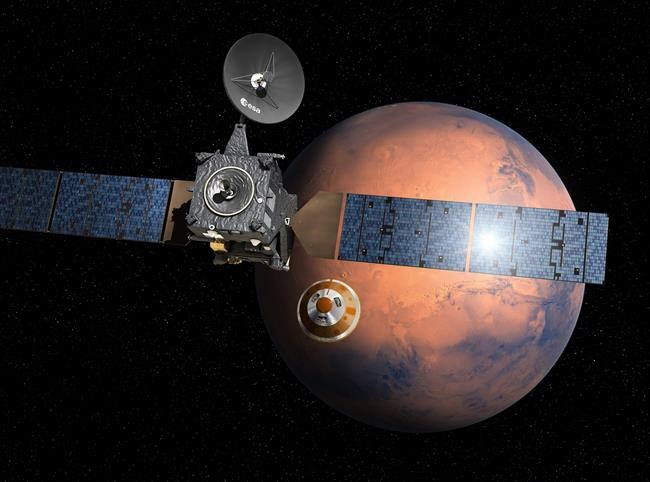
BERLIN – The European Space Agency dispatched an experimental probe Sunday on the final leg of its quest to land on Mars, part of a mission aimed at exploring the red planet’s atmosphere and searching for signs of life.
The Schiaparelli lander separated from its mother ship as scheduled, flight director Michel Denis announced to applause at control centre in Darmstadt, Germany. That set it on the way to a controlled descent to the surface on Wednesday.
Schiaparelli will take images of Mars and conduct scientific measurements on the surface, but its main purpose is to test technology for a future European Mars rover.
Schiaparelli’s mother ship, the Trace Gas Orbiter, will remain in orbit — analyzing methane and other gases in the Martian atmosphere to help determine whether there is or was life on Mars. Methane is created by biological or geological activity and breaks down within a relatively short period of time once it reaches the atmosphere.
The two craft are part of the ExoMars mission , a joint venture between ESA and Russia’s Roscosmos space agency, and were launched in March.
Landing a spacecraft on Mars is notoriously difficult. ESA’s last attempted Mars landing with the Beagle 2 rover failed at the end of 2003.
Beagle 2 disappeared during the landing process and was declared lost after several months. It wasn’t located until January 2015, when new photos from an orbiter showed that it had reached the surface but failed to deploy fully and start communicating.
ESA says that Schiaparelli will enter the atmosphere on Wednesday at a speed of nearly 21,000 kph (13,000 mph) before being slowed by atmospheric drag and then deploying a parachute and thrusters.
The 577-kilogram (1,272-pound) lander is expected to collect data during its descent and operate on the surface for a few days. The lander carries sensors designed to measure wind speed and direction, humidity, temperature and electric fields.
In the next stage of the ExoMars program, ESA plans to send a rover to Mars in 2020, equipped with a drill and instruments dedicated to geochemistry and the search for life.
The prospect of finding life on Mars, even microscopic organisms, has excited scientists for some time — but so far none has been discovered.
___
Frank Jordans in Berlin contributed to this report.
News from © The Associated Press, . All rights reserved.
This material may not be published, broadcast, rewritten or redistributed.

This site is protected by reCAPTCHA and the Google Privacy Policy and Terms of Service apply.
Want to share your thoughts, add context, or connect with others in your community?
You must be logged in to post a comment.