Elevate your local knowledge
Sign up for the iNFOnews newsletter today!

It’s not unusual for police officers to be in dangerous situations that may require them to harm or even kill a person posing an immediate danger. It’s rarer still for them to plan to kill someone.
But in May 2023, that’s what Chilliwack RCMP came up with to resolve a dangerous armed standoff with a man who had barricaded himself into his house, was mentally unstable and was heavily armed.
“Police approved a plan to intentionally set the residence on fire using smoke grenades to force Mr. Hackl out or to bring the standoff to a conclusion,” BC Supreme Court Justice Jasmin Ahmad said. “The goal was to remove Mr. Hackl from the residence for arrest, have a lethal confrontation with Mr. Hackl, or have Mr. Hackl perish in the fire.”
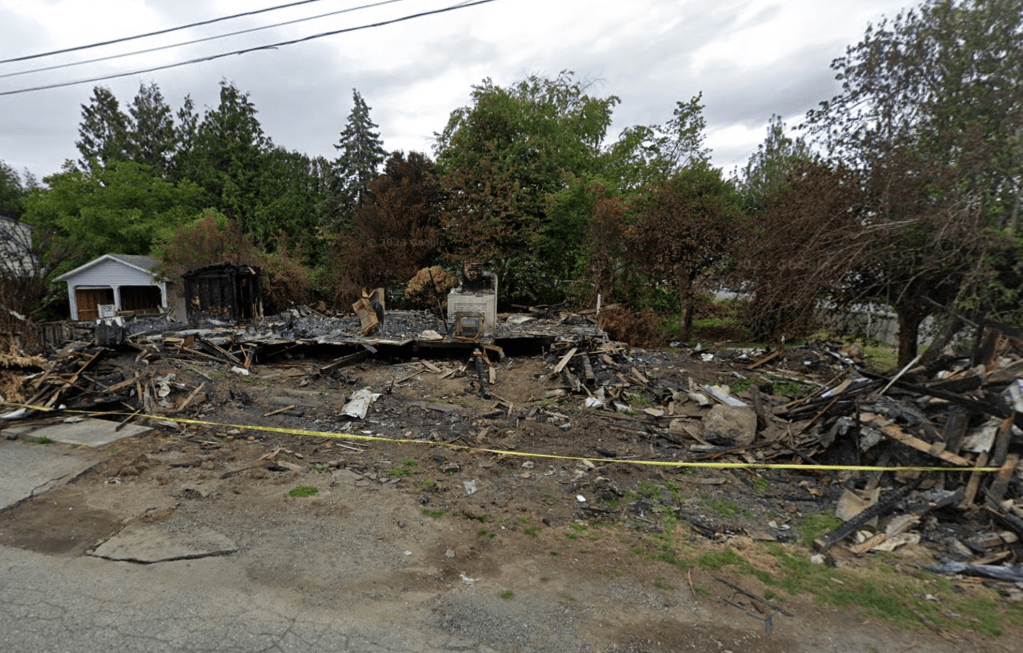
At 11:20 p.m. police set Daniel Hackl’s Chilliwack home on fire. It was burning for about 40 minutes before he finally came out with his hands up, laughing. He was naked except for body armour.
The background as to how police came to be in the position whereby a person burning to death was part of its decision-making is laid out in a May 29 Supreme Court decision, which tells the story of a seemingly normal 29-year-old whose mental health quickly spiralled.
In the months prior to the police standoff, Hackl’s began “getting weird,” and his mother said he’d made “wild statements” that had no basis in reality. He also had numerous legally obtained firearms, along with 3D-printed guns.
“Mr. Hackl later told his mother that when he met with his father, the moon had disappeared and that his father and other family members were ‘dark and evil,’” Justice Ahmad says in the decision. “He also described placing and burying ‘talismans’ around his broken-down vehicle.”
His roommate reported Hackl had been making claims that he was God or Jesus, and that he could create anything and move mountains. He called himself a prophet who could control how the world worked using pendulums.
On May 22, 2023, Hackl’s family contacted the RCMP for a wellness check.
The decision makes no mention of whether other options were discussed, but at 6:10 p.m., the Lower Mainland District Emergency Response Team turned up on the quiet residential street.
Lights, sirens and loudhailer announcements were used, but Hackl stayed put.
Police deployed tear gas into the home and used drones that Hackl shot at.
“A robotic device eventually enabled limited communication with Mr. Hackl, who made explicit threats to kill police, spoke erratically, and refused to surrender despite repeated assurances he would not be harmed,” the decision reads.
An hour and a half after police arrived, Hackl was firing guns in the house, and for reasons not explained, an armoured vehicle had become immobilized. The evacuation of all the neighbours also hadn’t been completed.
At 8 p.m. police made a second attempt to release a smoke grenade inside the house.
Two officers approached the house, holding a ballistic shield in front of them and in the process of throwing a smoke grenade, Hackl fired three rounds. One bullet hit the shield, another narrowly missed the officer, and another hit the armoured vehicle.
“He fired again at a police robot and made explicit threats to shoot anyone entering the residence. Despite being informed he was under arrest for attempted murder he remained non-compliant and continued to act in a hostile and erratic manner,” the Justice said.
At 8:30 p.m., due to the escalating danger, a lethal force order was issued.
“Nonetheless, negotiations continued using a robot-based audio system and guidance from a psychologist, but Mr. Hackl repeatedly threatened to kill any officers who entered, expressed willingness to prolong the standoff, and encouraged police to come inside so he could shoot them, while laughing and exhibiting manic behaviour,” the Justice said.
At 10:20 p.m. police approved the plan to set fire to his home.
At 11:20 p.m. the “plan was executed,” and Hackl’s home soon became fully engulfed in flames. His ammunition began igniting as the fire spread.
Just after midnight, Hackl finally came out of the house.
There’s no mention of why police couldn’t have waited it out. Hackl’s single-family house looked out to farmland, and while he had multiple neighbours, the area isn’t particularly densely populated.
He was charged with the attempted murder of two police officers and later pleaded guilty.
Justice Ahmad said that “by all accounts” Hackl was living an ordinary life, working, living independently, and having family support.
But in the weeks before the standoff, his mental health took a steep decline.
The decision said that after being arrested, his unstable behaviour continued, and he was apprehended for a mental health assessment due to “public safety concerns.” The decision didn’t say what those concerns were.
However, almost a month later he was transferred to a psychiatric hospital, where he was “manic, irritable, and having incongruous laughter.”
He was given medication and a week later had made a recovery.
“Mr. Hackl has had no further incidents of mental health decline or instability since,” the Justice said.
A psychiatrist’s assessment found that Hackl experienced “decompensation,” most likely triggered by “holotropic breathwork,” the practice of using rapid breathing to induce altered states of consciousness.
Hackl was found to have a “nil to low” risk for future violence.
Both Crown and defence lawyers accepted that Hackl’s mental health crisis significantly reduced his degree of responsibility for what took place. There is no mention in the decision of whether a verdict of Not Criminally Responsible on Account of Mental Disorder verdict was ever canvassed.
Both RCMP officers submitted victim impact statements to the court.
“I have always understood that policing can involve risk, but I want to be clear about something that is often misunderstood: violence directed toward police officers is not simply ‘part of the job.’ It is not something anyone signs up for or accepts as normal,” RCMP Corp. Cropley said in his statement.
“It is clear from both statements that even though police officers are trained to face danger and operate in high-risk situations, they remain human beings with families, responsibilities, and lives beyond the job. Their willingness to confront risk does not diminish their inherent vulnerability,” the Justice said.
Defence lawyer Marilyn Sandford argued for four years’ jail – the minimum sentence for attempted murder, citing the unique circumstances of the case.
Justice Ahmad agreed.
“While I do not diminish the fact that Mr. Hackl fired shots on the officers, I accept that he did so in response to what was an encroachment on him,” the Justice said. “To be clear, that conclusion is not intended as a criticism of the decisions made and conduct of the (police)… while the appropriateness of their conduct is not before me, I accept that they conducted themselves in a manner that they deemed appropriate given the circumstances.”
The decision also said Hackl apologized to the officers for what took place that day.
With time already served in custody, Hackl was left with two-and-a-half months left in prison.
News from © iNFOnews.ca, . All rights reserved.
This material may not be published, broadcast, rewritten or redistributed.

This site is protected by reCAPTCHA and the Google Privacy Policy and Terms of Service apply.
Want to share your thoughts, add context, or connect with others in your community?
You must be logged in to post a comment.